Rafsanjani Makes A Deal?

Geneive Abdo reports:

In exchange for Rafsanjani's loyalty, the supreme leader appears to have given him power over a new bill that will establish a National Elections Commission to reform the electoral process. Not only is this issue at the heart of Iran's political crisis, but the commission would also determine the eligibility of individuals to stand as candidates in elections. And the Expediency Council, which monitors legislation and is responsible for any conflicts that might result over Iranian laws, will also decide the members who serve on the National Elections Commission.

What Are The Chances? Ctd

First Read:

We’re told that the White House and House Dem leaders are fewer than five votes away from 216, after Dennis Kucinich’s no-to-yes switch yesterday and pro-life Dem Dale Kildee saying that he’s ok with the Senate bill’s abortion language.

Chait increases his confidence level:

I think this is going to happen unless something goes wrong. Of course, something could go wrong. Anyway, having held steady at around 60% for a couple months, I'm now up to 75%.

Intrade has health care at a 78 percent chance of passing as of this writing.

When Enemies Are Not Uniform

Chait takes on one of Thiessen's talking points against the DOJ lawyers:

Maybe the U.S. government has never previously granted such due process to captured enemy combatants. This is because, as Republicans point out ad nauseam in other contexts, this war is unlike previous wars. The enemy wears no uniform, obeys no international conventions of warfare, and so on. We didn’t need to provide habeas corpus rights during World War II because, when we captured a man in a German army uniform, we could be pretty confident that he was actually a German soldier, not some hapless goatherd sold into our custody by a jealous village rival.

Yglesias Award Nominee

"No economic analyst doubts that a final defeat of the Bush bailout would have produced a devastating wave of major failures in the financial world and a near total freeze of the banking system. When the House of Representatives narrowly turned down the TARP proposal in its first vote on September 29th, Wall Street responded the next day with the greatest one-time loss in Dow Jones history — plummeting a gut-wrenching, unprecedented 777 points. That experience helped persuade additional Democrats, and 91 of 199 Republicans, to go along with both presidential candidates and to approve the package. And what if Obama had split with McCain and Bush, aligning himself with overwhelming public opposition to the bailout, and blocking its approval in Congress?

When the market collapsed and companies went under, there’s no chance the public would have blamed the candidate criticizing Bush and Paulson more than they blamed the candidate (McCain) who backed them. In fact, populist opposition to TARP, combined with the resulting financial catastrophe, would have produced an even greater margin of victory for Obama and the Democrats. Instead of winning by 7 percentage points, the Democratic nominee could have easily won by an historic landslide of 20 points or more," – Michael Medved, calmly dissecting and demolishing some of the more paranoid conspiracy theorists on the right. Since they really are his audience, this takes integrity, even though it's a sign of our completely crazy times that it does.

The End Of The Op-Ed Page?

Shafer vents:

In a perfect world, a publication is edited for readers. In the imperfect world that we inhabit, too many publications are edited for the benefit of their staffs and their friends and associates. The Washington Post op-ed page, which hoards its space for its own, is one of the worst offenders.

But what's revealing to me is that some of the toughest criticism of the Post's chummy neocon-drenched, establishment op-ed page came from … the WaPo's own Ezra Klein, rattling the bars of Dan Froomkin's former cage:

I don't really understand why my op-ed page, or all the other op-ed pages, waste so much real estate publishing talking points from politicians.

These carefully vetted bits of politi-speak are not interesting op-eds (and the least interesting, I should say, are those written by members of the White House), and they are frequently misleading. They also make the op-ed page a confusing place: Pieces written by writers and experts are published for a different reason, and written for a different purpose, than those written by political actors.

Which isn't to say that politicians shouldn't have a place to make their arguments. But with the rise of the Internet, they can put their arguments online (Ryan, to his credit, does exactly that, and his willingness to respond has led to profitable exchanges between him and his critics). If they want more space, or more publicity, it's been my experience that readers really enjoy probing interviews with politicians, and op-ed pages could certainly use members of their editorial boards to conduct those interviews. It'll also improve the reader experience, because only the politicians who think their arguments are strong enough to withstand questioning will enter the fray. That is not, I think, how these op-eds work.

But that argument, when you really unravel it, is a case for abolishing op-ed pages altogether. Before, of course, they abolish themselves by irrelevance.

Putting “Abuse” Into Clear English

The NYT reported today:

Benedict himself has been under scrutiny, after the German church suspended a priest this week who had been allowed to work with children for decades after a court convicted him of molesting boys. In 1980, Benedict, then Archbishop Joseph Ratzinger, allowed the priest to move to Munich for therapy after allegations of abuse. The priest returned to pastoral work, but last week another church official took responsibility for allowing that move. Some church analysts have questioned whether Cardinal Brady will resign, saying that would only provoke questions about why the pope, who also failed to report a priest accused of abuse to civil authorities, did not also resign.

Here is one small detail of what happened. Benedict was told that the priest in question had raped an eleven-year-old boy by forcing him to perform oral sex on him. He did not report the priest to the civil authorities, he merely sent the priest to therapy, the priest was subsequently convicted of child abuse, but after his prison sentence was allowed to continue in the priesthood until the past week.

Benedict was not just directly implicated in this case, he was subsequently responsible for all sex abuse cases as head of the CDF and in that position supported a policy of maximum secrecy.

How do you retain moral respect for someone who was told that someone under his direct authority had raped a child and did not report that to the police and make sure that person was never allowed near kids again? We are told that the standards then were different, that we shouldn't apply our new and deeper understanding of the horrors of child abuse to days gone by.

Please: raping children is not a hard call for a Christian. Today or at any time in history. Covering it up is evil. If defending the perpetrators, rather than saving the victims, is not immoral, what is?

So when will this Pope resign? And what happens to the church hierarchy's moral authority if he doesn't?

Rallying The Base – And the Center

HealthCareAndPartisans

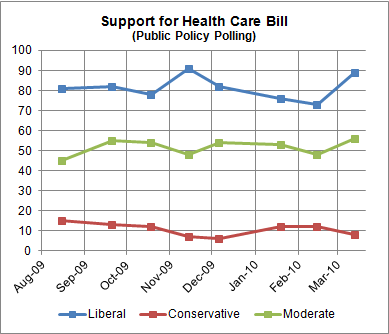
Nate Silver on why the left is suddenly unified behind the bill:

Personally, I think the reason for the increase in support is mostly this: the Democratic leadership, and particularly President Obama, are now fighting for this bill tooth and nail. They didn't necessarily have to do this; they could have thrown in the towel, passed off some bipartisan crap that didn't do much to help the uninsured, and called it a day. That's what Rahm Emanuel wanted to do, as Chris Bowers points out. But that isn't what Obama did: instead, he's gone all-in on the thing, potentially staking his Presidency on the outcome. Liberals like the idea of being the scrappy underdog — being the fighter — and Obama, after a strangely aloof performance on the health care bill throughout 2009, has been fighting the good fight.

But look what's happened to moderates too. Obama's measured performance these past two months, his civility and his outreach to the GOP has won them over as well as the liberals. And the right has become more isolated this year.

Meep meep?