How The Right Could Improve Health Reform In The Future

Noah Millman is hammering together a policy platform (here are parts one, two, three, four, five, and six). From the second post:

My own inclination is to say that Obama’s health-care proposal is a step in the right direction, the kind of reform that would make it easier for a subsequent Republican administration to reform it in a direction that will be more open to the kinds of price signals that drive medical innovation and, in turn, actually lower costs. Such reforms are essentially impossible until a functional individual insurance market is created, and the Obama health-care plan, if it works, promises to create such a market. That’s a big “if” – but if it doesn’t create a functional individual insurance market, then it will fail, and the citizenry, rather than demanding repeal, will demand that it be changed to make that market work.

That's my view as well. If I were starting over from scratch, I wouldn't end up where we are or will be.

But we're not starting from scratch, and finding a way to get universal coverage as a moral necessity, while including potentially big cost-control measures and individual insurance markets, is good enough for me right now.

Market-oriented conservatives should, in my view, propose to amend the law in future to expand those things they favor – tort reform – and include new measures, like more price signals for consumers in healthcare. There's a lot in this bill that conservatives could work on; instead they have sought to kill it and then repeal it.

At some point, they'll grow up, and realize politics is not a game to be "won" but a process to be engaged.

Leave NCLB Behind? Ctd

A reader writes:

I'd like to chime in on your ongoing series about education reform with a few stories about the company I work for.  It is one of the largest providers of online charter programs in the country: we have contracts with 20 states and a private school available to anyone in the country willing to pay for our services.  We have a wide range of courses and offer a great deal of flexibility.  I agree with your earlier commenter that, on paper, charter schools look great. (I have taught in two rough, inner-city public schools.)

But over the course of 18 months working for this company, I have seen decisions get made by people with doctorate degrees in education that blatantly degrade the quality of our curriculum in favor of cutting costs and avoiding conflicts with parents over terms like "global warming" and "evolution."

My company has bent over backwards to provide courses that don't offend, but also don't challenge students.  Recently, all of the subject matter experts in the department that develops curriculum had their positions eliminated in favor of contractors or third-party vendors who provide courses so riddled with grammar and content errors that it surprises me they could put together a course at all.  We decreased the number of reading and writing assignments in some of our high school English courses so that parents would stop complaining about the workload.  Our students engage their content in what basically amounts to lengthy PowerPoint slides turned into Web pages, and are forced to use message boards (!) instead of Web 2.0 technology to grow and learn.  How can we possibly expect to be taken seriously when we eliminate people who have multiple degrees, teaching experience, and content expertise, while subjecting students to technologies that were obsolete in 1997?

Nothing in my life has soured my personality and squashed my youthful optimism like working for this company.  If anything, this job has taught me that American parents often don't want to challenge their kids–they simply want them to graduate.  I'm sure you'll get lots of readers claiming this isn't true (this is just an anecdote), but I can't emphasize enough how appalled I've been by the utter lack of respect for the goals of education by this company and other charter schools that I read about.

Another writes:

One of your readers wrote:

The way that proficiency is determined through normed testing (which Ravitch fails miserably to properly explain) means that essentially, all the students in the state take the test, and a mean score is determined.  Proficiency then means achieving at or above that score.

That is a flat-out falsehood.  Proficiency for NCLB purposes is determined by criterion-referenced tests, not norm-referenced tests.  What this means is that proficiency is determined by some objective criterion — say, how well you do compared to a state curricular standard — not by how well you do compared to the overall population.  In fact, states aren't even ALLOWED to use pure norm-referenced tests for NCLB purposes, because — for obvious reasons — it would be impossible for 100% of students to achieve above the mean on a norm-referenced test.  (States are allowed to use so-called "augmented" norm tests, in which part of the test is norm-based, but other questions are based on objective criteria related to a state's content standards.)

It appears the use of criterion- or norm-referenced tests varies by state. Another writes:

I would just like to offer my experience in response to your reader who insists that charters work. The truth is that SOME charters work, but certainly not all.  And there is such a ridiculous lack of oversight of charter schools that the ones that don't work, the ones that are drastically under-performing the district they are meant to serve, fly under the radar for so long and when they are finally noticed, the only ones ever held accountable are the teachers.

I teach in one of those charter schools that work.  In fact, my school was one of only four charter schools in the state of Missouri to make AYP in the 2007-2008 school year – a year when 84.6% of Missouri charter schools (and 57.5% nationally) failed to make the grade. Even the KIPP school (a name that is often thrown around as the savior of urban schools) did not even come close to making the scores needed to reach AYP.  Adequate yearly progress is a questionable way to measure school success, but charter school students consistently under-perform their public school peers on NAEP tests as well.

I enjoy my job and I think we do have a bit more flexibility (sometimes too much flexibility) to change our curriculum to meet the needs of our students and there is more of a professional teamwork atmosphere than I experienced working in larger urban districts.  But these conditions apply to my school only, not to charters as a whole.  I think we are doing some wonderful things.  We also have our problems, not the least of which is failing to retain good teachers.  Many teachers will put in their time and move on to a district with better pay, better job security, better retirement, and better hours. Thus we have had three principals in four years and start each school year with about half of our staff new and often as first year teachers.

My husband is a first year teacher teaching Middle School Science, Social Studies, and Math in one of those charter schools that doesn't work.  This school has been open for 10 years and has consistently scored below the (pitiful) surrounding district.  My husband works with no textbooks and very few materials.  Just last night he had to run to the store to buy meter sticks so that his class could complete a science experiment.  Meter sticks!  Where has the money gone for 10 years that they haven't gotten around to buying textbooks or meter sticks? 

And when the scores come back dismal as I'm sure they will, who will be held "accountable"?  The students?  The parents?  The school leadership that prioritized God knows what over instructional supplies?  The state university that sponsors their charter?  No. The teachers will take the blame, lose their jobs, and another crop of first year teachers will be brought in and expected to teach without curricular, administrative, or behavioral support.

There are some amazing things going on in charter schools across the country.  There are also some terrible things going on in charters.  Guess what?  The same can be said about public schools, or any school for that matter.  But the data simply does not show that charters are the answer.  Anyone, including your reader and Obama, that embraces charters wholeheartedly without looking at the facts is only doing a disservice to charters, our students, and education as a whole in this country.
Irish By Default

Matthew Schmitz has a beef with Saint Paddy's Day.  Dreher adds:

It really would be weird to think about an ethnic festival for any of the other major white groups in this country. Can't do English because of their complicated relationship with the founding of America (we fought them, after all). Germans? Self-explanatory. Scandinavian? No fun! Italian? Well, maybe … but we did fight the Axis in World War II, and besides, Italians don't speak English, and are a bit removed from the Anglo-Scots-Irish majority of white people in this country. So it's the Irish by default!

The Process Debate

Chait furrows his brow:

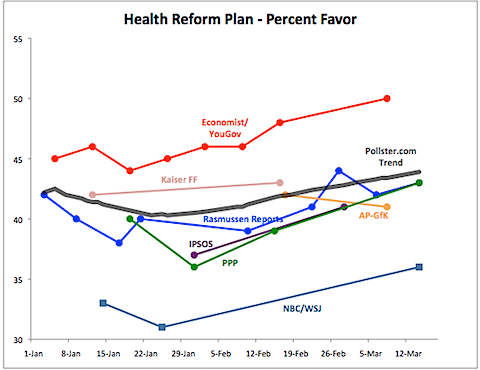
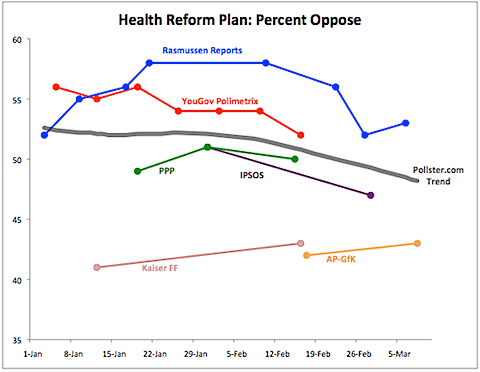
The striking thing about this debate is the degree to which Republicans have devoted the bulk of their energies to putting forth disingenuous arguments. The have deep-seated reasons to oppose health care reform, but they spend an enormous amount of time on arguments that they would never were the situation reversed. I don't doubt that there's some political benefit to this — the GOP base already opposes health care reform on the merits, so the way to keep them whipped into a state of outrage is to produce a stream of new process arguments about how the Democrats are doing violence to the beloved system of the Founding Fathers. Swing voters, meanwhile, do favor both the general proposition of health care reform and most of the provisions of the plan, but have recoiled at the process. So there's a logic behind the constant stream of process complaints from the right. It's just created a stupid debate.

Face Of The Day

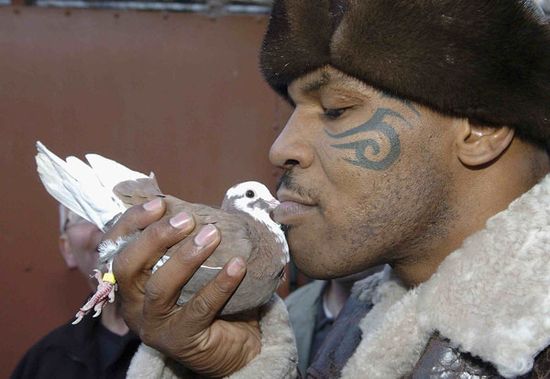
Mike-tyson-pigeon

From a press release:

Tyson has a deep passion for the birds and raised pigeons all his life. In fact his first-ever fight as a child was in defense of his birds. But this show will follow his first foray into racing them competitively… “I’m honored to be a part of this monumental show on Animal Planet,” said Tyson. “I feel a great pride acting as an official representative for all the pigeon fancier’s out there.

Warming Glow:

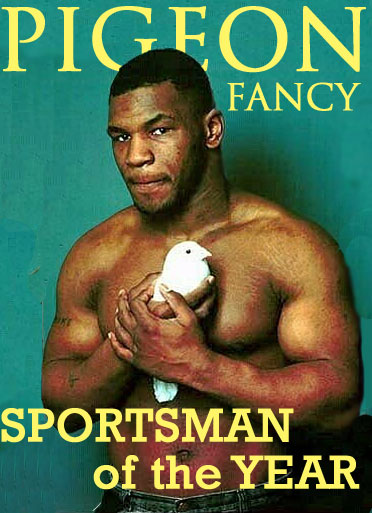
Wait a second, did I just read the phrase “pigeon fancier”? Of course! How could I forget the magazine cover that helped launch his career:

Tyson-pigeon-fancy

“Media Is Everything,” Ctd

A reader writes:

I don't know Breitbart well enough to comment on him personally, but anytime I read about a man who 1) has not dealt with death, and his own fear of death, 2) violently suppresses his emotions, beginning with his deep grief ("I've created a horrific buttress of protections"), and then 3) apparently specializes in a war of rage against those "others" he considers "wrong", I can't help but suspect a case of arrested development, fueled by fear, marked by displacement and projection, and perpetuated by the inability or unwillingness to face himself. I might have every sympathy for the guy — in fact, even the short quotes you featured were moving — but I have to ask, why do we all have to suffer his rage while this man works his neurosis out publicly? As Rumi said:

"You're crazy and numb.
You're drinking our blood,
and have no experience

of the nearness."

Don't we have enough of this everywhere we turn now?

We have a world in serious trouble, and a country that's become almost ungovernable. We need people now who are constructive, not destructive: sane adults who are fueled by a sense of responsibility, by courage and by love, not adolescents looking for the nest excuse to throw a neurotic tantrum. Rage can be very satisfying — temporarily. But what gets "satisfied"? The whole man or woman, the adult? Or the fearful, angry child? Or the neurosis itself?

As I understand it, Breitbart is a "conservative"; whatever that now means, I've always understood conservatives associate it, above all, with taking responsibility for yourself, with being accountable. It might do Breitbart (and all the rest of us) a world of good if he'd put aside his rage and his war against the 'other' until he's dealt with his own issues. Then he might have something to say — something real, something worth listening to.

This note was hardly worth writing — especially, as I say, since I don't know Breitbart well — except that our entire political discourse, national and international, now seems swamped by this kind of displaced fear and rage. We need to get a grip.

We need to start calling out those — left, right or middle — who are 'crazy and numb', and make their living (and perpetuate their 'horrific buttresses of self-protection') by 'drinking our blood'. We do not have to live lives, and govern a world, based on the mental illnesses of the most angry, the most fearful, the most self-absorbed. There are alternatives — and we'd better start finding them, or we will all pay the price. The 'satisfaction' of rage is not free.

The Shame Of Obesity, Ctd

Dreher continues the conversation:

I push back hard against well-meaning people like Harriet Brown, not because I think Fat People Are Bad, but because I want to push back against this culture that tells me I can't overcome my own sloth and gluttony, that I ought to settle for the spiritual disorder that results in my being overweight. Weight loss really is hard, and as TNC says, you have to push back against this permissive, indulgent culture at every turn. I have never done it to a satisfactory degree, and any progress I've made has never been permanent. But if I weren't determined to hold the line as best I can, I would be a lot bigger than I am, and a lot less healthy.