"Is there no shame anymore?" – Norm Ornstein on the post-modern GOP leadership, just lying and lying and lying about parliamentary procedure. I feel the same way about their feigned outrage over spending.
Month: March 2010
“Media Is Everything”
Chris Beam brilliantly profiles Andrew Breitbart:
Breitbart likes to think of himself as the big-picture guy. Sure, he can be the doofus who rubs his nipples and snorts red wine powder. But when it comes to substance, every discussion is panoramic. He talks culture as much as politics. Change the way people think, goes his argument, and you'll change the policies they support. "I'm trying to shift the focus of conservative movement from the narrow—the policy—to a much higher elevation, granting them a greater perspective." He's all about unified theory. That's why he can transition naturally from Obama ("a joyless PC freak") to ACORN to Bill Clinton to Clarence Thomas to Hollywood to political correctness to the New York Times before finally settling on why Sarah Palin should skip the presidency and just become "red-state Oprah." It's the upside of Breitbart's ADD.
Chait adds his two cents. I've never met Breitbart but we throw each other emails every now and again. I found the following part of the piece the most revealing:
"You wanna meet downer Andrew?" he said. He was picking at a fruit salad. Every few minutes, a piece of cantaloupe would slide down his fork and fall off. He would reskewer it until it fell off again. "It's a fundamental flaw in my psyche. I don't do well with death."
Breitbart's father, now in failing health himself, once tried to explain death to him. It was 1979, Breitbart was 10, and the Yankees catcher Thurman Munson had just died. "I asked my dad what happened. He said he died. I didn't understand, but he didn't have a way to explain the finality." Later, he said, he remembers being crushed by the death of his dogs. When Breitbart was 24, his best friend was killed in a robbery. Breitbart never really dealt with it. "I think I've created a horrific buttress of protections because I was so devastated by the permanence of death as a child," he said later. "My ability to be emotive and cry … I think I'm so fearful of tapping that that I won't know how to turn it off."
Breitbart, like Drudge, gets the web. He understands its subversive and rhetorical power: the sheer thrill of the direct access to millions, the fuel that ideology brings to everything, the traffic that anger summons like a dog whistle to the alienated. This is an angry time, and the web helps tap our anger, monetize it, leverage it in intoxicating ways. I don't begrudge him one bit his fury at some liberals' smugness, or the p.c. nonsense of the 1990s, or the cant of a lot of academia. I never came from liberalism, so I never felt I had to shuck it off.
But Drudge has kept himself sealed off as a human being for a reason, I suspect. He's public only as an avatar. It is because this transparent, raging, brutal world is too destructive to the soul and the psyche to remain so exposed in such a raw fashion for so long without serious damage. Drudge is smart. Andrew, I suspect, will realize how smart eventually.
Yep, death happens because the Internet has replaced life for some but it hasn't abolished the real thing. And Breitbart's vulnerable moment in the piece shows how even the enraged and always offensive are sad and defensive at times, vulnerable often. The web has not banished these truths. Ideology is false. Labels obscure. Rage eventually undoes the enraged, even if the anger is merited. And no, media isn't everything. The battle isn't everything.
Something else remains.
Leave NCLB Behind? Ctd
A reader writes:
I read your quote from Diane Ravitch, and I have to say that while I appreciate her forthrightness in admitting the error of her ways, I find even her admission to be maddening. I have taught middle school English for the past 8 years, so my entire career has been dominated by the presence of NCLB. What is so angering to me is that even as a 22 year old rookie, fresh out of college, it was clear to me that NCLB was always about dismantling the public education system.
The way that proficiency is determined through normed testing (which Ravitch fails miserably to properly explain) means that essentially, all the students in the state take the test, and a mean score is determined. Proficiency then means achieving at or above that score. So by definition, a huge section of the state population will always be below proficiency … like, 50%. Even the best schools or school systems could easily have 20-30% of their population "below proficiency." Those who designed this bill clearly knew this and cynically set up a system that would lead to failure and a crisis of confidence in public education. Anyone who claims they did not is either dishonest or not competent to discuss the matter.
On a side note, I saw that you mentioned the disparity between state test scores and performance on NAEP. A large part of this discrepancy can be explained by the fact that we are dealing with children, not robots. Unlike a robot, into which you feed a set of commands and out comes some action or another, children stubbornly have minds of their own. When you tell a kid that today, instead of being with your friends in class, you are going to go to the library and sit with a very nice Test Administrator whom you've never met and will never see again, and who will give you an endless, boring test, that will have no bearing on your grades or your life, and the results of which you will probably never see, let's not fall backwards of shock when the students put forth less than maximum effort…
Another writes:
I am progressive Democrat, but Diane Ravitch is wrong. Charter schools aren't just a good idea; charters work. I live in Los Angeles and founded the most diverse, high-performing charter school in the city. I can tell you the power of charters.
Urban education is a disaster, driving families with any means to the suburbs and destroying our cities. If we want to rebuild them, we need a decent public school system for middle-class families. I have seen die-hard liberals rail against charters — until they walked into their local public school to enroll their child and realized why charter schools are saving our cities. Charters are making a difference — for the kids who go there, and for the schools they "leave behind."
In 2005, our local school was failing, overcrowded, and had a year-round schedule. We proposed opening a charter is the neighborhood. Within a year, the district brought in a new principal to the failing school, it was able to switch a traditional calendar, and it was no longer overcrowded. In five years, the test scores went up almost 100 points. Our charter inspired two other community groups to open two more schools, with two more hoping to open next year.
That is competition in action — helping all kids. It's a movement of concerned parents who want diverse, excellent public schools. And it's where liberals meet conservatives; the liberals care passionately about public education, diversity, and serving low income kids; and conservatives believe that competition will force districts to improve. With charter schools, they are both winning.
Diane Ravitch is sorely misguided — she is not on the ground, with kids in school. The idea that we can wait for the system to somehow self-correct is naive. Charters are working and serving low income kids. But they have the power to bring the middle class back into the public school system and keep the middle class in cities, instead of taking all their energy (and money) to the suburbs.
Kim Jong Il Looking At Stuff, Ctd
MightyGodKing got there first:

Alternate caption: "I has a bucket." Another Dish fave after the jump:
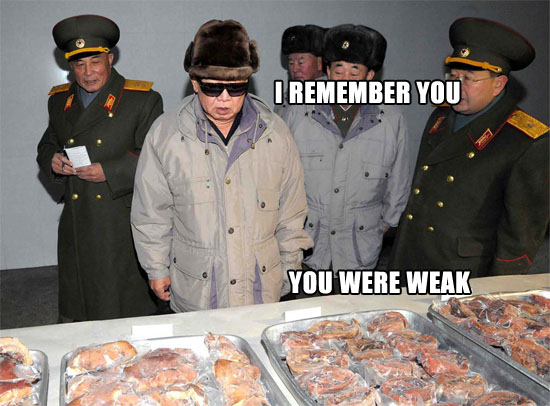
And yet behind this absurdity, it is so important to remember the vastness of the cruelty and evil this creature imposes on so many. Sometimes I wonder if the funniness of Kim Jong Il is sometimes a shield for his evil in the West.
He is a monster.
Pass. The. Damn. Bill.
From the NYT health care blog:
The number of uninsured adults and children in California swelled by 25 percent between 2007 and 2009, according to a new report by researchers at the University of California, Los Angeles. One quarter of the state’s population is now uninsured, according to the analysis, and less than half of those with insurance receive it through employers.
Malkin Award Nominee
"I look back 20 years ago in the square in Prague… when tens of thousands showed up there and they shook their keys peacefully and they took over their country and they achieved their freedom back again," he said. "If you can keep coming to this city, fill up the congressional offices across the country but jam this city. If you can get on your cell phones, and get on your Blackberries and your email, and ask people to keep coming to this town. Storm this city, fill up Washington D.C., jam this capital so they can't move. And if tens of thousands, hundreds of thousands of you show up, we will win. We will defeat this bill and you will have your liberty back," – Congressman Steve King (R-IA), to a crowd of tea-partiers.
Defying The Fatwa
Yesterday marked the fire festival of Chaharshanbeh Suri, an annual celebration that precedes Norooz, the Persian New Year. The Iranian government frowns upon the ancient Zoroastrian holiday because of its non-Islamic roots. Shirin Sadeghi explains why this year is different:
[A]midst what has become a people's movement for fundamental change in Iran, authorities went one step further than their usual disapproval of all things Norooz, and the Supreme Leader outright banned the fire festival with a fatwa. The fatwa states that the fire festival "has no basis in Sharia and is a requisite for much harm and corruption."
A heavy security presence and arrests kept large crowds under control, but many small-scale protests shone through.
The Daily Wrap
Today on the Dish we saw Netanyahu refuse to back down while McCain and Lieberman joined him. Kevin Sullivan was stunned by the situation, Greenwald challenged ultra-Israel loyalists, Roger Cohen got to the crux of the conflict, Chait defended the administration, and Walter Russell Mead offered his advice. In a must-read post, Goldblog reported Obama's intentions.
In other news, Ezra Klein discussed "deem and pass," Petraeus sounded off on DADT, and scientists discovered some cool creatures under Antarctica. Andrew reviewed the pope controversy, a gay reader shared his experience with Catholic culture, another challenged Andrew on "social justice," and others chimed in over school choice. Diane Ravitch made her case against NCLB, Bernstein countered Saletan over politicians catering to polls, TNC tackled the obesity stigma, and Wehner deliberately distorted Tom Ricks.
MHB here and cool ad here. Window from Pakistan. Another installment of Andrew's Princteton speech – this time on gay Republicans – here.
— C.B.
Colbert Bait, Ctd
A reader writes:
Thank goodness that, a well-regulated militia being necessary to the security of a free state, the right to keep and arm bears has never been abridged.
The Results Begin To Trickle In
Marc Lynch checks in on the Iraqi election:
Over the last few years, most American analysts have argued that these elections would offer a path to power through the ballot box for the leaders of the Awakenings. Their evident washout in Anbar suggest that they won't, which may trigger a lot of the fears of those analysts (including me) who for years warned about the dangers of not accommodating Sunnis in the political system or integrating the Awakenings and Sons of Iraq into the state. But the response thus far suggests reasons to be less worried than in the past. During last January's provincial election, when it appeared that Abu Risha's list had lost, he threatened to turn Anbar into a "graveyard" for the Islamic Party if his List was not declared the victor. Despite mounting claims of fraud, I haven't yet been seeing many such threats this time, and don't see any reason yet to anticipate that it will trigger the much-feared resurgence of the insurgency.
 The Dish