Blaming America First

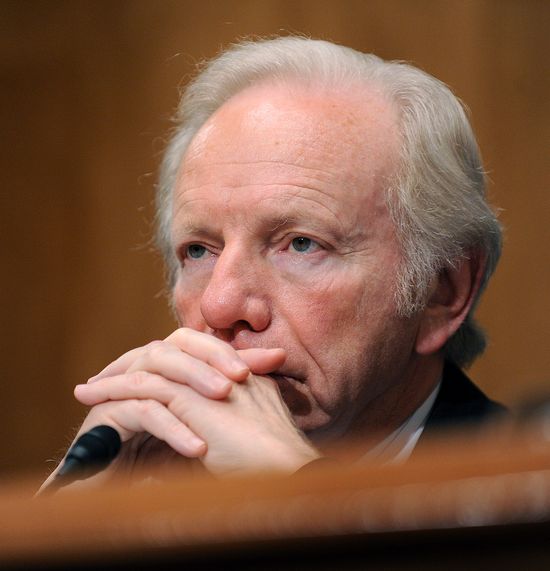
LIEBERMANTimSloan:AFP:Getty

It's so weird watching hawkish politicians who are usually castigating Obama for weakness with respect to foreign leaders suddenly turning around and accusing the president of … standing up for America's interests:

Lieberman questioned why the initial flap was allowed to continue on the Sunday talk shows. Singling out David Axelrod, he noted that calling it an “affront” serves nobody’s interests. From there, McCain said the escalation “may be giving the impression to the wrong people, the neighbors of Israel have stated time after time that they are bent on Israel’s extinction.”

McCain and Lieberman previously went to Israel itself to undermine the foreign policy of the US president, by stating that they would bar any attempt to use aid or loan guarantee leverage against Israel in its continuing aggressive settlement policy. The Washington Post puts almost all the blame for the tension on – surprise! – the US. In fact, they use the term "bludgeon" to describe the president's understandable reaction to Netanyahu's insult of Biden:

A larger question concerns Mr. Obama's quickness to bludgeon the Israeli government. He is not the first president to do so; in fact, he is not even the first to be hard on Mr. Netanyahu. But tough tactics don't always work: Last year Israelis rallied behind Mr. Netanyahu, while Mr. Obama's poll ratings in Israel plunged to the single digits. The president is perceived by many Israelis as making unprecedented demands on their government while overlooking the intransigence of Palestinian and Arab leaders. If this episode reinforces that image, Mr. Obama will accomplish the opposite of what he intends.

In other words, the success or failure of the US president's foreign policy in the Middle East should be measured by his ratings in Israel, rather than his determination of the national interest of the United States. How on earth did this get so upside down?

Notice that in this case, Israel means a government beholden to the most extreme elements of the Israeli religious right. The Republican party is also lining up behind the Netanyahu government against the president of the United States:

America's first post-partisan President anyone? Maybe it was George H.W. Bush. He managed to unite everyone against him, at least on Israel. Unfortunately, most of the Democrats are putting party over principle in this dispute – at least so far.

Eric Cantor calls asking the Israeli government to stop provocative settlement building as a way to build trust toward peace negotiations is "beyond irresponsible". He won't even condemn the planned Jerusalem settlement.

(Photo: Tim Sloan/Getty.)

Pass. The. Damn. Bill.

point out several parallels between now and the last time the Democrats controlled Congress and the White House:

To be sure, there were many reasons for Democrats’ massive losses in 1994, including scandals and angry gun owners. But the failure to fulfill their responsibility for governing contributed mightily to the debacle. That was the conclusion of pollsters from both parties in the aftermath of the November contests. Two weeks after the election, Republican pollster Bill McInturff found that “one of the most important predicates for Republican success was not having health care pass.” He noted that the collapse of the plan reinforced voters’ belief that Washington was in a dysfunctional state of gridlock.

Bernstein nods his head. The president says: "We're going to make this happen."

Counting Everyone

Mark Blumenthal wants to do away with the census:

Does it make sense to spend $14.7 billion (the estimated cost of the 2010 Census) every 10 years trying to get each and every household in the United States to fill out a census form? Probably not. There is a more efficient alternative, but it requires the use of statistical sampling and, presumably, bipartisan support for a constitutional amendment to update the meaning of "enumerate." Too bad the same conservatives who complain about the cost of the census also reject that idea out of hand.

Chart Of The Day

Healthcosts

From the Commonwealth Fund, courtesy of Ezra Klein:

These days, we spend a bit more than 17 percent of our GDP on health care. That comes out to more than $2.5 trillion. If we'd reformed the system in 1995, and our spending had slowed by 1.5 percentage points then, health care would only be 14.2 percent of GDP right now. If we'd followed Carter's schedule and moved in 1980, we'd be down to 11.5 percent of GDP. And Nixon's plan in 1975? A mere 10.75 percent of GDP, which as you can see on the graph, isn't that far from what Europe spends. The lesson is simple: The earlier you start, the more you save. And with each opportunity you miss, you lose years of accumulated savings.

Back To School, Ctd

A reader writes:

I've always been a fan of Diane Ravitch's. I worked in educational publishing for about 15 years and she has always had her finger on the pulse of what's wrong with American education. And while I do agree with her about vouchers, I couldn't disagree with her more about charter schools.

On paper, she's right — there isn't a lot of evidence or research that charter schools are better than regular public schools. But I think something is getting lost in the analysis. Part of what makes charter schools interesting and valuable is that they allow "small school" settings that are publicly funded.

Charter schools are districts unto themselves and can be much more flexible and try out new things. As long as they meet state laws, they have a lot of freedom. Some new ideas don't work so well (and can be dropped, or the charter school can fail) and others ideas do work. The things that work can be replicated in other public schools (charter or not).

I am in the Houston area and there are two successful charter franchises that keep expanding — KIPP and Harmony Schools. I think that charter schools serve the rest of public education in America as valuable "idea labs" that allow alternative models to thrive — or fail. They also save lots of public funds  — here in Texas, charter schools receive $1,200 LESS per student than regular school districts do. These are some benefits of charter schools on a larger scale.

On a smaller, more personal scale, charter schools and their flexibility can be god-sent for a lot of families. My own kids go to a local charter school that is not part of any chain. Ironically, it is in one of the best public school districts in the state — Katy ISD, a place people move to in order to get their kids into the schools. Katy ISD is a very good system overall, but it is quite large and bureaucratic, and very inflexible. It is a one-size-fits-all school setting.

And you know what? One size fits MOST, but it doesn't fit all. The charter school my kids go to attracts the kids at either end of the spectrum, and has a disproportionate number of highly gifted kids and kids with learning or social problems. Gifted kids really get nothing out of most public school systems. Our local ISD has rules that children can be advanced one grade only, and my daughter has a fall birthday. Our charter school was willing to try what would work for the child instead of what would work for the rules.

The result is a happy, well-adjusted kid who has been placed at her ability-level in her weakest subject and is accommodated upwards in her stronger areas. She competes at a state level in her strengths. And the school is small enough that there is no social ostracism for being "different." She is a 9-year-old 5th grader whose best friend this year is a 12-year-old 5th grader with cerebral palsy and a number of learning disabilities. Our charter school in a nutshell, and part of why it may never have top state test scores.

Another writes:

From Sara Mosle's review of Ravitch's new book:

In California, for example, less than 1 percent of students in failing schools actually sought a transfer. In Colorado, less than 2 percent did.

I've been a public-school teacher for 21 years, and I'll tell you why this is so.  Moving a student from his or her neighborhood school requires action by and involvement of parents.  It also often requires transportation of the student by parents, every day. There is a lot of paperwork. There are meetings at the new school and the old. There are transcripts to be picked up.

In many "failing" schools, it is a lack of parental involvement and an absence of parental belief in the importance of education that lead to students' low achievement. Most students who are not doing well, or even adequately, have parents who do not show up for conferences, or check homework, come to performances, or, often, even get their kids to school every day washed, fed and properly clothed. 

To expect these parents to do the work necessary to find a charter school, get their student enrolled, and get their student to the school every day ready to learn, is pure folly.  This is the downfall of every voluntary school choice program.  The kids who are achieving are also the kids whose parents have the ability and inclination to find them a better school.  All of these achievers leave, and the failing school fails farther, faster.

From The Annals Of Chutzpah

"I think this is part of a broader problem with the Obama administration. … We saw it in Honduras. Where rather than monitoring the situation, they let a cowboy president try to act in an extra-constitutional way to violate a fundamental principle in the Constitution, all without having done their homework in advance," – Karl Rove, when asked about Obama's handling of the Biden-Netanyahu row.

The Daily Wrap

Today on the Dish we saw AIPAC place the blame on the US government while Walter Russell Mead came down on Israel. A reader made an shrewd point about a double standard applied to Obama and Andrew responded to Goldblog's refusal to respond to him any further.

On HCR, Nate Silver assessed the odds of success, Jonathan Bernstein told us what to keep our eyes on, Frum showed the similarities between Obamacare and Romneycare, and Will Saletan spoke the truth on polling. The Texas Board Of Education tore out Jefferson from its history books and Andrew somewhat sided with Beck over social justice. 

Friedersdorf and Powerline continued to expose Andy McCarthy's awfulness, Wendy Kaminer knocked the ACLU for having selective principles, Douthat defended Paul Ryan, Sara Mosle talked school choice, Lady GaGa released an underwhelming video, and Kucinich continued to suck. Bob Barker was one creepy dude. Weekend wrap here. Another segment of Andrew's Princeton speech here. And today's window was great.

— C.B.

Pass. The. Damn. Bill.

Will Saletan:

From the standpoint of a campaign strategist, everything you do in Congress should aim at re-election. That's one reason why our government has become dysfunctional: Lawmakers spend less time completing the work they were assigned in the last election and more time preparing for the next one. They inflame or placate the public when they should be serving it. Elections were supposed to be a means to good legislation. Instead, legislation has become a means to election. The polling mentality has turned democracy upside down.