Here's yet another source of information.
Month: March 2010
When Marriage Gets You Fired
An Air Force sergeant is discharged under DADT after civilian police officers outed her to her commanders upon seeing her Iowa marriage license.
The Case Against Liberalism On The Question Of Homosexuality
Here's part of my Princeton speech that helps explain why I and the Human Rights Campaign and the Democratic Party do not quite get along on the subject of homosexual politics. I also emphasize the vital task of protecting religious freedom – even when, and especially when, it means discrimination against gays within religious institutions. Their conscience matters as much as our conscience, their freedom as much as our freedom. Extra: a defense of ACT-UP!:
Quote For The Day
"I use Google Alert for my name to start fights with people in comment sections or on Twitter. It's clear that Keith Olbermann's strategy to get noticed was to attack people above him. I have precisely the opposite strategy: to go after the mosquitoes that bite my ankles,"- Andrew Breitbart.
On That Map Again
A reader writes:
Maybe people are so mad about your posting these maps because, well, the picture isn't very pretty and when you see it as a picture, it's hard to miss seeing something. When I was young I thought Israel was a fact, a friend to the US, a bulwark against Communism, & the Holocaust justified its existence. Looking at those maps makes clear the original problem in the American/European support of Israel's creation — in your supposedly more Israel-friendly map, there is not a single region that you show where a plurality of the inhabits were Jewish — by what right did any Jewish state rise up to kick this many people out of their homes & claim this land?
European war crimes don't justify this level of displacement of people who had nothing to do with the crimes. The older I get, the more I see the Palestinian point of view, even though the means by which the Palestinians push their point of view has grown more hateful & violent. Is there any intellectually honest map you could show that would not excite hostility? If not, then why would maps showing something that's true make people mad?
By the way, where are the "no apologies," never-bow-to-foreign-heads-of-state folks when Israel treats us poorly? Why isn't it weak of Obama not to stand up to Israel?
Ask Bill Kristol.
Beck vs JC
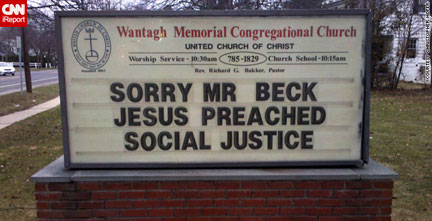
Amy Sullivan chronicles the backlash against Glenn Beck's call for people to flee their church if it preaches "social or economic justice":
[H]e managed to outrage Christians in most mainline Protestant denominations, African-American congregations, Hispanic churches, and Catholics–who first heard the term "social justice" in papal encyclicals and have a little something in their tradition called "Catholic social teaching." (Not to mention the teaching of a certain fellow from Nazareth who was always blathering on about justice…)
He also managed to bring the National Council of Churches–once a powerful umbrella organization for Christian churches–out from hibernation, in the form of a withering response from leader Peg Chemberlin. Progressive evangelical leader Jim Wallis, taking a page from his conservative counterparts, is calling for Christians to boycott Beck's shows.
Religion blogger Mark Silk notes:
Not to belabor the point, but the Judeo-Christian tradition from which Beck's Church of Jesus Christ of Latter-day Saints springs expects the poor to be provided for as a matter of public law. And indeed, in the days when the LDS Church ran its corner of North America as a theocracy, that's just what it did.
I have to say I'm going to side a tiny bit with Beck on this matter.
It seems to me that although helping the poor is obviously a critical facet of Jesus' teaching, it is a legitimate matter of debate how to help the poor.
Socialism, for example, clearly does not help the poor: it just makes everyone poorer. It can spring from envy, not charity. It can instill dependency, not self-respect. And charity is not something anyone can delegate to an institution. A state cannot feel love and cannot be redeemed. Only a human being can. Sometimes, an over-weening welfare state can actually remove the capacity of many people to be personally generous by taxing their worldly goods before they have a chance to give them away.
My own view is that there should be a collective and strong safety net for the poor, combined with, for Christians, a very powerful, indeed binding, injunction to give and give generously to others, and to take a personal interest in the needs of others. There's a balance here, in other words, between social justice and statist redistributionism. And while Beck is obviously out of line – the Catholic Church's teachings on social justice could not be further removed from Ayn Rand – I'm suspicious of the dangers of taking the virtue of social justice and turning it into the system of socialism.
(Image via Amanda Terkel)
AIPAC: Blame America First
In its press release in the wake of a rebuke even Binyamin Netanyahu has apologized for and which the Isreali press has raked him over the coals for, AIPAC calls on the US to make amends:
The Obama Administration’s recent statements regarding the U.S. relationship with Israel are a matter of serious concern. AIPAC calls on the Administration to take immediate steps to defuse the tension with the Jewish State… The Administration should make a conscious effort to move away from public demands and unilateral deadlines directed at Israel, with whom the United States shares basic, fundamental, and strategic interests. The escalated rhetoric of recent days only serves as a distraction from the substantive work that needs to be done with regard to the urgent issue of Iran’s rapid pursuit of nuclear weapons, and the pursuit of peace between Israel and all her Arab neighbors.
Steve Clemons parodies it here, not that it needs much of a parody.
A simple point, echoing Steve: Iran's Revolutionary Guards no doubt love the fact that the Netanyahu government's continued settlement policy is dividing the US and Israel at this time, just as they were buoyed by the assault on Gaza over a year ago (they care not a whit about the Palestinians, of course, but do care about isolating Israel from the West). And a fundamental reason for the failure of peace talks are the settlements and the attempt to annex East Jeruslem by the Israeli far-right, whom Netanyahu chose as a coalition partner over Kadima.
Romneycare And Obamacare
David Frum reviews Romney's new book. On health care:
[Romney] adamantly opposes [the public option]. Yet in many other respects, there is common ground. Like Obama, Romney worries about the malign incentives of fee-for-service medicine. Like Obama, Romney regards the status quo as unsustainable. Like Obama, Romney is a big fan of the healthcare journalism of Atul Gawande.
And of course, the public option has now vanished from the Obama plan. Which means that the federal plan bears a closer family resemblance than ever to Romney’s idea: regulated health insurance exchanges, mandates to buy insurance for those who can afford it, subsidies for those who cannot. Romney’s preference would be to omit the mandate for those who “can demonstrate their ability to pay their own health-care bills.” (176) That would be precious few of us. And he wants to allow states ample leeway to innovate without hindrance by the federal government.
Razib Kahn thinks that "Mitt Romney has a 1 out of 5 chance of gaining the nomination in 2012 for the presidency if the Democrats do not pass health care legislation" but if health care passes he puts "Romney’s odds at 1 in 20."
Why Paul Ryan’s Plan Might Work
Douthat defends Ryan's plan against the charge that it is a giveaway to the rich:
Ryan’s proposed changes to the tax code — his reduction in the highest rates, and his addition of a consumption tax — would shift the tax burden down the income ladder, just as Chait says. But nearly every other major element of the roadmap would make the American welfare state more redistributionist, rather than less so.
But it wouldn't balance the budget, would it? For Krugman's critique, see here.
What Are The Chances?
Nate Silver counts votes. He gives health care a slightly better than even chance of passing:
For essentially the first time during the health care battle, all of the key Democratic constituencies are lined up behind the bill: the Congressional leadership, the White House, the unions, the non-Naderite activists. And when one cuts through all the clutter, the vote-counting news has basically been pretty good for the Demorats: (i) the Stupak bloc is toward the smaller end of its prospective range; (ii) some non-retiring no votes, such as Jason Altmire and Scott Murphy, have been openly flirting with a yes; (iii) none of the non-Stupak yes votes have yet flipped.
 The Dish