Disease And Xenophobia

The BPS highlights a study:

When it comes to avoiding infection, a growing body of evidence suggests we don't just have a physiological immune system, we also have a behavioural immune system – one that alerts us to people likely to be carrying disease, and that puts us off interacting with them. Indeed, there's research showing that people who are more fearful of disease tend to hold more xenophobic attitudes and to display greater prejudice towards people with outwardly visible disabilities. Now Chad Mortensen and his co-workers have extended this line of research by showing that a disease-themed slide show makes people feel less sociable and extravert, and primes their motor system for repelling other people.

Free Association While High

Jonah Lehrer responds to this post:

A new paper published in Psychiatry Research sheds some light on this phenomenon, or why smoking weed seems to unleash a stream of loose associations. The study looked at a phenomenon called semantic priming, in which the activation of one word allows us to react more quickly to related words. For instance, the word "dog" might lead to decreased reaction times for "wolf," "pet" and "Lassie," but won't alter how quickly we react to "chair". Interestingly, marijuana seems to induce a state of hyper-priming, in which the reach of semantic priming extends outwards to distantly related concepts. As a result, we hear "dog" and think of nouns that, in more sober circumstances, would seem to have nothing in common.

He warns that "you don't want too much hyper-priming, or else everything seems connected; the web of associations becomes a source of delusions." Vaughan Bell has more along those lines.

Face Of The Day

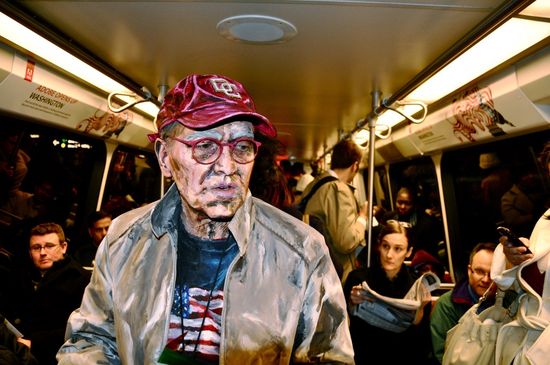
PaintingAndPhotoAlexaMeade

The above image is a photograph by Alexa Meade. How she describes her work:

Alexa Meade is an installation artist based in the Washington, DC area. Her background in the world of political communications has fueled her intellectual interest in the tensions between perception and reality. Alexa Meade's innovative use of paint on the three dimensional surfaces of found objects, live models, and architectural spaces has been incorporated into a series of installations that create a perceptual shift in how we experience and interpret spatial relationships.

More images here and here. Another Dish fave:

AlexaMeade

Sacred Values And Iran’s Nukes

Scientific American checks out research on the subject:

As diverse as people are in ascribing sacred status to possessions, they are equally varied in which values they consider sacred, a diversity that can breed substantial conflict. The abortion debate, for example, often presents a divide between those who consider woman’s “right to choose” sacred versus those who consider a fetus’ “right to life” sacred. A recent study in the journal for Judgment and Decision Making assessed how the Iranian nuclear defense program has become a sacred value and how this affects negotiation over Iranian disarmament, an issue of growing global concern.

Just last month Iran defied the United Nations in beginning to enrich its uranium supply to bolster its nuclear program. The recent study on this topic by Morteza Dehghani and colleagues, offers two key insights. It demonstrates how a relatively recent issue, one that—unlike abortion—lacks any longstanding historical or religious significance, can become sacred. And it suggests, surprisingly, that offering material incentives in exchange for sacred values may backfire badly. The work is a reminder that sacred values are tremendously influential in disputes both international and interpersonal, but that our negotiating instincts can lead us away from common ground.

Revising The Ten Commandments

Hitch gives it a go:

From his article on the subject:

It’s difficult to take oneself with sufficient seriousness to begin any sentence with the words “Thou shalt not.” But who cannot summon the confidence to say: Do not condemn people on the basis of their ethnicity or color. Do not ever use people as private property. Despise those who use violence or the threat of it in sexual relations. Hide your face and weep if you dare to harm a child. Do not condemn people for their inborn nature—why would God create so many homosexuals only in order to torture and destroy them?

Be aware that you too are an animal and dependent on the web of nature, and think and act accordingly. Do not imagine that you can escape judgment if you rob people with a false prospectus rather than with a knife. Turn off that fucking cell phone—you have no idea how unimportant your call is to us. Denounce all jihadists and crusaders for what they are: psychopathic criminals with ugly delusions. Be willing to renounce any god or any religion if any holy commandments should contradict any of the above. In short: Do not swallow your moral code in tablet form.

Does God Need Friends?

Angie Hobbs, a University of Warwick fellow who "has written widely on the philosophical history of friendship," discusses Plato's Lysis:

[Socrates, Lysis, Menexenus, and Hippothales] examine a variety of models for why individuals form friendships. The protagonists consider the idea of like being attracted to like, which is a pre-Socratic idea from Empedocles, but reject it on the grounds that such a friendship would produce too much competition and rivalry. They wonder about the Heraclitian view that opposites attract—which was a popular proverb for the ancient Greeks, as it is for us—but throw that out on the grounds that it would mean that the good is attracted to the bad, or the just to the unjust, and that can’t be the case. The model to which they appear most sympathetic is that of friendship between two good people—not because they are alike, but because they are attracted to each other’s goodness.

The best kind of friendship isn’t based on utility or pleasure or some particular end, but on appreciation of the other’s goodness, which reflects your own goodness. This is not entirely conclusive, because questions about self-sufficiency linger in the air—do truly good people really need friends? Are they not self-sufficient? This is a problem if friendship is viewed as simply filling a lack, like food or drink. These questions are not entirely resolved, and are complicated still further if we are supposed to be trying to imitate God: surely God has no need of friends.?

Atheistic Reincarnation, Ctd

A reader writes:

As I'm sure you know Rowe's argument is explicitly made by Friedrich Nietzsche, who calls the doctrine "the eternal recurrence" thesis. The problem is, it's provably mathematically false. In mathematics all sorts of things go to infinity without ever repeating.

Another reader:

The idea that you would have to lead your life over and over he

thought would be a spur to living a more authentic life. There are

problems with this idea.

First is that we do not know if either space or time is in fact "infinite". And then there is the fact that some infinities are larger than others, as Cantor proved mathematically.

For instance the infinite number of whole numbers has to be smaller than the infinite number of fractions. Suppose the infinity of time is smaller than the infinity of space and matter. It would never repeat.

Another reader adds:

Atheistic reincarnation seems to be dependent on a universe that's not only infinite, but self regenerating. If the universe began as an infinitesimally small point and then expands forever into a void, then it may not be so. In that case, entropy increases through the life of the universe and the random events that created who you are, are extremely unlikely to reoccur even in an infinite time-line.

On the other hand, if the universe is in a kind of loop where it expands and then eventually collapses back in on itself, then this reincarnation concept is almost a certainty. Every time the universe falls back in on itself the deck is reshuffled.

Even accepting the fantasy premise, the essence of reincarnation requires that there be something uniquely me-ish about my next incarnation. If I am reincarnated next century as a lizard, that lizard has to have some essence of me to distinguish it from all other lizards. If a physically identical me were to re-occur in some identical recurrence of this universe, it would be a mock-up, not a reincarnation, unless you also suppose a soul or something else eternal, waiting in some heaven for the replays of its earthly existence. And that gets you pretty far away from atheism.

A reader writes:

The problems with Mr. Rowe's argument are three folds. To begin with, no current evidence points to a universe that is infinite in either direction of the time dimension; in other words from all appearances, our Universe is bounded with a specific beginning and a specific end. It may very well be that the cycle of Bang and Crunch is cyclical, but then again it may not; moreover, baring new evidence, the current consensus is that a slow drifting heat-death, not a cosmic collapse, is the end in store for our cosmos. So much for infinite time.

Secondly, Mr. Rowe underestimates the infinite variety possible even with just four partnered amino acids locked in bounded carbon chains. Even when one should have a good chance of genetic "reincarnation"; when the noise of generations is generally small, such an occurrence is unheard of. Children are only removed from their parent's DNA by one generation; in other words, their chances of being phenotypic copies of their parents are much higher than that of the general population if only because they are working from (mostly) the same blueprint, yet how often does a child resemble, exactly, a parent?

To argue that variety is insufficient to allow for "reincarnation" at one generation, but sufficient to allow for it in a 187th cousin 500 years ago is to misunderstand genetics as simple statistics (and to misunderstand statistics, for that matter). Thirdly, he makes the common error of assuming genetics is determinative where, in reality, it is dispositional. Your genes are not "fate". They may grant you a predisposition to be witty, or fast, or towards easier and faster muscle construction, but it is environment and the decisions you, as the product both of genetic variation and infant experience, begin to make almost form the time you leave the womb that determines if and how you will make use of those predispositions. How many children of Olympic athletes become olympians themselves? Where does the great, great, great, great, great, great grandson of Socrates teach philosophy and logic? What new discoveries in physics have been made by Einstein's children, and grand-children, and great-grand-children? All of them were born, to lesser or greater degrees, with the same skill and attribute dispositions as their distinguished ancestors, but few if any of them have followed that ancestor's venerable path. Why is this? Because even if time and genetics are not infinite, choice and circumstance are.

Choices With Ripples

FreeWill
 

Jonah Lehrer points to studies finding that qualities like generosity, obesity, and selfishness move through social networks. He pulls this quote from James Fowler on what this means for free will:

Everyone always tells me that this research is so depressing and that it means we don't have free will. But I think they're forgetting to look at the flipside. Because of social networks, your actions aren't just having an impact on what you do, or on what your friends do, but on thousands of other people too. So if I go home and I make an effort to be in a good mood, I'm not just making my wife happy, or my children happy. I'm also making the friends of my children happy. My choices have a ripple effect.

Image by Luke Surl via Crooked Timber.