Success, Eventually

R.L.G at DiA interviewed Iranian human rights activist Shirin Ebadi last weekend:

[Ebadi] was 100% certain that the democratic movement in Iran would eventually succeed—but the trick is that she could not say when. It would depend on the American relationship, the nuclear negotiations, the price of oil, and Russia and China's role, she said. She supports sanctions like those that would deny visas to the Revolutionary Guards and other regime figures, and confiscate their foreign holdings. But she opposes sanctions that would hit the population as a whole (presumably including refined petroleum sanctions, though she did not mention them by name).

Ms Ebadi repeatedly compared the green movement to the struggle for black civil rights in America, and was convinced it would triumph in the same way.

Goldblog Splutters

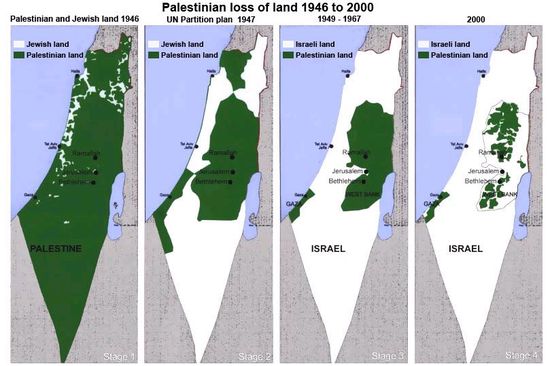
Israel-palestine-map

The maps above cause a conniption at Goldblog, prompts another claim to authoritah (a sure sign that someone has a weak argument) and ascribes to me all sorts of views I did not write in the post. (Despite Goldberg's claim, by the way, I did cite a reference – to Juan Cole's blog. Goldberg is free to take up the particulars with Cole if he so wishes – but I really wish he'd fact-check before making statements like that before he blogs.)

I will respond merely to the criticism of the Dish. First, the map was not discussed except as an historical illustrative context for the way in which the Netanyahu government is intent on aggressively expanding Israeli settlement even further in Jerusalem and the West Bank. This matters because as that famous anti-Semite, Joe Biden, said yesterday

“This is starting to get dangerous for us. What you’re doing here undermines the security of our

troops who are fighting in Iraq, Afghanistan and Pakistan. That endangers us and it endangers regional peace.”

Yes, there's a huge amount of historical context on the last sixty odd years, and, as I wrote in my response to Goldberg's luke-warm defense of my not being a bigot:

Like America's founding, [Israel's] was not immaculate, and its survival has been a brutal struggle in which Israel has not been as innocent as some want to believe, but whose enemies' anti-Semitism and hatred is tangible and omnipresent and despicable.

But that was scarcely the point of the post, and we can go on for ever on the subject. But some specific charges:

The intent of this propaganda map is to suggest that an Arab country called "Palestine" existed in 1946 and was driven from existence by Jewish imperialists. Not only was there no such country as "Palestine" in 1946, there has never been a country called Palestine.

Of course not. But there was a place called Palestine (among other things) under mostly Ottoman or British rule for a very long time before Israel came into existence. Wikipedia tells us that in 1850, for example, the population of the area comprised roughly 85% Muslims, 11% Christians and 4% Jews. In 1920, the League of Nations reported that 

Four-fifths of the whole population are Moslems. A small proportion of these are Bedouin Arabs; the remainder, although they speak Arabic and are termed Arabs, are largely of mixed race. Some 77,000 of the population are Christians, in large majority belonging to the Orthodox Church, and speaking Arabic. The Jewish element of the population numbers 76,000.

By the end of the British mandate, and an influx of Jewish refugees and Zionists, the proportions were roughly 70 percent Muslims and 30 percent Jews. Jews were concentrated in urban areas along the coast but, as the first map shows, some were indeed in the West Bank, although as a tiny minority.

This isn't propaganda; it's fact.

The maps show what has happened since – in sixty years in terms of growing sovereignty and accelerating Israeli control. The Muslim population is expanding as the geographic extent of their political self-government keeps diminishing. While Jerusalem was once in the center of Palestinian territory – and the Israelis agreed to this, while the Arabs refused – it is now not only in Israel but all of it will soon be under sole Israeli control, as Netanyahu continues, despite pleas from his American benefactors and allies, merely to freeze them.

The point of the illustration was to provide some background to the now-unavoidable fact that Israel has every intention of expanding its sovereignty to the Jordan river for ever, to segregate Palestinians into walled enclaves within, and to station large numbers of Israeli troops on the Eastern border. I notice that Goldberg has time to splutter against this blog but, until yesterday, no time to refer to the Israeli government's contemptuous treatment of the US vice-president in his visit, a subject that has dominated the Israeli press but contradicts Goldberg's view that my notion that the new Israeli that I have worried about this past year is real and is dangerous – to itself, the region, the world and, above all, the United States.

“Nowness Over Ripeness”

David Gelernter contemplates the state of the Internet:

Nowness is one of the most important cultural phenomena of the modern age: the western world’s attention shifted gradually from the deep but narrow domain of one family or village and its history to the (broader but shallower) domains of the larger community, the nation, the world. The cult of celebrity, the importance of opinion polls, the decline in the teaching and learning of history, the uniformity of opinions and attitudes in academia and other educated elites — they are all part of one phenomenon. Nowness ignores all other moments but this.

Nick Carr:

But, [Gelernter] suggests, we can correct that bias.

We can turn the realtime stream into a “lifestream,” tended by historians, along which the past will crystallize into rich, digital deposits of knowledge. We will leap beyond Web 2.0 to "the post-Web," where all the views are long. It’s a pretty vision. I wish I could believe it.

There are times when human beings are able to correct the bias of a technology. There are other times when we make the bias of an instrument our own. Everything we've seen in the development of the Net over the past 20 years, and, indeed, in the development of mass media over the past 50 years, indicates that what we’re seeing today is an example of the latter phenomenon. We are choosing nowness over ripeness.

Uproar In The Indian Parliament

A bill passed this week would amend the constitution to reserve one-third of national and state legislative seats for women:

Opponents of the bill say that it will favor wealthy upper-caste women at the expense of the lower castes and Muslims. “We are not against women reservation,” said Lalu Prasad Yadav, leader of one of the parties seeking to block the amendment. “Give reservation to poor India, to original India. Ninety percent of the population is deprived in India.”

Critics of the amendment say that it will only worsen what is already a big problem — powerful men substituting their daughters, wives and sisters as proxies in political office. 

Aparna Ray has an extensive round-up of opinion on both sides.

(Video: "Agitated lawmakers opposed to the tabling of a women's reservation bill created a commotion and tore a copy of the bill, in the upper house of the Indian parliament.")

You Are Your Computer

According to a new study:

[Anthony] Chemero’s experiment, published March 9 in Public Library of Science, was designed to test one of Heidegger’s fundamental concepts: that people don’t notice familiar, functional tools, but instead “see through” them to a task at hand, for precisely the same reasons that one doesn’t think of one’s fingers while tying shoelaces. The tools are us. This idea, called “ready-to-hand,” has influenced artificial intelligence and cognitive science research, but without being directly tested.

The Daily Wrap

Today on the Dish, Daniel Levy reported on the reaction to Biden's humiliation, DiA held Israel to a higher standard, Steven Cook defended the neocons, Bob Kaplan shared some ominous signs from Afghanistan, Michael Hanna updated us on the Iraq election, and Mike Crowley compared Maliki and Allawi.

On the domestic front, Ambinder took stock on HCR and explained the Paul Ryan budget, Adam Serwer relayed the crack/cocaine compromise, Matt Corley countered Thiessen, Andrew Sprung took down Mukasey, Chait questioned Mike Allen, and Hiatt embraced Rasmussen.

Readers argued over the Dish's use of explicit photos here and here. Others shared their experiences with kids who were easy to accept same-sex partners. Andrew featured a video of him debating natural law at Princeton (reader response here). Cool ad here.

— C.B.

Health Care Tea Leaves

Ambers tries to make sense of a confusing week. On the timing:

This morning, the majority whip, James Clyburn, said that the House will vote within the next ten days. Yesterday, the majority leader, Steny Hoyer, said he expected a vote by the end of the week. The president's decision essentially allows the House to work on Saturday and Sunday — gives Democrats a bit of cover — and gives him the chance to work the phones.  The idea is that the House has until the 21st or so to pass its bill, and reconciliation talks will begin on the 22nd, and the whole shebang will be shebanged by the 26th of March.

Cohn has more on the time-line.

Maliki Or Allawi

Mike Crowley wonders which presidential contender would be in the best interest of the US:

[A] reason Obama might be pulling for Allawi is his wariness towards Iran. On a visit to Iraq last December, I heard one prominent Sunni politician complain about Maliki’s ties to Shiite Iran. During his own period of exile, Maliki spent eight years living in Iran, and since he became prime minister in 2006, he has paid several state visits to Tehran. The Sunni politician complained bitterly about Shiite leaders in Baghdad who are “only Iraqi on their official documents”—which sounded like a reference to Maliki’s longtime residency in Iran. Though Allawi is also a Shiite, he is more secular than Maliki and has expressed more suspicion of Tehran.