
A swan swims at Lake Toepper (Toeppersee) in the western German city of Duisburg on March 11, 2010. Small signs of the approaching spring can be seen in many parts of Germany, despite continuing cold weather. By Jens Schlueter/AFP/Getty Images.
A swan swims at Lake Toepper (Toeppersee) in the western German city of Duisburg on March 11, 2010. Small signs of the approaching spring can be seen in many parts of Germany, despite continuing cold weather. By Jens Schlueter/AFP/Getty Images.
E.D. Kain wants me to spend more time on the subject because he thinks "this issue rests at the heart of what went wrong with conservatism." Italics his. An excerpt from his larger argument:
Sprawl is a result of massive statist interventions into our culture and society, and its symptoms are equally enormous. Everything that conservatism has historically stood for is undermined by sprawl. It is not only the physical manifestation of our decline, it is a poison which continues to contribute to that decline. Its repercussions can be felt in our discourse, in our speech, in our way of thinking. This is not merely a matter of aesthetically pleasing communities, but of communities which allow individuals to be a part of the whole. I doubt this is sustainable, this suburban maze – in any way: fiscally, socially, spiritually. It is, as James Howard Kunstler called it, “a peculiar blip in human experience.”
Larison joins the debate:
[T]here is greater interest in the [Israeli and Palestinian] conflict because of the sacred geography of the disputed territories. The same cultural heritage and religious sentiments that foster sympathy for Israel in the West also make the world’s Christians and Muslims pay far more attention to a conflict taking place in the Holy Land. Depending on the theology and politics of the church in question, this attention will translate into zealous Christian Zionist support for Israel, social justice-driven concern for dispossessed, stateless people, the witness of peace churches against political violence or confessional solidarity with the small number of Palestinian Christians who remain.
"I understand perfectly well how intelligent people who don't follow this debate closely might not catch on to the distinction. But this is what Mike Allen does all day — and, as I understand it, much of the night and the wee hours of the morning as well. How can anybody still not understand this? I'm at a loss here. Look, there's an endless list of topics I don't understand at all. I went through an entire semester of pre-Calculus in high school and was never able to understand what a function is. I still don't. It's a complicated subject and I was a lazy student. But this reconciliation distinction is easy, and Mike Allen is (legendarily) not lazy. So, what the hell is going on here?" – Jon Chait, TNR.
Steven Cook posits:
Needless to say, Washington's position in the Middle East was far worse after the ascendance of the neoconservatives during the Bush years. The region was further from peace, stability, and prosperity than when they found it in early 2001. Still, the neocons' perspective on the nature of the Syrian and Iranian regimes were largely accurate, and their forceful advocacy of democracy and freedom in the Middle East may have grated on many, but it did much to advance those causes in a region once described as "democracy's desert." Any number of observers would surely disagree with these claims, but I suspect that has more to do with politics than a careful evaluation of what the neocons have to offer to the foreign-policy debate.
And then there's the reality of seeing their policies in Israel and Iraq over the last ten years. And the refusal of so many of them to adjust. Personally, as someone once said, I've been mugged by reality.
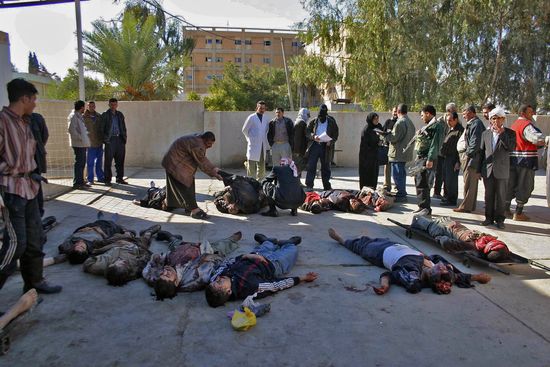
A reader writes:
I have to agree with the dissenter of the day when he said that there should be some sort of warning before being subjected to those disturbing photos. I know for myself that not only could I not read that posting, but I couldn’t read the one above it either because part of the photo would appear in my browser. At no point did he say that those photos shouldn’t be published and I’m not either, just that they shouldn’t be published on the front page and some warning should be given that photos who some may consider disturbing appear after the jump. Besides, you’ve already set a precedent for this with other photos of a more sexual nature. I have seen “NSFW after the jump”. If you’ve determined that sexually suggestive photos should be given that caveat, I don’t see why violent ones shouldn’t either.
Another writes:
When it takes a viewing of The Hurt Locker for people to understand and be disturbed by what is happening in Afghanistan and Iraq, clearly something is wrong. We, the public, have been shielded from the suffering and horror faced by young men and women who chose for whatever reason to join the military. We do them and the entire military a disservice when our daily reminder is a well-intended formal portrait on the evening news rather than the reality and ugliness of combat.
Another:
I agree with your response to your reader. Let me say that I think his request was a reasonable one, but the case for publishing those photos in broad daylight is too profound to let the sensitivities of those whose stomachs are too weak to handle them influence the manner of their display.
The historical case for this approach to journalism is all too strong. The active coverage of war zones in Vietnam was one of the primary reasons why the protests against it were so spirited. Going back farther, you can see the folly of our American ancestors in the romanticizing of war, to the point where people viewed pitched battles as entertainment, not knowing the horror that they would soon witness as bodies were shattered by musket balls and artillery rounds.
Compare this to the Bush-era policy of not allowing the caskets of dead soldiers returning from a war zone to be filmed by camera crews. Why? Why not show the American public the awful price of war? Why are we hiding the inevitable results of armed conflict from the public? Is it because if they have to see dead American sons and daughters returning from Iraq and Afghanistan, they might be a little less supportive of the war?
There is a photo that galvanized me against the war in Iraq shortly after we invaded Baghdad. It is shocking, graphic, grizzly, and heart-breaking all at once: it showed an Iraqi boy who’d had both his arms blown off by shrapnel from a tomahawk missile. He was in obvious pain, and disfigured horribly. It is terrible to look upon, but that is the price of waging war. Innocent people die. And it has been my experience (and yours as well it seems), that unless you shove these photos in peoples’ faces, they will refuse to look at them.
If we truly believe a war (or in Israel’s case, a pattern of military action) is just, we should be willing to look upon these photos and accept responsibility for them. Graphic photos such as the one you posted expose hard truths to those who view them, and force them to consider their opinion of the policies that created the circumstances for that photo to be taken.
Another:
When I first read your response to the Dissent of The Day I thought you were way out of line. But the more I thought about it the more I started to agree with you and your position to show the picture. I hated seeing that photograph. I was angry at you for having put it out in the open for me to see. By the same token the ability to edit my reality as I see fit is perhaps more dangerous and more disturbing possibility. The internet, while availing us of the opportunity to view all sorts of things we might otherwise not have seen or heard about also affords us the unique ability to see only what we want to see, to listen only to those with whom we agree.
Another:
For a generation raised on Grand Theft Auto and Second Life, it can be a challenge to bring the horrors of war and tyranny to full consciousness. My day came in 1992 when I saw my first graphic image of a Gulf War casualty, burned to a crisp at the wheel of his jeep. I saw it at a photography exhibit in Germany; we in the US only saw nightcam images of tracers from the planes far above the action. So we X-ers aren’t much better on that front. Kudos to you for reminding us all of the brutality we must fight to end, and what’s on the line when we choose to do so.
(Photo: one night’s victims of sectarian murders in Baquba, Iraq, under US occupation, by Yussef Ali/Getty.)
Josh Marshall is hopeful:
I think it's worth keeping an eye out to see if this becomes a trend. Because we're still in a highly volatile political period. And I don't think it's clear yet that how things look today is how they're going to look in the fall.
A reader writes:
Wow, thanks for reminding me what marriage is all about. As someone who has been married for almost 32 years and sometimes wonders if it’s all inertia, your convictions expressed so wonderfully in this discussion brought me back to the true meaning of that commitment.
In this throw away world it is a wonderful gift to have someone who is willing to be with you through all the uglies of life. It is one of the things that makes life worth living.
I'll be posting segments of the talk over the next few days. The first is a discussion of the natural law prohibitionist view of gay rights; the second a critique of queer liberationism; the third a discussion of moderate conservatism's incoherence on the topic and the last an objection to conventional liberal views, especially hate crimes laws and a defense of free speech for bigots. In other words: Virtually Normal as performance art fifteen years later. If you want to listen to it on the radio or iPod, the podcast of the whole thing is available here. The entire speech can also be viewed on Princeton's website here. At some point, CSPAN has said they will broadcast it. But I thought segments on the Dish would be easier if you do not have the time.
Another reader writes:
I am not a Catholic although my father was Jesuit-educated and I was brought up in great respect of it. That said, I am so in awe of what you said to that young man I can hardly find words.
I am put very much in mind of Lord Acton when he found himself so very much in opposition to Papal Infallibility, and hoping very strongly that you do not get similarly disillusioned because, because, in my humble mind at least, you stood there expressing the very best of the two millennia history and tradition of that incredible institution.
The camera work is nearly as impressive as the skating:
Pre BitterCold – By Vinny Minton from Imperial Productions on Vimeo.
Andrew Sprung notes the latest flim-flam from the anti-anti-torture right:
While Mukasey's piece does defend those who defend "clients that were or became unpopular," the piece is a bait-and-switch, built on a false and dangerous equivalence that is sure to become a Republican talking point. After noting perfunctorily that Bernie Madoff's lawyer was reviled, Mukasey turns to his true passion:
More recently, we've witnessed a campaign to impose professional discipline on two former Justice Department lawyers, John Yoo and Jay Bybee, for legal positions they took as to whether interrogation techniques devised and proposed by others were lawful—a campaign that also featured casual denunciations of them as purveyors of torture.
After then noting the denunciation of Justice Department attorneys who in private practice represented terrorist suspects or upheld their rights, Mukasey makes his move:
This is all of a piece, and what it is a piece of is something both shoddy and dangerous.
This is an outrageous comparison.
First off, Yoo and Bybee have not yet been charged with anything. When they are, I sure hope they have the best lawyers to defend them against some of the most serious charges anyone can face: war crimes. Secondly, I have never made any "casual denunciations" of them as purveyors of torture. I have made very specific, clear, thoroughly argued, unimpeachable legal, moral and historical cases that they were indisputably legal architects of what the Bush administration's own Gitmo chief prosecutor called torture. And torture is a war crime. By the Nuremberg, principle, they are as responsible a their bosses and the torturers themselves and all those who aided and abetted this evil.
Their work in twisting the law to make what was plainly illegal "legal" was described thus by the OPR report from the Department of Justice:
Based on the results of our investigation, we concluded that former Deputy AAG John Yoo committed intentional professional misconduct when he violated his duty to exercise independent legal judgment and render thorough, objective, and candid legal advice.
The OPR explained what this meant:
OPR finds professional misconduct when an attorney intentionally violates or acts in reckless disregard of a known, unambiguous obligation imposed by law, rule of professional conduct, or Department regulation or policy. In determining whether an attorney has engaged in professional misconduct, OPR uses the preponderance of the evidence standard to make factual findings.
An attorney intentionally violates an obligation or standard when the attorney (1) engages in conduct with the purpose of obtaining a result that the obligation or standard unambiguously prohibits; or (2) engages in conduct knowing its natural and probable consequence, and that consequence is a result that the obligation or standard unambiguously prohibits.
My italics. These lawyers were not defending unpopular defendants. They were providing fraudulent legal advice to enable politicians who were then riding the highest of poll numbers to break the law.
 The Dish