[Re-posted from the weekend]
The chattering classes at this moment are declaring the rebirth of conservatism in the energy on the Republican ideological right, the likelihood of major Democratic losses this fall, the success of the Republican party in defining the essentially pragmatic, centrist healthcare reform bill as a product of some left-liberal social engineering project, and on and on. The op-ed pages think in terms of this rubric; cable "news" seems incapable of seeing anything but this rubric. And the creation of a cocooned, conservative, religio-political subculture, complete with a massively lucrative publishing/broadcasting/blogging service industry, reinforces this with a cultural sledge-hammer. Republicans like Bill Kristol see "victory" ahead, have already seen "victory" in Iraq, and urge the intense and constant rallying cry of "Toujours l'audace!"
This narrative is a reflexive and easy one; it echoes the inanity of "Who Won The Day?" Politico-style analysis; it has turned political journalism into sports journalism; it avoids historical context in favor of  constant cultural and political amnesia. It takes the mind of the American people as an etch-a-sketch, shaken anew every electoral cycle. It infects left and right.
Just look at Frank Rich's column today, which like MSNBC to FNC, which is the same dynamic, and the same understanding of politics, and its purposes. In this worldview – which is now the worldview in American political analysis – ideology has infiltrated everything, it has saturated public and private, it has invaded even something sacred like religious faith, in which the mysteries of existence have been distilled in writing or even understanding the churches into a battle between "liberals" and "conservatives."
People accuse me of pedantry or semantics in insisting that all of this – on the right and the left – is in fact a sign of the death of conservatism as a temperament or a politics, rather than its revival. But I have been arguing this for more than a decade. Conservatism, if it means anything, is a resistance to ideology and the world of ideas ideology represents, whether that ideology is a function of the left or the right.
In the mid-twentieth century conservatism revived itself by a profound critique of liberal hubris and rationalism, of liberals' belief that they really could transform the world through better government, of the new left's critique that the personal is political, and of the stifling of human nature, individualism and freedom that socialism and communism had wrought.
From the green shoots of Hayek and Oakeshott and Friedman to the final blooming of Thatcher and Reagan, this regenerated conservatism really did restore the balance between state and society toward 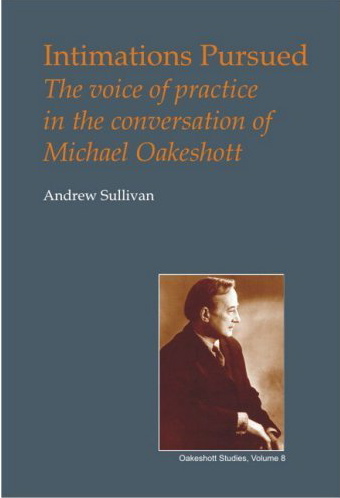 society and away from the state. It harnessed traditional impulses – nationalism in Britain, evangelicalism in America – but it never fully gave into them. Its pragmatism remained in the Reagan tax hikes, Thatcher's retention of socialized medicine, their mutual outreach to Gorbachev, and Thatcher's insistence on international law. In some ways, I believe, the pinnacle of this conservative achievement came in the presidency of George H W Bush and the premiership of John Major (see my 1999 NYT essay, The End Of Britain"). They both solidified the reforms of their predecessors, were the final forces that reformed the left, and made hard decisions – like raising taxes, entrenching international law in the liberation of Kuwait, or staying out of the euro – that look better and better the more time goes by. That the first Bush is so widely reviled by the "movement" that passes for conservatism in America today, in favor of the brain-dead ressentiment of Palin or the philistine pseudo-intellectualism of Gingrich or the neo-imperial radicalism of the neoconservatives, is the smell of a decomposing corpse, not a newborn child.
I believe that although Obama is indeed a liberal in the sense that he believes government really can and must improve the lives of its citizens, he is much much more like a real conservative than his detractors on right and left. The change he still represents at home is an abandonment of this ideological, red-blue abstract form of politics toward a realistic, pragmatic, reasonable center. Abroad, he represents an attempt to defuse the dangerously polarizing religious and cultural warfare that is fomenting terrorism, and further fusing religion and politics in so many places across the world. In this sense, I regard him as a vital, indispensable figure standing against the forces of ideology and religious warfare, whose failure could lead to catastrophic consequences for our future.
I remain utterly unapologetic about this belief. I stand proudly as a conservative behind him. And the more deranged the right becomes, and the more confused and angry the left gets, the more it seems important that he succeed in his presidency. Not win: succeed. Every political career ends in failure, because the problems that need to be fixed cede to different problems. Because the tragedy of human life and politics is never resolved. Because a politics aiming for "victory" is not a politics; it is a dangerous and self-destructive delusion.
Maybe my critics are right and this conservatism cannot survive in this culture. Maybe things are too far gone. But given the stakes, I refuse to believe that, and given the character and shrewd judgments and decisions this reasonable president has made, and given his extraordinary poise in this climate, and the depth of the disaster he inherited from exactly this decadent "conservatism", I believe he deserves far more support – especially from the younger generation whose future really is at issue.
My Sunday column this week treats Obama as a liberal "trimmer" in the best sense of that word. I can see the logic of his strategy and the patience it requires. I'd also like to recommend a brilliant little post by Freddie DeBoeur, a leftist who actually understands a bit about what actual conservatism is about (unlike today's "conservatives"), and how unconservative this fundamentalist, radical, unconstitutional, ideological, nihilist Republicanism now is.
There aren't many of us who back Obama for these reasons. And I certainly do not believe and have never believed he is a savior (the delusion that he is remains part of the problem for the Democrats). My Savior is not political. And in so far as I am political, the last thing I'd ever want to be is "saved".
But I remain gladly standing athwart the current conservative movement yelling "Stop!" Because even if it achieves the "victory" it so desperately seeks, its very identity ensures that it will kill the things – both political and religious – it purports to love.

 The Dish