On Being Wrong

TNC wishes journalists were upfront about it:

[M]edia in general, often confuse accuracy with honesty. I think analysts, reporters, and the people overseeing them, are loath to admit error because they see it as a kind of brand erosion. The question becomes–If I admit to you that I was wrong, why should ever trust me to be right again? My sense is that only a fool actually expects media people to be right all of the time. 

What they expect, I think, is for you to be honest and informed…

[Then] there's what my label-mate Andrew calls, "journalism's dirty secret." The dirty secret is this–perhaps more than any other "profession" journalism's barriers to entry are really artificial. It does take a special person to be a great journalist. Curiosity in the extreme is important. A strong desire to see, and thus think, clearly is important. But neither of these can really be taught in a crude classroom environment. Journalism can't be absorbed through a series of lectures and assigned readings. It must be done. No one can teach you how to go up to strangers and ask rude questions. You just have to do it. Repeatedly.
Internet Money

Felix Salmon contends that social network data is better than a paywall:

[N]ewspapers with a cover price tend to have higher ad rates than free sheets, because their readership is more affluent and is also more likely to actually read the paper (and see its ads).But essentially what’s happening here is that advertisers are using willingness to pay for a newspaper as a proxy for all manner of other desirable traits in newspaper readers, just because there’s no other way of really knowing who’s reading what…

[But the] fact is that if I sign in to a free site using my Twitter login, I’m actually more valuable to advertisers than if I paid to enter that site. That’s because the list of people I follow on Twitter says a huge amount about me, and a smart media-buying organization can target ads at me which are much more narrowly focused than if all they knew about me was that I was paying to read the Times.

Drum is melancholy about the death of privacy.

Frost’s Relationship With Nature

A reader writes:

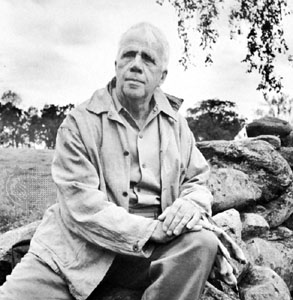
I've got to agree with your reader that "Mending Wall" is much more complex than it seems initially.  As the title suggests, the act of building the wall may provide a kind of healing that Frost1 brings the two neighbors together.  Frost is tricky because we tend to read his invocations of nature romantically.  "Something there is that doesn't love a wall/ That sends the frozen-ground-swell under it,/ And spills the upper boulders in the sun."  Nature is the force tearing down this wall, and we like to think that nature is a force for the righteous and the good.
But this isn't the case in the world of Robert Frost.  Nature terrifies in "The Hill Wife."  It conspires in "Design."  It appalls in "Desert Places."  We need those fences and walls to make sense of a desolate, bewildering world.  Think of the exquisite, painful line a father utters after he has buried his dead child in "Home Burial": "Three foggy mornings and one rainy day/ Will rot the best birch fence a man can build."  Those fences, and the work we put into building them, are our "momentary stay against confusion," a metaphor Frost used to describe the work of poetry.  One more lovely line in this regard:  "The fact is the sweetest dream that labor knows."

First Impressions

Jonah Lehrer believes our responses to the BP spill and the Icelandic ash cloud were sabotaged by the wiring of our brains:

I think we simply need to be more aware that our initial beliefs about a crisis – those opinions that are most shrouded in ignorance and uncertainty – will exert an irrational influence on our subsequent actions, even after we have more (and more reliable) information. The end result is a kind of epistemic stubbornness, in which we're irrationally anchored to an outmoded assumption.

The Daily Wrap

97831501

Today on the Dish, the House voted to end DADT and a key Senate committee did as well. Joyner questioned the public opposition to it, lesbians harmed by the policy told their stories here and here, and we glanced at the dregs of the debate here and here. The oil leak appeared to be plugged, bloggers debated its similarity to Katrina, more images of the damage emerged, and we looked back at another big spill in the Gulf. The Dish also did due diligence on the Korean crisis.

In Palin coverage, she erected a fence to fend off McGinniss but not convicted criminals, Jack Shafer shielded the journalist, Kate Pickert partially backed Palin, and readers more so. Bernstein insisted on scrutinizing her, Timothy Egan pwned her, Ben Smith reported more juicy details, a reader requested a view from McGinniss' window, Andrew doubted Bristol, and Pareene put it best.

Rand Paul updates here and here. Noah Millman queried the paleocons, Douthat doubted their relevance, Wehner marveled at the lack of crime, Massie covered Clegg, and Friedersdorf manhandled McCarthy. More on the Israel debate here.

Critical Ralph updates here and here. Kaus campaign coverage here. Recession view from a reader here. Early Christian discussion here and Robert Frost in the Atlantic here. More on 24 here and here. Beard-blogging here and metrosexual-blogging here and here.

— C.B.

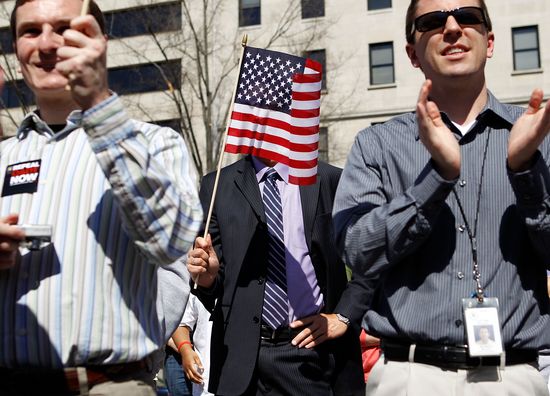
(A man covers up his face with a U.S. flag as he participates in a rally in support of a repeal of the 'Don't Ask, Don't Tell' policy March 18, 2010 at the Freedom Plaza in Washington, DC. The policy is currently under review by the Pentagon and Democrats in the House and the Senate have unveiled legislation to repeal the policy. By Alex Wong/Getty Images.)

The Oil Spill vs Katrina

Yuval Levin posits:

I think it’s actually right to say that the BP oil spill is something like Obama’s Katrina, but not in the sense in which most critics seem to mean it. It’s like Katrina in that many people’s attitudes regarding the response to it reveal completely unreasonable expectations of government. The fact is, accidents (not to mention storms) happen. We can work to prepare for them, we can have various preventive rules and measures in place. We can build the capacity for response and recovery in advance. But these things happen, and sometimes they happen on a scale that is just too great to be easily addressed. It is totally unreasonable to expect the government to be able to easily address them — and the kind of government that would be capable of that is not the kind of government that we should want.

Drum demurs, writing that “Katrina was an example of the type of disaster that the federal government is specifically tasked with handling” while there “is no federal expertise in capping oil blowouts” and there “is no federal agency tasked with repairing oil spills.” I find those point pretty dispositive, although I take Yuval’s argument about government’s capacity in general. Clive Crook adds:

The notion that the government should be directing, as opposed to merely supervising, the effort to stop the leak — BP should be pushed aside; bring in the military — is absurd. So far as that side of the operations goes, all that matters is who has more technical expertise: the company or the administration? (If your house was burning down, would you want the White House directing the fire crews, or maybe calling in air strikes, as a sign of how seriously Obama takes your problem?)

I think you can and should excoriate BP for cost-cutting, and the MMS for inadequate supervision. But I see no reason to blame the feds for how hard it is to stop one of these. In 1979, it took ten months.