Bombing Iran

John Bolton is still itching for a war. In response, R.M. at DiA asks:

Why is it that those wishing to see military action against Iran tend to end their analyses the moment the bombs strike the republic's nuclear facilities? This is somewhat reminiscent of the short-sighted planning that went into the Iraq war, which taught us that stuff happens as a result of our actions. The hawkishness of folks like Mr Bolton is based on the idea that Tehran is an evil, unpredictable force—for example, Mr Bolton dismisses the argument that a nuclear Iran could be deterred because "Iran's theocratic regime and the high value placed on life in the hereafter makes this an exceedingly dangerous assumption." What, then, should we assume about the mullahs' response to a direct attack on their country? To use the words of Mr Bolton, surely pre-emptive military force (whether carried out by America or Israel) would set up another "stark, unattractive reality"—the very real possibility of a regional war. Perhaps that does not tip the scale in favour of the largely-toothless alternative option. But it should certainly be part of the debate.

The neoconservative mindset is less concerned with real-life effects and consequences of actions than with the a priori ideological propriety of such actions. That was, in so many ways, my own profound error in the buildup to the Iraq war. I was far more content congratulating myself for the high morality of ridding the world of a monster like Saddam than examining the exact details of the WMD intelligence or the precise plans for occupying Iraq after victory.

I was thinking like an ideologue, not like a conservative. I have learned my lesson. But when, like Bolton, you are dealing solely with abstractions and raw force, learning lessons is for wusses.

28 Seats Shy Of A Tory Majority? Ctd

A reader writes:

What that Rubik's cube map shows is that pretty much any part of the UK that did the heavy lifting of the industrial revolution – and which has paid the price for de-industrialization – still thinks on aggregate that the Tories don't have anything to offer them. Neither party seems to have come up with much beyond various ham-fisted attempts to subsidize local manufacturing, instead of just admitting that the old days of well-paid semi-skilled jobs aren't coming back. And neither party seems to willing to ask any serious questions about what it means that Eastern Europeans seem to be able to come to the UK and find work.

(This is where my long-departed, west-of-Scotland-working-class-Tory grandfather would have asked if it might be because they weren't a load of bloody useless work-shy idlers, but this is why he wasn't in politics, and why he didn't balk at Pakistani immigrants back in the day.)

It seems to me that if the Tories get a working majority in the coming election, it's not an epochal shift as such, because they're capitalizing on the +/- 15 years that the UK electorate is willing to give a party to become completely ossified and unelectable. There's nothing about the platform that I've noticed that says they're trying anything seriously different than tweaking their side of the political divide in policy terms.

If the Tories wanted an epochal shift, their response to work in Britain wouldn't be superficially pragmatic with nativist dog-whistles (limit immigration), it would surely involve a serious rethink about how to encourage either the creation and relocation of jobs – or of workers – in the UK. If they want to gain electoral success in the long term by means other than gerrymandering, addressing work and basic affluence would surely be a good way to go.

Until then, it's just the same old back and forth with slightly better packaging this time around. And look at Tony Blair – what could go wrong with a media-friendly centrist papering over internal party divisions?

Another writes:

Could you please explain something to me?  You've been banging away for weeks now about the British election, the new Cameron strain of Tory, then the rise of Clegg at the debates, etc.  But after noting the contrast between Lib-Dems' massive surge in popularity and the actual seats they stand to gain, you turn around and argue against election reform?

"I like clear, strong governments with clear mandates," you explain.  Is that how you would describe British politics over the past decade?  How about American politics during the 1990s?  And even after a landslide, is the incoming party's mandate really so clear?  If they owe their victory more to widespread discontent with the incumbent rather than the popularity of their own policies, what exactly can they hope to transform?  Further, citizen engagement is crucial to the survival of any participatory democracy; what could be more effective at depressing voter turnout than a two party monopoly on power?

More to the point, while the vision of a "clear, strong government with a clear mandate" may resonate emotionally, countries with PV such as Germany and Australia don't seem to be the worse off for using that instead of first past the post.  People love to point to Italy as an example of the perils of coalition politics, but is that really the fault of coalitions as a concept or simply other, uniquely Italian factors in Italian politics?

I also find your enthusiasm for seeing the Lib Dems permanently supplant Labour and ensure that "Britain can oscillate between a Whiggish Toryish and a Tory Whiggism" as a bit naive, unless you're for PV.  FPP actually makes it harder for this transformation of the political playing field to occur.  It also puts a great deal of perverse pressure on the Lib Dems once they've replaced Labour.  All of the constituencies (interest groups, not boroughs) that Labour fought for will have to look to the Lib Dems instead, and they'll expect a quid pro quo from Clegg. 

I suppose in the long run I could possibly see the sort of transformation you're looking for, but again, I think PV could give it a real boost, free up people who want just that sort of "Whiggish Toryish and Tory Whiggism" to vote their preferences rather than their fears (anything but Labour!  anything but Tory!).
Why Critics Shouldn’t Create, Ctd

A reader writes:

The "Who Killed Bambi?" quotes are a little disturbing, but let's not forget that Ebert also wrote the screenplay to the 1970 comic masterpiece "Beyond the Valley of the Dolls," which is a really great film, if you like cult movies. The Village Voice apparently does, because they named it as #87 on their list of the hundred greatest films of the twentieth century.

Another writes:

Have you SEEN "Beyond the Valley of the Dolls"? That satire is why I trust Roger Ebert TO critique. It is glorious.

A behind-the-scenes trailer above. This quintessential scene is probably NSFW. Yes, I have seen it. Many times – under duress. I think of it as Advanced Gay. I never got it for years, having an uncertain grasp on gay camp. Then I went to indoctrination camp (via a good friend and my husband) and graduated from Intermediate Gay, and was allowed to watch it alongside Grey Gardens.

I still can't stand musical theater, though, and Mary Tyler Moore leaves me cold. Still, with appropriate levels of consciousness alteration, BTVOTD has its moments, though never reaching the true aesthetic heights of "Can't Stop The Music." I guess I will never be a True Gay. Just look at what I wear.

Quote For The Day III

"My old man works in the postal service, my mum in a hospital and my brother in a factory. They're my family and when I play rugby I'm representing them. But coming out was different. More than anyone, I feared for my father. I used to be a postman myself and so I know that working environment. It's a macho world and I was worried about him going into work and hearing bad things about me. But I think he's 10 times prouder of me now than six months ago," – Gareth Thomas, now openly gay rugby player, and former captain of the Welsh team.

Immigration: The Law Or The Numbers?

Max Fisher compares Britain and America in the immigration debate:

Foreign-born residents make up slightly more than ten percent of the population in both the U.S. and UK, with grants of asylum accounting for about one percent of new residents. However, 10.7 million of the 38 million foreign-born U.S. residents are here unlawfully, making them three times as likely to reside illegally as the 6.7 million UK migrants, about one in ten of whom are illegal immigrants. That could help explain why Britons like the woman Brown offended worry about legal immigrants while Americans talk primarily about illegal immigrants. A recent poll showed 77 percent of Britons want immigration cut and more than half want it reduced by "a lot." In the U.S., 73 percent want illegal immigration decreased and 60 percent see it as a "very serious" problem. The fact that Britons hold similar attitudes despite mostly legal immigration suggests that the number of immigrants is more important to provoking anti-immigration backlash than whether those immigrants are here legally.

The Tory Nightmare Scenario

308UK

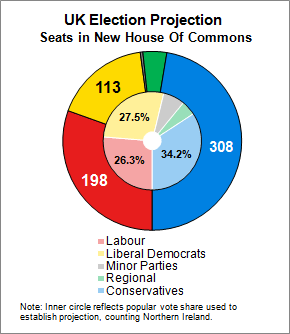
Nate Silver's current projection of the election result:

If seats in the House of Commons are distributed exactly as our model suggests, it would create an unusual situation in which Conservatives alone could not form a majority, but Labour and Liberal Democrats could also not combine to form a majority. My personal view is that the most likely outcome of such a scenario would be a Conservative minority government, possibly followed by new elections in relatively short order as Conservatives sought to win an outright majority.

The Tory nightmare scenario – foretold to me last autumn by a senior Tory – is that they have to govern as a minority government, enact stringent spending cuts and then face an angry electorate after a few months, because their minority government is brought down in the Commons. In other words: the Tories would be used to do the dirty work of actually cutting spending and then pilloried and replaced.

Renard Sexton crunches the numbers various ways. An unlikely but frightening scenario:

Labour could pull off a 13 seat plurality of seats, while sneaking in third place in the national popular vote.

Tweaking Arizona

Yglesias calls one of the modifications significant but still thinks Republicans are going to take a major hit among Hispanics. The lesson Chait draws is that "even the most restrictionist politicians do respond to political counter-pressure." Brownstein marks the death of pro-immigration Republicanism:

Just four years ago, 62 U.S. senators, including 23 Republicans, voted for a comprehensive immigration reform bill that included a pathway to citizenship for illegal aliens….In 2007, Senate negotiators tilted the bill further to the right on issues such as border enforcement and guest workers. And yet, amid a rebellion from grassroots conservatives against anything approaching "amnesty," just 12 Senate Republicans supported the measure as it fell victim to a filibuster.

His kicker:

Amid drug violence in Mexico and high unemployment in the U.S., concern about controlling the borders is understandable. But the hardening GOP position also shows how the party is being tugged toward nativism as its coalition grows more monochromatic: In a nation that is more than one-third minority, nearly 90 percent of McCain's votes in the 2008 presidential election came from whites. That exclusionary posture could expose the GOP to long-term political danger. Although Hispanics are now one-sixth of the U.S. population, they constitute one-fifth of all 10-year-olds and one-fourth of 1-year-olds. The larger threat is to America's social cohesion. Democrats, with their own divisions, can't reform the immigration system alone. Either both parties will accept that responsibility or the nation will likely suffer through years of sharpening social division symbolized by the escalating battle over Arizona.

Drum nods.