Month: May 2010
Gays vs Free Speech
It seems to me that those of us who believe in the unfettered rights of our opponents to speak their minds – especially within the context of sincere religious faith – should be decrying what just happened in Britain:
Dale McAlpine was charged with causing “harassment, alarm or distress” after a homosexual police community support officer (PCSO) overheard him reciting a number of “sins” referred to in the Bible, including blasphemy, drunkenness and same sex relationships…
Mr McAlpine, who was taken to the police station in the back of a marked van and locked in a cell for seven hours on April 20, said the incident was among the worst experiences of his life.
“I felt deeply shocked and humiliated that I had been arrested in my own town and treated like a common criminal in front of people I know," he said. “My freedom was taken away on the hearsay of someone who disliked what I said, and I was charged under a law that doesn't apply.”
Britain doesn't have a First Amendment, a lack which makes it much easier to police and intimidate speech. This shows it could do with one.
The Morality Of Oil
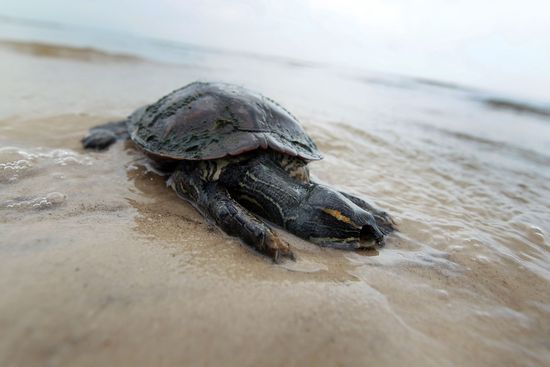
National Review is still for drilling, but even they refuse to repeat the Palin mantra:
“Drill, baby, drill,” has lost whatever usefulness it may have had as a slogan.
I can perfectly well understand the cost-benefit analyses of off-shore drilling and in purely economic terms, I'm inclined to believe that National Review is broadly correct. But I have to say that watching this ghastly slick spread over the Gulf makes me pause. Even if it makes economic sense to keep drilling for the time being, even if a growing economy will require carbon fuels for decades, even if we have yet to find a way to develop non-carbon energy that can easily replace carbon at a reasonable price … does not the sight of this wound in the deep sea prompt us to look again at the models we simply assume about life on this planet?
I'm not talking here about the logic once one has conceded the modern world's attempt to master the earth as a resource so as to create the fantastic wealth and technology and health many human beings now have access to. I'm talking about a humbler view toward the moral and ethical cost of such an achievement. In the words of T.S. Eliot,
A wrong attitude toward nature implies, somewhere, a wrong attitude towards God . . . . It would be as well for us to face the permanent conditions upon which God allows us to live on this planet.
This planet is clearly resilient. But we know now in ways we didn't know at the beginning of this era of mastery of our global domain (a split second in the entire history of humanity) that it is not invulnerable to humankind's ambition and selfishness. We can debate the costs and benefits of a carbon tax or a cap and trade regime, we can hope for a medium term arrest in the global population, we can hope for a technological miracle, we can reassure ourselves by examining far greater ecological and environmental shifts and ruptures in the ancient past, we can see how economic growth may be the only way to mitigate the damage of economic growth … and yet unease persists.
These wounds, these temperatures, these destructive weather patterns are symptoms of a planet in distress. At some point, those of us who see our relationship to the natural world as something more than mere economics – as something sacred – need to face up to the fact that our civilization is not taking this sacredness seriously enough. When do we ask ourselves: by what right do humans believe we can despoil the earth for every other species with impunity? By what self-love have we granted ourselves not just dominion over the earth but wanton exploitation of its every treasure?
Is there no point at which we can say: this is enough?
(Photo: A dead turtle lies in the surf as concern continues that the massive oil spill in the Gulf of Mexico may harm animals in its path on May 3, 2010 in Bay St Louis, Mississippi. It is unknown if the turtle died due to the oil spill. Oil is still leaking out of the Deepwater Horizon wellhead at an estimated rate of 1,000-5,000 barrels a day. By Joe Raedle/Getty Images.)
The Hollow Shell Of John McCain
The man who voted to allow the CIA to do to prisoners what the Vietnamese once did to him now favors shredding any constitutional rights for an American citizen suspected of a terror attack. Yes, he picked Sarah Palin. And why not? When you're as cynical and as power-hungry as McCain, what else matters but whatever works for now?
The Times Square Bomb, Ctd
How Will This Spill Be Different?

A reader writes:
I was a young man living in Britanny during the Amoco Cadiz disaster, which spilled 6 times more oil than the Exxon Valdez. The Amoco Cadiz resulted in a judgment against Amoco in 1990 for – are you ready for this? – $120 million dollars, probably 1/20th the actual cost, if that. The only way to stop this is to make the company pay for the *full cost* – and yes, that's many billions of dollars. It's not like they can't afford it. As long as it's far more profitable to take the financial hit on a spill than to prevent it, this kind of thing will continue to happen. Why would it stop?
The federal government is set to bear the overwhelming cost of the cleanup, but* Brad Plumer sees reform on the horizon:
… Senators Robert Menendez, Frank Lautenberg, and Bill Nelson are now pushing the "Big Oil Bailout Prevention Act," which would raise the liability cap on economic damages from $75 million to $10 billion. Given that BP is already spending $6 million per day on cleanup, that would be a huge deal. Presumably one argument for raising the liability limit is that it would give rig operators even more incentive to invest in safety measurers—especially in light of reports that BP fought against requirements to invest in a $500,000 remote-control shutoff switch.
(Photo: BP CEO Anthony Hayward peers out a window before leaving the U.S. Department of the Interior May 3, 2010 in Washington, DC. Hayward and other BP executives were meeting with Interior Secretary Ken Salazar, Homeland Security Secretary Janet Napolitano and others about the recent deepwater oil rig explosion and subsequent leak in the Gulf of Mexico. By Chip Somodevilla/Getty Images.)
*Update from a reader:
It appears that you may be conflating the $75 million cap on economic damages with the cost of the cleanup. The Oil Pollution Act says that the responsible party pays for all of the cleanup costs. Talking Points Memo did a summary on who pays: "There are two broad categories of costs associated with the catastrophic BP Gulf oil spill: one is cleanup; the other is damage caused by the oil — to shoreline property, local tax revenues, the fishing and tourism industries, and other businesses and individuals." The latter category is where the "who pays?" question gets really complicated.
Quote For The Day
“Immigration has gone up which is creating friction within communities. The country is getting bigger and messier. The role of ministers has gone bureaucratic and the action of ministers has gone downhill — it is corrupt. The loss of social values is the basic problem and this is not what the Labour Party is about. I believe Gordon Brown has been the worst prime minister we have had in this country. It is a disgrace and he owes an apology to the people and the Queen,”- Labour candidate, Manish Sood, running for the safe Tory seat of North West Norfolk.
The Exposure Of Torture
A breakthrough in Britain: MI5 and MI6 will not be able to keep evidence in a civil trial secret because it pertains to their alleged collusion in the Bush-Cheney torture policy:
In their ruling, Lord Neuberger, master of the rolls, Lord Justice Maurice Kay, and Lord Justice Sullivan said that accepting the case of the security and intelligence agencies would amount to "undermining one of [the common law's] most fundamental principles".
"A further fundamental common law principle is that trials should be conducted in
public, and the judgments should be given in public.
"In our view the principle that a litigant should be able to see and hear all the evidence which is seen and heard by a court determining his case is so fundamental, so embedded in the common law that, in the absence of parliamentary authority, no judge should override it, at any rate in relation to an ordinary civil claim …"
Moreover, the judges said, if a party was to win a case where the evidence was heard in secret, there was a "substantial risk" that it "would not be vindicated and that justice would not be seen to have been done. The outcome would be likely to be a pyrrhic victory for the defendants whose reputation would be damaged by such a process, but the damage to the reputation of the court would in all probability, be even greater."
Showing Their Hands
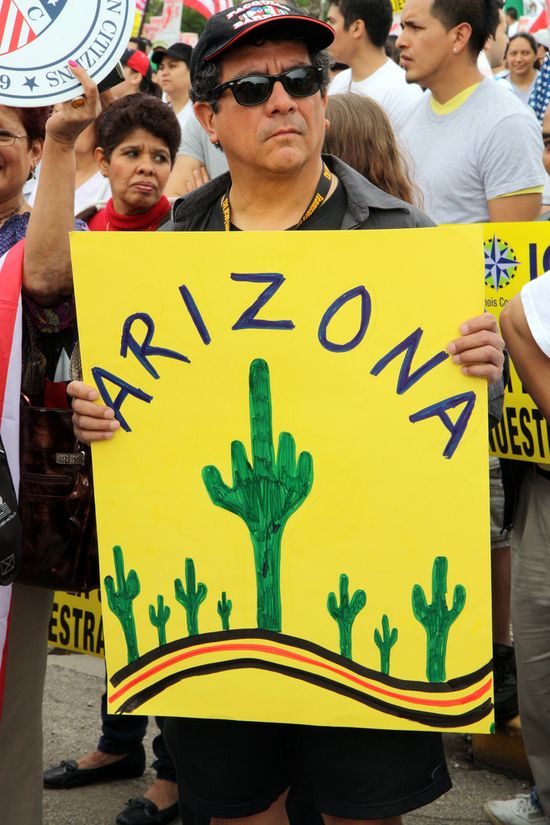
Gerson addresses conservative writers in the wake of several revisions to the Arizona law:
It must be awkward to have risen to the vigorous defense of legal language that even its authors, in the end, could not defend. But the law’s advocates are making the best of things out on their sawed-off limb. The law is now more “explicit” about its true intention. It is a “clarification.” But this isn’t a clarification; it is retreat. The authors of the Arizona law initially wrote it as broadly as they thought they could get away with. But they were caught. Their retreat does not confirm their intentions were good. It confirms that the original law was deeply flawed — a dramatic, disturbing overreach.
Despite the revisions, Gerson admits that they "do not address all the problems and ambiguities in the law — and are not likely to end the controversy surrounding it." Dara Lind agrees.
(Photo by Carrie Sloan. More protest signs here and here.)
Cheney And The Gulf Spill
Bill Galston asks:
So here’s my question: what is responsible for Minerals Management Service's (the division of the Interior Department responsible for offshore drilling) change of heart between 2000 and 2003 on the crucial issue of requiring a remote control switch for offshore rigs? What we do know is that unfettered oil drilling was to Dick Cheney’s domestic concerns what the invasion of Iraq was to his foreign policy—a core objective, implacably pursued regardless of the risks. Is there a connection between his infamous secret energy task force and the corrupt mindset that came to dominate a key program within MMS? Would $500,000 per rig have been regarded as an unacceptably expensive insurance policy if a drill-baby-drill administration hadn’t placed its thumb so heavily on the scale?
 The Dish