The situation of the United Kingdom in fiscal terms is in fact worse than the situation of Greece. That may come as a surprise to you, but if you look at the most recent paper on the subject published by the Bank for International Settlements, it is very clear. The trajectory of U.K. public debt over the next 30 years, absent a major change of policy, will take it to a mind-blowing 500% of GDP, which is about 100 percentage points worse than Greece. If Britain had done what many right-thinking people thought it should do and joined the euro, the situation of Britain would be worse than that of Greece today. The only reason that Britain isn’t an honourary member of the PIIGS club, along with Portugal, Ireland, Italy and Spain, is that it stayed outside the eurozone and therefore reserves the right to debase the currency as an exit strategy. I don’t know about you, but I don’t find that very cheery as a prospect
So, Britain has a massive fiscal crisis that is just about to break. Whoever wins this election … they are going to have a ghastly task on their hands to try to reform a system of entitlements and welfare and state subsidy that has hugely expanded under Gordon Brown since 1997.
The final Tory PEB (public election broadcast) above. Contrary to earlier reports, Cameron says marriage equality isn't in the cards:
Mr Cameron said that he was not planning to rename civil partnerships as civil marriage, as some papers had been speculating.
"We are not planning that. I think that civil partnerships are excellent thing because they give gay people the opportunity to form a partnership and have some of the advantages of marriage. I think that is right. I am very happy to have a look at how we can take policy forward… but I think where we are at the moment, I think has dealt with one of the great unfairnesses. So we should look to the future cautious about whether we can build on that."
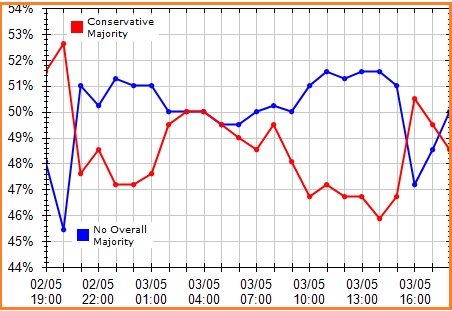
Mehdi Hasan blames Cameron for letting a "a 28-point poll lead more or less disappear":
Cameron is the longest-serving of the three party leaders – and, if a week is a long time in politics, then four and a half years is an eternity. That he is still struggling to stay ahead – against an unpopular and unelected prime minister, at the helm of a party in office for the past 13 years – is a damning indictment of his poor leadership. As one cabinet minister pointed out to me a few days ago: "Cleggmania is a distraction. The real, unreported story of this election campaign is how David Cameron failed to pull away – even before the debates."
Alex Massie and John O'Sullivan are debating why the Tories aren't doing better. Here's John O'Sullivan:
I think that the Tory leadership as a group forgot how to manage its "broad Church" coalition. They went from realizing that the base was insufficient for victory to believing that it was an obstacle to victory. In pursuing centrist voters they were insouciant about losing voters to their right. Their desire to demonstrate Tory support for public services led them to embrace Labour's budgetary strategy until shortly after the roof fell in. And they tried only fitfully to integrate their new ideas into the party's tradition and sense of itself. Not only did this approach drive some traditional conservatives into UKIP, but it also gave an impression of inauthenticity and even cynicism. It prevented the Tories from deriving any political benefit from Labour's budgetary implosion. And it may even have prepared the ground for the Lib-Dem surge by validating their brand of politics in advance-but I concede that's a stretch. Mr. Massie thinks that the problem is that the leadership did not pursue the strategy of alienating the base consistently and vigorously enough to convince centrist doubters. We will have to differ.
[Y]es, it is a worry (from a Conservative perspective) that the party may not win much more than 35% or 36% of the vote on Thursday. If it does worse than this then, yes, Cameron's critics will consider themselves vindicated and they may have a point. Nevertheless even if we end up considering Project Dave a failure that doesn't mean an alternative strategy – one that might win support from Peter Hitchens and Simon Heffer for instance – would have prevailed or done any better. I suspect it might have done very much worse and that the Conservatives could have been fortunate to win even 30% of the vote in such circumstances.
Life is often incremental. In each age, many things get better and some worse, and it is rarely clear whose ideas are right at the time.
I think David Cameron, at his best, thinks like this. If he wins the election this week – as his confident body language on television today certainly suggested he expects to – he will avoid grand promises and schemes. Rhetoric falls badly from his lips because it implies a certainty he cannot share. The Big Society and – worse – the Great Ignored are phrases of his that failed in this election because they pretended to offer some all-encompassing Conservative theory of progress. No such thing exists. Cameron used a better and modest line today in his BBC interview to describe his intentions: "quiet effectiveness". That is what he would want a Tory government to offer; a series of rolling judgments, often small, sometimes contradictory when compared ideologically, which might amount to a modest but sustained improvement in the condition of the country.
When I suggest to Cameron that he intended to 'detoxify’ the Tories, he visibly winces. 'I don’t use the phrase because it’s not just as simple as let’s put a lick of fresh paint on an existing car; it’s more a case of taking all the good bits of the old car and building a modern car.’ He talks about 'lighting the touch paper’ to a vision of 'compassionate conservatism’ that is actually part of a deep-seated Conservative tradition of social reform that goes back to Peel and Disraeli.
'I’ve always found it very condescending, this idea that you have to be left-wing in order to be compassionate. I think the Conservatives are deeply compassionate because we understand that the things that actually deliver a more compassionate society are things like families and good schools. The party has modernised and is more in connection with the country it seeks to govern, but the core beliefs that the good society is the responsible society, that government can’t do everything, that communities need to do more together, that is as old as the hills.’
An inspiring video in support of the Lib Dems above. Renard Sexton looks at Clegg's options:
[If] the Liberal Democrats want to govern at some point – and it seems that Nick Clegg sees it this way – a simple reform to the electoral system that will bring modest returns to the party at best may not be they way to go. Perhaps they should set their sights on knocking Labour out as much as they can this election — effectively conceding 2010 to the Tories, but building their chances for long term success in the next decades.
Nick Clegg will not bring down the government: he has more to lose from a second election than Cameron. I suspect there is enough gas left in the LibDem bubble to last until Thursday – Clegg may raise his tally of MPs from 62 to 80 or even 100. He still enjoys the novelty factor: he is not well enough known to be disliked. This will change. You can bet that, in a second election, he would kiss goodbye to his new recruits. It is Cameron that would have a gun against Clegg’s head, not vice versa.
Clegg is hampered by the democratic structure of his party, the manifesto is written partly by the activist membership, many of whom are radical left-wingers – the infamous weirdie beardies. Clegg emphasises all the vote winning right-of-centre policies on television; cutting personal taxes, putting more police on the streets, cutting back the health and educational bureaucracies. His party has also saddled him with a manifesto that is soft on sentencing criminals, backs banning-the-bomb and joining the euro policies.
The wider Lib Dem campaign has not been very effective. It is as though party strategists were as much taken by surprise as everyone else by their man’s success in the first debate. Clegg has continued to be relaxed and generally strong on the trail, but back in London the party should have flooded the gaps left by their enemy (the two old parties) with initiatives and practical populist policy pronouncements to emphasize there was more to this than a post-debate bubble. They didn’t.
James Macintyre calls Brown's speech today (clip above) his best of the campaign:
Brown, speaking as I type, is genuinely moved. He looks angry about poverty, determined and serious. As he talks through his values, imbued in him by his church of Scotland father, "bigot-gate" seems a very long way away. As he talks of the minimum wage, the audience are going wild for him, even more so than they did for Nick Clegg.
This is Brown at his best. Labour strategists will wish he could be like this all the time, and certainly in the next couple of days.
[If] you live in one of the 100-plus Tory/Labour marginals, just remember that if you go to bed with Nick next Thursday, you wake up with silken-skinned Dave on Friday morning, and that voice will be slipping through our brains for a few years, announcing change that will damage the economy, public services, and generally take our country backwards to the kind of Britain [David Cameron] really believes in.
The overall picture is one of an Iranian economy that is heavily straight jacketed already. The current government is largely to blame. Based on the regime's track record of incompetence and the consequences of that incompetence for the Iranian economy, the U.S. would be wise to take a step back, allowing Iran to continue on its present course. As its position grows weaker, the U.S. position would grow stronger, shoring up American diplomatic leverage or at least making Iran easier to contain or deter. The U.S. would also sidestep accusations that its policies had contributed further hardship to the Iranian people. Congress is searching for the most effective means to weaken the Iranian economy; the best approach may be for it to do nothing at all.
Anyone who tries to set a vehicle on fire in Times Square on a warm Saturday night is going to make news in a big way. Presumably that was the primary goal of the perpetrators—to attract attention, to spawn fear. The very amateurishness of the attack—unlike the Christmas Day attack, for example, it does not immediately call into question the competence of the government’s defenses—offers President Obama the opportunity to start talking back to terrorists everywhere in a more resilient, sustainable language than he has yet discovered. By which I mean: They intend to frighten us; we are not frightened. They intend to kill and maim; we will bring them to justice. They intend to attract attention for their extremist views; the indiscriminate nature of their violence only discredits and isolates them. They intend to disrupt us and throw us into fits of media-saturated hysteria; we will remain vigilant, but we will also keep their unsuccessful attempted murder in perspective. Something like that.
I have a friend – one of my very best, actually – who I affectionately refer to as my "anti-me". She is everything I am not.
She is Republican, Evangelical, Christianist, and Liberty University educated. She married at 22 followed in short order by 2 kids. She lived in the suburbs when we met and now lives in a rural area outside of a very small town. She is homophobic, anti-abortion, and a Tea Party sympathizer. She loves Sarah Palin. She thinks Barack Obama is an over-educated socialist who is trying to ruin America.
I am a Democrat, a skeptical Catholic, never been married and with no kids. I live in the city and can't imagine living in a small town. I have gay friends and gay relatives and I am pro-gay marriage. I am pro-choice. I think Sarah Palin is an uneducated extremist who is trying to ruin America (to say the least). I voted for and continue to support Obama.
There is no reason that we should be friends. But we listen to each other. We talk, civilly, about the things we disagree about but it doesn't dominate our friendship. We respect each others' viewpoints, even when we think it is the craziest thing we've ever heard. I think I have become a better, more intellectually well-rounded person because I know her. I am less quick to judge and more open to hearing new ideas. I challenge my own beliefs more and I am better at examining view points I oppose.
Remember the TRAX music magazine print ads featuring young amateur critics displaying their aural displeasure by barfing out of their ears? Well, here, finally, is the accompanying retched spot. Pretty French girl is being wooed at an apartment party by jerk with bad haircut—which ends up being not nearly as bad as his voice; he sounds like Russell Brand in Forgetting Sarah Marshall. Besides the spot being about 30 seconds too long, the girl, duh, should have been the ear-puker. Btw, did you know that a year-long study discovered that vomiting is the world’s worst sound? French hip-hop didn’t make the list.
A reader takes issue with Mearsheimer's protestation that
Nevertheless, a Jewish apartheid state is not politically viable over the long term. In the end, it will become a democratic bi-national state, whose politics will be dominated by its Palestinian citizens. In other words, it will cease being a Jewish state, which will mean the end of the Zionist dream.
My reader writes:
This is naïve. Assuming no genocide, the American South ran an apartheid state for almost a century. You can look at America’s historic treatment of Blacks and Indians to see where Israel is headed.
The influence of America and Europe is declining, and the international consensus on human rights against practices such as torture and rendition has unraveled. Assuming a shift in alliances, do you think China or Russia would care what Israel did to its Palestinians?
The militants aren’t afraid to kill, maim, or steal. Others, perhaps a majority, don’t agree with the militants' tactics, but aren’t about to stick their necks out. They’re also not going to mind if the problem just “goes away.” We’re on the brink of a brave new world of brutal nationalistic struggles—think early nineteenth century Europe on an International scale with nukes.
I fear my reader is right. The "forever war" is the point. Hussein Ibish sees the following scenario as the likeliest:
[Mearsheimer] takes a perfectly reasonable observation — that because of the occupation Israel is charging headlong down the path towards self-destruction — which is undoubtedly true, but attaches to that accurate assessment the weird corollary that this somehow means Palestinian victory. As I keep saying, again and again, it is entirely possible for either or, quite possibly, both sides to lose everything in this conflict. Nothing about it is a zero sum.
Just as both Israelis and Palestinians require a peace agreement to secure a reasonable future, both of them are likely to face wretched futures as far as the imagination can justifiably be stretched in almost any scenario likely to be produced by a lack of peace (leaving aside, of course, science fiction-like fantasies that have no relation to the political and other forces that actually produce outcomes).


 The Dish