The leader of the conservative movement in America, whom no one in the GOP dare cross, now says the rig explosion in the Gulf was detonated by those opposed to off-shore drilling in the energy bill. See if any leading Republican knocks this down. Or is this merely "entertainment"?
Month: May 2010
“Suspected”
TNC counters Frum:
Defenders of the law will say that police still have to stop you for something, and they still have to "suspect" that you did something.
Forgive, but I don't find that comforting. Amadou Diallo is dead because the police "suspected" he was drawing a gun. Oscar Grant is dead because the police "suspected" he needed to be tased. My old friend, Prince Jones, Howard University student and father of a baby girl, was murdered by the police in front of his daughter's home because police "suspected" he was a drug-dealer. (The cop was not kicked off the force.) Only a year ago, I was stopped in Chelsea, coming from an interview with NPR, because police "suspected" I was the Latino male who'd recently robbed someone.
This comes down to police power, and how comfortable you are with its extension. George Will, in a bit of populist demagoguery, implies that the critics of the Arizona law are people who only know illegal immigrants as cheap labor. But I suspect Will mostly has the exact same relationship with illegal immigrants. Moreover, I suspect that he only knows the police as the kind of Officer Friendlies who only arrest "the bad people."
Quote For The Day III
"Jay’s got The Tonight Show. I have a beard and an inflatable bat. And I’m touring city to city. Who can say who won and who lost?” – Conan O'Brien.
Dead In The Water
Paul Tullis criticizes the NYT for pushing the "Obama's Katrina" meme and spells out the differences between the oil spill and the hurricane. John Hinderaker – surprise! – takes the other side. Michael Roston also casts a critical eye on the administration's preparedness. The NYT follows up with more scrutiny. Ambers, meanwhile, predicts that "offshore drilling is dead in the water as a policy anytime soon, much like the Three Mile Island accident soured politicians and the public on nuclear power."
Pascal-Emmanuel Gobry cautions:
[T]he fact that an activity carries risk does not mean it is ill-advised. It does mean that precautions must be taken. “Drill baby drill” is a simplistic slogan, but thinking “drill baby drill” is made wrong by one oil spill is equally simplistic — and we don’t want to be as simplistic as Sarah Palin, do we?
Room For Debate also focuses on costs and benefits. Here's Matthew Kotchen, an environmental economics professor:
In terms of benefits, the amount of oil under consideration is so small compared to domestic consumption that we can confidently dismiss all arguments about decreasing prices and reducing our reliance on imports.The real benefit is that oil is worth a lot. And this is why the Obama administration sees an opportunity. Sizeable revenue from the sale of offshore leases can help build political and financial support for more comprehensive climate and energy policies.
Dreher looks at the local impact:
I don't see how it's avoidable that this spill is going to have major, major impact, and not just on the coastal environment. According to the Louisiana Wildlife and Fisheries department, the Louisiana seafood industry is worth $265 billion annually "at the dockside," and beyond that has a $2.3 trillion economic impact. The state's budget was already in dire shape, with dramatic cuts to higher education and state services on their way for next year … and now the state is faced with the possible destruction of its fishing industry. The economic pain could be extreme — likewise for the coastal tourism industries in Mississippi, Alabama, still struggling to recover from Katrina, and perhaps even the Florida Panhandle. The entire nation benefits from the oil harvested from Gulf waters, but now the cost of it is going to be borne in a particularly horrible way by Louisiana and neighboring states.
More along these lines from Nicole Allan. And from John Besh. Lisa Margonelli advocates:
The oil spill in the Gulf is horrific and it's very likely it'll get worse. While locals get to work scrubbing the oiled birds with Dawn dish detergent, a fracas will begin in Washington. Generally speaking this is an opera called "The Punishment," and for the last two major oil spills of great political consequence (Santa Barbara in 1969 and the Exxon Valdez in 1989) it involved a moratorium on drilling somewhere in the US. The problem with this, as I lay out in an op-ed in today's New York Times, is that we basically shift drilling and its risks to other countries. (The figure that the Niger Delta, roughly the size of England, has suffered the equivalent of an Exxon Valdez of spilled oil every year since 1969 ought to make us cry.)
This time we need to use the political will generated by this really awful event to implement a comprehensive plan to reduce American dependence on oil.
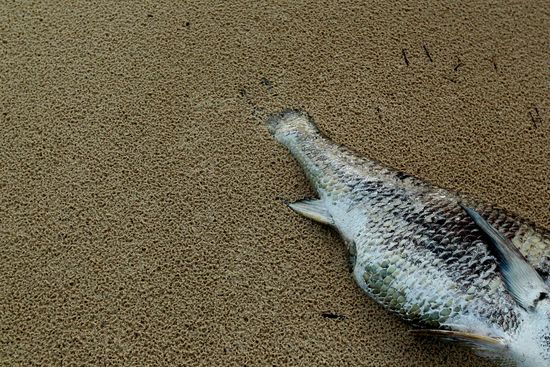
(Image: A dead fish lies on the beach as concern continues for the creatures that are in the path of the massive oil spill in the Gulf of Mexico on May 3, 2010 in Gulfport, Mississippi. It is unknown if the fish died due to the oil spill. Oil is still leaking out of the Deepwater Horizon wellhead at an estimated rate of 1,000-5,000 barrels a day. By Joe Raedle/Getty Images)
Yglesias Award Nominee
"Think about what the environmentalists have always said about this. Is it’s not a matter of if there’ll be a disaster of this kind resulting in this kind of offshore drilling, it’s only a matter of when. This verifies that argument, and becomes a powerful factor in the debate over what to do next. I don’t see any way around the political reality that this will set back the cause of offshore drilling in the United States," – Brit Hume, a drilling advocate.
Quote For The Day II
"My wish is that we be made chaste, continent, and thrifty — but not yet," – Paul Krugman.
The GOP vs Gays And Latinos
"I've been thinking I might leave the party. A lot of my Latino Republican friends have been talking about it after this law," – Adam Bustos, a third-generation Mexican-American, who has voted Republican since Ronald Reagan ran for president.
The GOP is now doing to Latinos what it did to gays. Its leaders – by backing the Federal Marriage Amendment in the last decade and now the Arizona law in this – are essentially saying that they do not understand how these measures could impact a minority's collective psyche. Whatever the technical merits of either measure – and there were intellectually coherent (if, to my mind, unpersuasive) defenses of both – the lack of empathy or understanding is the real issue. It places the Republican "us" against the minority "them." This is not just a failure of empathy; it is failure of judgment. The votes of Latinos will be massively important in the very near future, and the number of people who know and love gay people grows daily.
The Republican base's inability to place itself in the shoes of homosexuals who are being told they could be second class citizens for ever or in the shoes of Latinos being told they are effectively guilty before being found innocent is a fatal moral and political gambit. Once your party has revealed that it cannot empathize and is willing to stigmatize an entire minority, it takes decades to reverse the damage.
British Muslims For The Tories
Just to blow Mark Steyn’s mind. To the tune of “I vow to thee, my country.”
“Some Things About Our Culture Are Non-Negotiable”
Bill Maher delivers a passionate and patriotic defense of free speech:
Mexican Exceptionalism
Ross describes the downsides to having a whopping 57% of illegal immigrants come from one country:
A more diverse immigrant population would have fewer opportunities to self-segregate and stronger incentives to assimilate. Fears of a Spanish-speaking reconquista would diminish, and so would the likelihood of backlash. And instead of being heavily skewed toward low-skilled migrants, our system could tilt toward higher-skilled applicants, making America more competitive and less stratified.
 The Dish