A Memo To Conservative Hawks

Bartlett asks when neoconservatives will wake up and recognize the debt is a national defense issue:

Republicans primarily concerned about national security ought to be in the forefront of efforts to raise revenues to reduce deficits, free up domestic saving for domestic investment, and reduce the importation of foreign saving and the trade deficit. But so far they are not. They remain loyal to the Republican obsession with tax cuts and a refusal to raise taxes in any way for any reason. However, I think my national security-minded friends are soon going to discover that massive defense budget cuts will necessarily be a big part of the price that will be paid for not raising revenues.

“Why Rand Paul Matters”

A reader writes:

While I think that Rand Paul was smart to take a step back from the national microphones and skip this week's "Meet the Press," I think his decision highlights a larger problem: politicians on the right will not venture beyond the safe confines of Fox News.  MSNBC's Joe Scarborough rhetorically asked this question on his show on Friday: "What the hell was Rand Paul doing on MSNBC?"  That says it all.  As you have chronicled much on your blog about the separation between red and blue states, this is just another nail in the coffin of debate in this country.  When the right and left of this country will not share the same TV shows to discuss or debate the issues facing our country, we all lose.

Yglesias Award Nominee II

“When the comparative impulse becomes primary, accounting becomes apologetics. The really striking thing about the ethical texts of the Jews in exile is the extent to which they are silent about the adversity that the writers of these texts were regularly experiencing. For most of two millennia, the Jews had the standing alibi of anti-Semitism, if they wanted to take it up; but they did not want to take it up. They held themselves to the highest standards of conduct and then proceeded to the business of safety. One is not better merely because others are bad. And the better is not the same as the good,” – someone who was once called Leon Wieseltier.

Guilty Of Being Gay

Autumn Sandeen notes that Tiwonge Chimbalanga, who was given a 14 year sentence last week under Malawi’s anti-homosexuality law, identifies as a woman. Sandeen believes that "we can safely say that from past coverage by the LGBT press and LGBT blogosphere that this story would not have gained as much traction in LGBT media if this were considered a transgender or intersex story". But Jim Burroway isn't sure that either the gay or transgender label fits:

It turns out that in many traditional cultures, it may be more acceptable for women to take on what westerners perceive as “masculine” traits, and for men to take on what westerners would label more “feminine” traits. Which means that many of the external peripheral markers that we use to understand the contours of our masculinity or femininity become less important in many traditional cultures. But in these non-western cultures, gender roles — what men and women do as opposed to who they are — are considered much more important in defining what is a man and what is a woman. Against that realty, our understanding of gay/straight/transgender/whatever has only a passing relevance.

How The Taliban See The War

Packer reviews the memoir of Abdul Salam Zaeef, who served as Afghanistan's ambassador to Pakistan during Taliban rule. Zaeef was detained for three years at Gitmo and released without charge. Packer calls his memoir, My Life with the Taliban "perhaps the best, and maybe even the only, way for readers here to begin to grasp the world view of this xenophobic and opaque movement."

Keep in mind that Zaeef is sometimes referred to as a moderate:

The Americans have won the hatred of all Afghans, he concludes, and will lose the war as the Soviets lost theirs: the whole world is turning away from the U.S. and coming to see the justice of the Islamic cause. Like any religious revolutionary, Zaeef is certain that history and faith will soon rhyme. His entire story is saturated in righteousness; all the hardships he endures are redeemed by the solidarity of the faithful, whose superiority to non-Muslims is taken for granted. Zaeef doesn’t even pay lip service to the notion of equal rights for all: the only outrage is what’s done to Muslims, because they are Muslims and better than the rest of humanity. This world view is founded on such chauvinism that Americans, with our automatic assumptions about equality, might fail to notice it. “My Life with the Taliban” shows that, while all wars are foolish, some wars are not a matter of mere misunderstanding—that beneath the superficial differences of clothing and facial hair lie more profound differences that can’t be reconciled.

“An Uncluttered Life”, Ctd

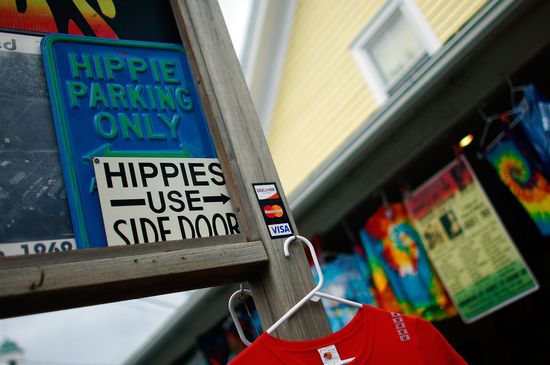
HIPPIESMarioTama:Getty

A reader writes:

The one thing Harry Reasoner got right in his diatribe against hippies was the work ethic that blossomed in San Francisco in the sixties, the tendency to "approach work the way the rest of us do sport." That attitude, about which Reasoner was so dismissive, shaped the cultures of technology and philanthropy and even influenced investing in Silicon Valley and beyond.

John Markoff chronicled the connection between computing and the "counterculture" in his 2005 book, What The Dormouse Said. Markhoff revealed what everyone in the Valley has always known, that the counterculture was not limited to runaway kids dancing and screwing in the park. The researchers at SRI and other research facilities in the area were getting high and fighting the status quo. They sent their kids to the famous Peninsula School in Menlo Park by day and went back in the evening for meetings of the HomeBrew club where they discussed how the computer would be a tool for personal and communal transformation.

Many of those HomeBrew guys went on to build world changing technologies and launch successful companies (I know – I live with one).

They marched against the war, read Stewart Brand's Whole Earth Catalogue, joined The Well and donated money to land trusts that have preserved significant open spaces along the coast and in the Bay Area hills. Their idealism is still embedded in the way programmers and user interface engineers think and produce.

While the smug Reasoner was lamenting, "when one thinks of the problems of our day that the cry for attack, imagination and youthful energy this seems like the greatest waste of all…" the seeds of digital connectivity were being planted and things we take for granted, like graphical interface and the computer mouse, were being developed. Sure some people burned out like Jerry Garcia but most of those kids in the park didn't. They followed Stewart Brand, Steve Jobs and Don Knuth, men who are very different from one another but who share connections to the counterculture. They, more than the Grateful Dead, shaped our world. Just as the MSM misses much of what is significant today, settling instead for name-calling and breast-beating, Reasoner missed the real story.

(Photo: A souvenir shop is seen as the 40th anniversary of the Woodstock music festival approaches August 13, 2009 in Woodstock, New York. On August 15-17 in 1969 an estimated 400,000 music fans gathered on Max Yasgur's farm in Bethel, N.Y. for the most celebrated music festival ever. While the original Woodstock concert was held in Bethel, the festival was conceived and originally planned for the town of Woodstock, which was and remains an artistic community. By Mario Tama/Getty Images)

Jesus And Christ, Ctd: “The Corpse Stood Up”

A reader writes:

I am a Christian because I follow Christ before anyone else (not to say I don’t believe that we have a lot to learn from the other faiths!), and there must be a reason for that, in my opinion.  Dali_Crucifixion_hypercubeIf Jesus was little more than a uniquely-adept Jewish mystic with a profound experience of the Divine (God-as-“Daddy,” a pretty great idea), then while that is profound, it’s no reason for me to follow him uniquely as opposed to the path of the Buddha, the Hindu mystics, or the Kabbalah.
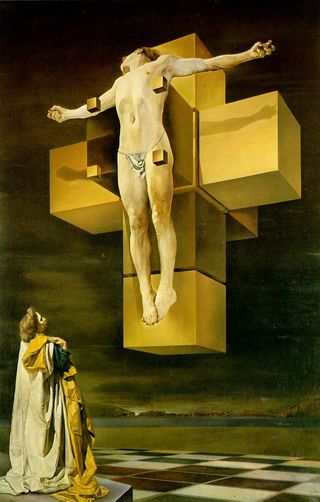
I could follow him as one sage among many, but not as something unique. 

This is fine, mind you, but let’s not kid ourselves by saying that we (or anyone else of any other faith, for that matter) could keep our special spiritual identity in this way.  We fall into an amorphous blob of “Jesus, Buddha, Muhammed, and the Gita are all saying the same thing!” philosophy, and while that may be good for the Kumbayah campfire, it’s not good for serious scholarship in comparative religion (Protherto is making the rounds with this point, thank God).

This is where the Resurrection comes in, I think.  I don’t believe the early Christians viewed this as a purely spiritual phenomenon (see research into the Semitic Totality Concept for just one reason why), but something real and physical (one of the earliest Christian creeds that we have on record is a bit crude about it, in fact, saying that, in regards to the Resurrection, “the corpse stood up”).

It was the thing that separated Jesus from all the other miracle-working Torah commentators of his day (as stated previously, if one just takes Jesus at face value, he’s pretty unremarkable).  The Resurrection divinizes Jesus and humanizes God (the most amazing part, I think), and as such, makes Christianity unique.  To say that there was a first-century Jew wandering the highways with whores and fisherman and breaking the bureaucracy of his religion and drinking like a fiend and bringing God to the masses is one thing.  To say that it was God that was doing all that is quite another.

Therein lies Christianity’s real trump card.

It’s not that we have a unique experience of God, it’s not that we have a monopoly on God, it’s not that our ceremonies and rituals are better (they’re pretty terrible sometimes).  It’s that God knows what it’s like to be a human being.  God eats, drinks, sleeps, cries, gets angry, bleeds, dies, and then shows us that death is not the end.  If we’re to believe the whole “We are the Body of Christ” bit, too, then that means this mystery is continuing.  Our eating, our drinking, our joys, our sufferings, and our deaths are all our participation in the life of God, and God’s participation in ours.

If Jesus did not rise, if he really was just chewed up by dogs after the crucifixion, then let’s be honest about it, see Christianity for the bankrupt system that it is, and move onward into other faiths of our choosing (I’ll probably be bathing in the Ganges.)  I can’t do this yet, however, because I believe the scholarship doesn’t allow it.