Not a Ricky Gervais podcast. Better.
Month: May 2010
Chart Of The Day
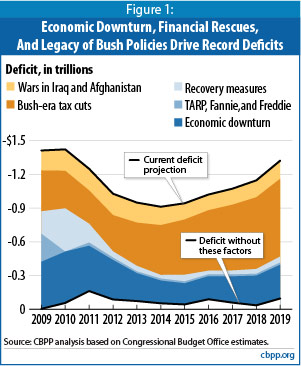
Yes, the debt largely is Bush's fault. – and his predecessors'.
That Screeching Sound You Hear Is Idealism Meeting Reality
Julian Sanchez has a judicious take on Rand Paul and on Libertarianism more generally:
At the scene of a four-century crime against humanity—the kidnap, torture, enslavement, and legal oppression of African-Americans—ideal theory fails. We libertarians, never burdened with an excess of governing power, have always had a utopian streak, a penchant for imagining what rich organic order would bubble up from the choices of free and equal citizens governed by a lean state enforcing a few simple rules. We tend to envision societies that, if not perfect, are at least consistently libertarian.
Unfortunately, history happened.
Rules for utopia can deal with individual crimes—the mugger and the killer and the vandal—but they stumble in the face of societywide injustice. They tell us the state shouldn't sanction the brutal enslavement or humiliating legal subordination of a people; they have less to say about what to do once we have. They tell us to respect the sanctity of the property rights that would arise as free people tamed the wilderness in John Locke's state of nature. They have less to say about the sanctity of property built on generations of slave sweat and blood.
Libertarians need to think harder about how our principles should degrade elegantly, how they can guide us through a fallen world where the live political options seldom afford a full escape from injustice.
No Talk Of Leaving
Travels With Shiloh attended a recent conference at Fort Leavenworth, the intellectual hub of counterinsurgency doctrine:
While, current U.S. policy states that we'll begin withdrawing our forces in 2011 there was a universal recognition that any real effort to apply COIN in Afghanistan would take a very long time. While the subject wasn't addressed (except for one question at the final Q&A roundtable) my impression was that all of the speakers (British, Canadian and U.S.) were operating under the assumption that forces would be in place well beyond 2011.
I heard no discussion about how to conduct any sort of hand off to the Afghans within 18 months, alterations to COIN theory or doctrine or trains of thought about alternate ways militaries could support/conduct COIN without significant numbers of forces on the ground. I would interpret that to mean that the military has been given the word (explicitly or implicitly) that that 2011 deadline is NOT set in stone. I would, in fact, go further and predict that barring some unforeseen change in the operating environment we will almost definitely have a significant presence in Afghanistan for some time.
(Hat tip: Ricks)
Marriage And The Race Gap
Hewitt Award Nominee
(Hat tip: RWW)
Polling The Coalition
A good start for the Lib-Tory government in Britain.
Where Rand Might Be A Positive Force
Larison has a glowing column on Rand Paul's foreign policy views:
On foreign policy and defense, Paul has said, “One of the enumerated powers is defense. So I believe that the defense of our country may be the primary enumerated power. Does that mean I believe in a blank check for the military? No. Does that mean I believe we have to have troops in 130 countries and 750 bases? No.” If elected, Paul would arguably be the first Senator since Robert Taft to represent the foreign policy tradition of the pre-war Old Right, while also projecting the anti-war spirit of the progressive Republican Sen. Robert LaFollette.
Just to have a fiscal conservative who sees defense as somewhere that can be cut is a step forward for a wider and freer debate in this country. Greg
It's one thing to make the case to the American public that U.S. foreign policy is too meddlesome in other states' business, too quick to reach for punitive sticks and too grandiose in scope and ambition. If that was Paul's message, I suspect it would find a lot of takers. But this is only a piece of what is a larger, more radical frontal assault against the post WWII institutions that, for better or for worse, the U.S. has worked to shape and lead to our general betterment. Some, like NATO, have arguably outlived their usefulness. Others, like the IMF and World Bank, likely need reforms. But a blanket rejection of U.S. participation in all of them just seems ill considered.
Larison bats the ball back over the net by noting that many of these international institutions have facilitated American interventionism. Scoblete parries:
Withdrawing from the UN would not act as a check on interventionism. If anything, given how vociferously hawks like John Bolton denounce it, I suspect it would lead to much more.
What we need is a moderate conservative understanding of defense and national security, aware of threats but not prone to messianism. You know: like Cheney, before he went mad.
The Pernicious Lies Of Sarah Palin III: BP And Obama
A useful reminder that she will say anything, however ludicrous:
According to the nonpartisan Center for Responsive Politics, Republicans receive far more campaign money from the oil and gas industry than do Democrats.
So far in 2010, the oil and gas industries have contributed $12.8 million to all candidates, with 71% of that money going to Republicans. During the 2008 election cycle, 77% of the industry’s $35.6 million in contributions went to Republicans, and in the 2008 presidential contest, Republican candidate Sen. John McCain received more than twice as much money from the oil and gas industries as Obama: McCain collected $2.4 million; Obama, $898,000.
Death In The Gulf
The fact that this disaster has happened slowly and cumulatively makes it no less severe:
Along with the marine toxicologist Susan Shaw, of the Marine Environmental Research Institute, I’ve come to peer into the hidden side of the Deepwater Horizon disaster. Wreathed
in neoprene and with Vaseline coating the exposed skin around our faces, we slip into the clear water in the lee of the boat. Beneath the mats of radioactive-looking, excrement-coloured sludge are smaller gobs of congealed oil. Taking a cautious, shallow breath through my snorkel I head downwards. Twelve metres under, the specks of sludge are smaller, but they are still everywhere.
Among the specks are those of a different hue. These are wisps of drifting plankton, the eggs and larvae of fish and the microscopic plants and animals that form the base of almost all marine food webs. Any plankton-eating fish would now have trouble distinguishing food from poison, let alone the larger filter-feeders.
Onshore, small landfalls of the same sludge have started to cause panic among locals as they coat the marshes. Here, just a few feet beneath the surface, a much bigger disaster is unfolding in slow motion.
“This is terrible, just terrible,” says Dr Shaw, back on the boat. “The situation in the water column is horrible all the way down. Combined with the dispersants, the toxic effects of the oil will be far worse for sea life. It’s death in the ocean from the top to the bottom.”
I have to say I have struggled with how to blog about this. In many ways, it seems to me to be the biggest story of the year, a gaping, unstaunched wound in the planet, emitting death. And yet the prospect of going without drilling seems remote, the possibility of any political will to jump-start alternatives with the impact we need seems just as elusive, and the helplessness of government and industry to stop this nightmare is the most obvious fact (I just assume that BP is doing all it can as of now): all of it makes this story as huge as it is simply despair-inducing.
If we cannot stop this, what else can we not stop?
(Photo: John Moore/Getty.)
 The Dish