Chart Of The Day

Francemarriage

That whole separate but equal thing works both ways:

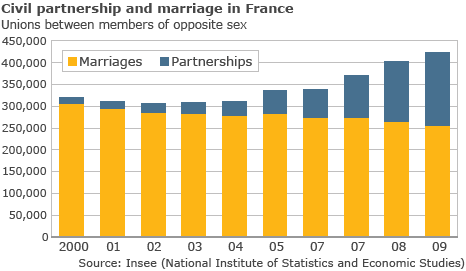
A heterosexual Austrian couple have embarked on a court battle to have their relationship legally recognised as a "registered partnership" – a new form of civil union for same-sex couples….Meanwhile, the kind of pared-down marriage they want is proving a huge hit with straight couples in France, where 95% of couples taking up the pacte civil de solidarite (Pacs) in 2009 were heterosexual. As the number of straight French couples opting for Pacs has grown, the number of marriages has shrunk, to the point that there are now two couples entering into a Pacs for every three getting married.

Apparently many straights feel partnerships are "a low-risk stepping stone to marriage." A quote from a heterosexual Pacsed woman:

"To me, it doesn't replace marriage. I'd still like to get married one day."

(Hat tip: Kincaid)

A Bumpier Ride For The GOP

Another relatively good omen for the Dems, as Meg Whitman's lead in the primary polls collapses in a vortex of negative campaigning:

Meanwhile, Democratic candidate Jerry Brown is waiting in the wings and raising money. And in every recent poll, he's moved ahead of both Republican candidates in general election trial heats. PPIC shows him leading Whitman 42-37 (and Poizner 45-32), after trailing her 39-44 in its March survey. It's unclear whether the recent GOP preoccupation with immigration is having an impact on the Latino vote, though everyone remembers the fallout that afflicted California Republicans the last time this issue dominated their message (in 1994, when Pete Wilson campaigned on Proposition 187, winning the battle but losing the war). Whitman is definitely walking a tightrope on that issue, calling most recently for National Guard troops to patrol the border (not exactly legal, but it sounds good), and running a radio ad in which her campaign chairman–yes, Pete Wilson himself–vouches for her toughness on immigration.

How To Cut The Budget

The Committee for a Responsible Federal Budget has a shiny new budget simulator. Derek Thompson takes it for a spin:

Ultimately the real lesson you learn as you play is that stabilizing debt, even when the method is box-checking, is painful.

I recommend it, if only because you may be surprised by your choices. I did the test quickly, forcing myself to be tougher than I would want to be. It doesn't ask you to perform the impossible; it lays out the real options in front of us and tries merely to get the debt stabilized at 60 percent of GDP by 2018. There are some options that are not there – I'd like to find a way to push the retirement age to 70 – but most are.

My policy preferences cut the debt to 51 percent of GDP in 2018 (compared with 85 percent on its current trajectory), and they did so, it turned out, by raising taxes by a $1.5 trillion and cutting spending by $1 trillion. That's largely because I favor the expiration of the unfunded Bush tax cuts. I could trim my tax hikes a lot though and still make the goal of 60 percent. Give it a whirl.

They Still Don’t Get It, Ctd

Drum admits that "I made up a list of questions about sexual activity and compared them to the question of whether someone is gay. That was a screwup."

But a revealing one. His larger point:

Andrew says he's interested in people's "public identity." And this gets to the core of my disagreement with him. Maybe I'm just mired in a different era, but I believe pretty passionately that people should be allowed a wide latitude to display themselves to the public however they want. There are limits, of course, because lots of aspects of our identities are inherently public — Barack Obama is black, Hillary Clinton is a woman — but this doesn't inescapably mean that we should also be required, as a prerequisite to public service, to make even the less visible parts of our identity visible whether we want to or not. Some of these less visible aspects, it's true, might well affect the way a Supreme Court justice views the law. But that's just logic chopping. Every aspect of identity potentially affects the way a Supreme Court justice views the law. It's the nature of the job. But that doesn't automatically mean that we the public have the right to know every last trace of their personal identities.

My issue here again is the phrase "every last trace". In a gay person's life, his or her orientation, and how he or she has handled it, is necessarily front and center – not some final, small detail.

Many well-meaning and pro-gay straight people do not get this because it is understandably so alien to them. But try a thought-experiment for a second, if you are straight.

Imagine living under the assumption that you are gay for your entire childhood and adolescence; imagine feeling compelled to date someone of the same sex at some point; imagine cultivating an all-encompassing skill at hiding key details of your life, spouse or social circles. Hide that photo on your desk at work; introduce your wife or husband to your work colleagues as a "friend"; remove from your chatter any personal pronouns; never mention children; never tell work colleagues of any social event that might imply straightness. Just try it for a couple of days. Now imagine it for a lifetime.

You think this is dealing with some "last trace" of identity? 

In some ways, I'd argue that the closet makes one's orientation more central to your identity than among openly gay people. One reason I came out of the closet young was that I really didn't feel I had the time to expend so much energy every day constructing and maintaining a lie – and I felt increasingly morally compromised by it. Sustaining the closet for a lifetime must necessarily change you deeply. It reaches into the core integrity of a person, and his courage and self-worth. Closet-cases can enable crime (look at the Catholic church); they can over-compensate by trying to win universal favor at all times; they can subliminally try to prove their straight credentials by opposing gay equality; they can get enmeshed in conflicts of interest which cannot be exposed without exposing their actual reality.

This is why the question matters. And why, much as we might like to, we cannot simply wish it away. 

The only way past this is through it.
Poseur Alert

“I love all animals. I have a fascination with fish, birds, whales—sentient life—insects, reptiles. I actually choose the way I eat according to the way animals have sex. I think fish are very dignified with sex. So are birds. But pigs, not so much. So I don’t eat pig meat or things like that. I eat fish and fowl," – Nicolas Cage.

At The Hour Of Their Death

A reader writes:

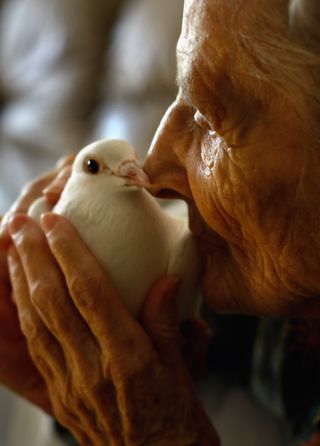
I may have missed the boat on this discussion, but I wanted to email you something since I may have an interesting perspective. I have been a registered nurse caring for hospice patients for the last two years. DOVEJohnMoore:Getty During these two years I've had pretty much a front row seat to some of the most amazingly touching things that I've ever seen in my life ; and some of the most horrific. I have held hands of people as they drew their last breath and plenty of times have had to look up from my stethoscope on a patients chest into the eyes of a family member and tell them that their loved one has passed.

I came into this experience as an agnostic who often had leanings to atheism, but while working with hospice patients my faith in something has been restored. When you are with someone as they die, you feel something. I can't say what it is. There is the remarkable, palpable feeling of departure. No flashes of light, no bursts of choral music, but it is felt. Even when you are not present at the moment of death, when you see someone alive and moments later see them dead, there is an overwhelming feeling that that person is not there.

An experienced nurse had a good way of putting it after I had seen my first patient die (and the first dead body I had ever seen), she said "you really see that we are just flesh animated by spirit". Other things that have caused me to doubt my doubt are things like every so often getting patients who will report visitations from long dead loved ones, and proceed to die a short time after. In the beginning, the skeptical part of my brain tried to explain these things away. Perhaps the human brain isn't used to seeing a perfectly motionless human face? Perhaps we pick up on micro movements even when people are sleeping that are so strange when they are absent on the face of the dead. Could that be the reason there is an immense feeling of the person being gone? Could visitations by long dead loved ones be caused by alterations in brain chemistry combined with a brain desperately trying to cope and rationalize what its going through?

After nights sitting up, holding hands, listening to past life stories, pushing morphine, consoling … there came a time when I felt that perhaps logic falls short. Perhaps the human/ the heart is an adequately calibrated measure to detect the divine. Now I say I believe in "the great I don’t know." Something … I don’t know what. Much better than nothing. 

(An aside: I am a single gay man, and working in hospice has added new levels of frustration and hurt when I hear anti gay marriage arguments. I am lucky to work in a very gay accepting facility, and in part to that, we have had many gay patients pass away at our facility. I have seen amazing commitment shown by the partners of these men and women. People who are up all night with anxious sad loved ones. Guys who are there every waking hour to care for their partners needs. I have found partners on their hands and knees cleaning up poop or vomit to save their partner the embarrassment of having ask a staff member do it. I've held the hand of a crying man as he said " what will I do without him?". Even though I am single, when I hear anti marriage rhetoric, it doesn’t only hurt as a gay man anymore, it hits me in my heart now. The thought that these couples who love each other so much that they stay together till death, staying through shit, tears, anxiety, and vomit to be there for them….. And they can't even get married.)