A Bus Driver’s Red Letter Day, Ctd

A reader writes:

The video of the Danish bus driver and his passengers brought tears to my eyes, literally.  It is incredibly moving to see all these (mostly) blonde, Danish-looking people celebrating with such joy an African immigrant who brings them to and from work and school every day.  On so many levels, the scene is beautiful, but mainly it shows that while we strive and toil and wish and hope for ever more, while we put off happiness hoping for it in some uncertain future, or in heaven if we believe in it, often little daily moments like those are the real "heaven" – the here and now. 

There was once a survey done on who are the happiest people on earth.  If my memory serves me correctly, it was the Danes.  When the researchers looked into why, it turned out that Danes are happy because they have very low expectations and so when something good happens, they are always pleasantly surprised.  Just like I was, with this moving video of a little serenade somewhere in Denmark.

The reader's memory bears out. Another:

Thanks for posting that.  Six months ago, extremists in Denmark were pitching legislation banning minarets.  And of course there was the Muhammed cartoon controversy.  Now a bus driver whose name means "chosen" in Arabic is celebrated by the folks who see him every day.  It's good to see a sense of goodwill, born of community, triumph over the tyranny of the fearful.

Why We Gamble

Jonah Lehrer pegs slot machine addiction to the brain's love of pattern recognition:

[It] helps to think about the slot machine from the perspective of your dopamine neurons. While you are losing money, your neurons are struggling to decipher the patterns inside the machine. They want to understand the game, to decode the logic of luck, to find the events that predict a payout.

But here's the catch: slot machines can't be solved. They use random number generators to determine their payout. There are no patterns or algorithms to uncover; studying our near-misses won't tell us how to win. There is only a stupid little microchip, churning out arbitrary digits. At this point, our dopamine neurons should just surrender: the slot machine is a waste of mental energy. But this isn't what happens. Instead of getting bored by the haphazard payouts, our dopamine neurons become obsessed. When we pull the lever and get a lucky reward, we experience a rush of pleasurable dopamine precisely because the reward was so unexpected.

Lessons Gleaned From Working At The Gawker Empire

Maureen Tkacik, of Jezebel fame, closes her eyes and meditates on the future of the printed/pixelated word. She suggests abandoning authority and productively channeling narcissism:

From a commercial perspective, “branding” has consistently bestowed its greatest rewards on those capable of projecting a kind of elusive authority that turns consumers’ fears, insecurities, aspirations, unarticulated dreams, etc. into healthy profit margins. But a sense of humanity is also a kind of authority. And maybe the best policy for our beaten-down population of journalists just naturally involves letting down the old guard of objectivity and letting go of illusions of unimpeachability. Rather than train journalists to dismiss their own experiences, what if we trained them to use those experiences to help them explain the news to their audience? Allow their humanity to shape their journalism? This isn’t some radically profound notion—it only seems that way in the context of the ridiculous zero-sum debate over the relative merits of “straight” news versus the self-absorbed nature of blogs. Maybe there is a way to combine the best of both.

If journalism’s more vital traditions of investigating corruption and synthesizing complex topics are going to be restored, it will never be at the expense of the personal, the sexual, the venal, or the sensational, but rather through mastering the kind of storytelling that understands that none of those things exists in a vacuum.

Outlawing The Burqa, Ctd

99882404

While defending France's burqa ban, Hitchens wrote that "my right to see your face is the beginning of it, as is your right to see mine." Geras deftly counters:

[D]o we have a moral right to see the face of those others with whom we come into close contact – with whom we have personal dealings or 'do business', with whom we interact, whom we sit opposite on the bus or beside on a bench or in a theatre, etc? One does not have to like the idea of not being able to see the faces of others in such situations in order to deny that one has a moral right to see them. You don't have a right to be spared everything you don't like. But what is the case for there being a right here? Are you gravely harmed by not being able to see a veiled woman's face, or cheated of the opportunity to flourish or to be happy? Is it a serious injustice to you, or indeed any kind of injustice? I think it's implausible to answer any of these questions in the affirmative; particularly since you have the freedom to minimize the veiled company you want to keep, as also to make it plain as often as you want what your own personal preferences are in this respect.

(Image: A Muslim woman wearing the niqab (veil which covers the body and leaves only a small strip for the eyes) participates in a meeting with Imam Ali El Moujahed on May 18, 2010 in Montreuil, outside Paris. The French parliament unanimously adopted on May 11, 2010 a resolution condemning the full-face Islamic veil as an affront to the nation's values. By Fred Dufour/AFP/Getty Image)

Iraq And Rand Paul Antibodies

Contra Frum, who asks how "is it that the GOP has lost its antibodies against a candidate like Rand Paul", Friedersdorf argues Paul would be a net positive in the Senate:

I’d say that the GOP has lost its ability to discredit candidates with libertarian foreign policy sympathies by backing an enormously expensive, strategically ill-conceived war in Iraq. They’ve compounded that error by refusing to publicly acknowledge that many of their judgments about the war have proved utterly wrong.

Were I a Kentucky voter, I’d have cast my ballot for Rand Paul, despite the fact that I disagree with some of his views about the financial system, the gold standard, and various other matters. This reflects my estimation that it is vanishingly unlikely Dr. Paul will cast a decisive vote to abolish the federal reserve, and that a far greater danger is a reflexively hawkish GOP Senator foolishly backing a future military campaign as ill-conceived as Iraq.

The Daily Wrap

Today on the Dish, we rounded up reaction to Rand Paul's big win in Kentucky. Packer feared his influence, Larison added two cents, and he also warned the GOP against nationalizing House races. Bloggers reacted to the sudden sanctions plan against Iran, the gay couple in Malawi was convicted, and some unsettling details emerged over Rekers.  Palin's lying again.

Andrew addressed the politics of questioning Kagan's orientation and delved deep into the deception of living in the closet. More fallout from the Beinart piece on Zionism here, here, and here.  Walter Frost questioned military spending, Kinsley got cute over Kagan, Andrew saw some cultural progress in American Idol, Joe Carter went after atheism, a reader grieved for Adam Bellow, another dissented over our drug coverage, and we were introduced to a utterly unique face in politics. More on NYC's alleged tyranny here and here.

TNR dodged a fabulist, a bus driver got the best birthday ever, and a head of state got owned by a wreath. Cool ad here and trippy MHB here.

— C.B.

The Tyranny Of NYC, Ctd

Screen-shot-2010-05-19-at-9.56.52-AM

Amy Davidson of the New Yorker defends our cultural capital:

One hears about places where one can live for twenty years and still be seen as a newcomer. New York is more generous—you don’t have to be here for very long before those of us born here consider you a New Yorker, and before writers for the Atlantic think nothing of holding you up as an archetype for our city. For a city of supposed snobs, we are quite good at making people feel right at home.

And not just people from Akron. How could Friedersdorf write about our role on the American scene—in the American drama—without mentioning that a third of the people in places like Akron and Allentown have an ancestor who passed through Ellis Island? New York has welcomed generations of immigrants and, by teaching them that they belonged to the city, also made them feel a part of America. This has made the rest of the country immeasurably stronger. Far from being a brain drain, we have been a schoolroom for new Americans and their children, and have done a pretty decent job.

Conor responds:

[Davidson's post] is a well-crafted, forceful and enjoyable rebuttal –  though I hasten to add, addressing everyone who has responded, that I neither wrote nor believe that New Yorkers are especially narcissistic, smug, or even blameworthy for the state of affairs that I lament. My post has been taken by some as an effort to diminish the esteem afforded to NYC. It is my intention to raise the esteem in which other cities are held by airing posts that describe their strengths (extending a project I began at Culture11 called Pins on a Map, and my current boosterism for the photography site What America Looks Like). I also want to call on the progeny of other cities to better them as inexorably as New York has been improved, though in a manner true to their own identities.

Insofar as I've been misunderstood, flaws in my initial post are the biggest culprit. This followup seeks clarity via a specific example: The cultural supremacy that worries me is exemplified in the world of journalism, and the particular way things

play out is instructive.

Exceptional publications exist outside of New York City. Subscriptions are available to one obvious example. Just as The Atlantic is a tribute to a long line of people in Boston and Washington DC, and is partly a product of the civilizational capital offered by those locales, New York City deserves credit for its exceptional journalistic products, a list longer than any other metropolis in the world can claim.

Abridge that list for the sake of brevity: let us take The New York Times, The Wall Street Journal, The New Yorker, The New York Review of Books, and New York Magazine. A moment's thought about these publications clarifies why it would be folly to blame New York City for its cultural supremacy. After all, these began as publications for New Yorkers, NYC remains indispensable to their identities, and serving its audience remains central to their editorial and business success. How else would we have them act?

The unhealthy thing is, for example, that every week in San Francisco when the Sunday New York Times arrives at the doorstep or is picked up at the Starbucks, its readers get international coverage, national news, and a first rate national magazine, accompanied by a bunch of cultural commentary, slices of life, and other miscellany filtered through the lens of NYC, magnifying its ethos and crowding out the local equivalent.

The whole post is worth reading, especially Conor's telling correction that "This American Life," founded in Chicago, has now in fact moved under the tyrannical umbrella of New York.

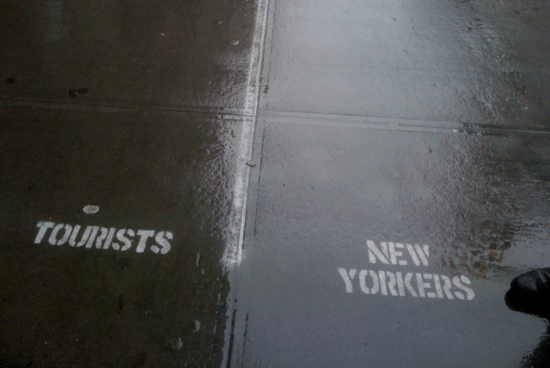
(Photo of sidewalk lanes via Choire)