Bangkok Burning

Bangkok

Patrick Winn is there:

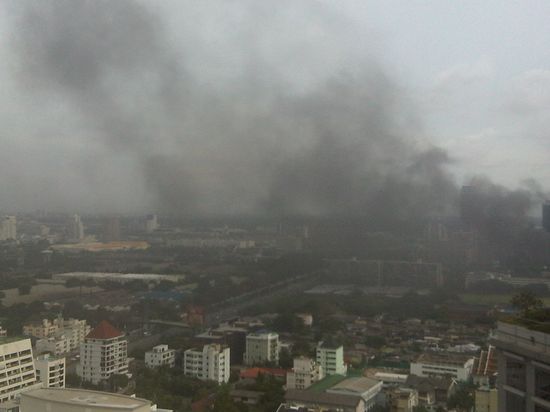
Bangkok is 10 weeks and more than 60 deaths into a stand-off between the military-backed government and a faction of self-proclaimed "commoners" — the Red Shirts — that insists the ruling party must fall. In recent days, the army has resorted to picking off protesters (the top brass calls them "terrorists") with sniper rifles from afar. But the Red Shirts have defended their encampment: two-square miles of Bangkok's priciest real estate, fortified with concertina wire and bamboo staves.

As Bangkok slips further into chaos, it's unclear if even the Red Shirt guiding statesmen can turn back the legions of Thai men (and some women) wading into near suicidal combat. "We must accept death," said Pichet Taweesin, a 40-year-old day laborer tending a flaming wall of truck tires. Nearby, teenagers snapped cell phone photos of their friends, striking hooligan poses while gripping homemade gas bombs.

Max Fisher provides a useful primer on the politics of the crisis. Photo sent by a Dish reader. The Big Picture has many more.

From Joke To Joke

Dave Barry describes his process:

I write very slowly—painfully slowly—and while yes, I really want it to look spontaneous and random, generally I'll spend a lot of time just on the first joke, till it seems right, and then I'll think, OK, what would be a good one to go after that. At that point I'm really not thinking about how it's going to end or how it's going to be structured—only about what the next joke will be. And then the next joke after that. There are exceptions, for instance if you're writing a screenplay or something you have more of an idea of what the structure will be, but most topics I don't. It's just a question of what's the next joke going to be. And I won't go on until I have it.

The Daily Wrap

Today on the Dish, Iran announced a deal over nuclear fuel and Portugal went for gay marriage. Peter Beinart provoked a new wave of commentary over the Zionist crisis, manifested here and here. More evidence to bolster his position here and here.

Andrew tackled Solmonese over the big Kagan question, Bernstein scolded his stance on ambition, and Donna Brazile backed her. Steve Coll showed the lack of sunlight between the Labour and Tory on foreign policy, Lisa Margonelli took in the implications of the oil spill, Balko vented over the drug war to Vice, and Steven Taylor illustrated the futility of the war. Get your Palin fix here.

Elsewhere, Andrew Rice looked at the growing addiction to SEO and pageviews, Suzanne Lenzer sold us on eating alone, and Scott Adams thought about thinking. More life and death talk here, here, here, and here. More NYC debate here and here. Porn follow-up here, insanely sexy CPR here, hathos alert here, and a baby sloth bonanza here.

— C.B.

What Do Atheists Think Of Death?, Ctd

DOVEJohnMoore:Getty

A sonnet, by John Masefield:

There, on the darkened deathbed, dies the brain
That flared three several times in seventy years;
It cannot lift the silly hand again,
Nor speak, nor sing, it neither sees nor hears.
And muffled mourners put it in the ground
And then go home, and in the earth it lies,
Too dark for vision and too deep for sound,
The million cells that made a good man wise.
Yet for a few short years an influence stirs,
A sense or wraith or essence of him dead,
Which makes insensate things its ministers
To those beloved, his spirit's daily bread;
Then that, too, fades; in book or deed a spark
Lingers, then that, too, fades; then all is dark.

(Photo: Terminally ill patient Jackie Beattie, 83, holds a dove on October 7, 2009 while at the Hospice of Saint John in Lakewood, Colorado. The dove releases are part of an animal therapy program designed to increase happiness, decrease loneliness and calm terminally ill patients during the last stage of life. By John Moore/Getty Images)

Checking In On Afghanistan

MarineDavidFurstGetty

Fred Kaplan reads a recent Pentagon report on the situation:

Here's how the report summarizes the situation in straight prose: "Some individual islands of security exist in the sea of instability or insecurity." The authors muster only two islands: the town of Mazur-i-Sharif in the north and "small contiguous areas" near the Ring Road in the south. The level of security, they add, is "significantly related to the presence of well-led and non-corrupt" units of Afghan soldiers or police.

The problem is that "well-led and non-corrupt" Afghan security forces are, as yet, rare commodities. The Afghan army and national police force are making "slow progress" toward its manpower targets because of "high attrition and low retention." Between 60 percent and 70 percent of uniformed police are "hired and deployed with no formal training." By this August, NATO troops will be mentoring Afghan police in 45 of the 80 most important districts. Yet the report notes that even well-trained police units "have regressed" after a mentoring team is reassigned elsewhere.

Joe Klein thinks we are losing. The Economist is hosting a debate on the war this week with John Nagl arguing that the war is winnable and Peter Galbraith arguing it isn't. Steinglass prods the debaters to examine the war's cost.

(Image: David Furst/Getty)

Face Of The Day

99640123

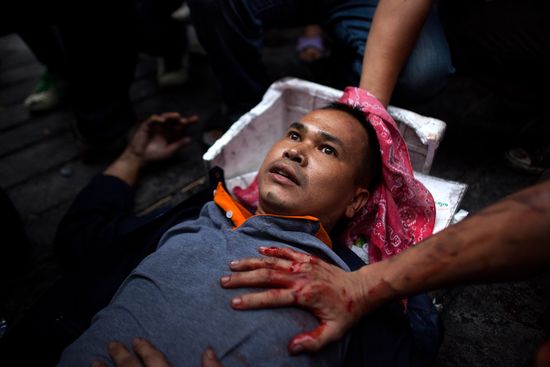
A red shirt anti-government protester receives help from others after being shot in the head as the violence in central Bangkok continues on May 17, 2010 in Bangkok, Thailand. Protesters and military clashed once again in central Bangkok after the government launched an operation following the anti-government protesters' refusal to obey orders to leave their fortified camp in the Thai capital. Photo by Athit Perawongmetha/Getty Images.

Deficits Matter

Last week, in an interview with Ezra Klein, James Galbraith argued that US deficit poses "zero" risk. Len Burman counters:

Taken to its illogical extreme, Galbraith’s argument implies that there is no limit to government’s borrowing capacity (and that the money never really has to be paid back).  If that’s the case, why not dispense with the annoyance of taxes altogether?

…Galbraith thinks deficit hawks are all anti-government kooks who want to dismantle the social safety net.  In reality, Galbraith and his fellow Cheneyites are the greater threat to vulnerable populations.  If we accumulate debt until it reaches catastrophic levels, the consequence would be a necessary sudden and drastic cut in government spending (see Greece and Iceland for examples of what happens to spending after a debt crisis) as well as an economic meltdown that could impoverish a generation (see Argentina).

How Kevin Thinks About Death, Ctd

Drum responds:

[T]his attitude toward death surely sums up a vast chasm between the religious and the nonreligious. "Facing it is our life's task"? I can't even conceive of that. I think about death sometimes, just like everyone, and sometimes these thoughts bother me more than other times. But thinking about it all the time? Casting it as uniquely central to the human condition? That's almost incomprehensible to me. Wondering about our own finitude is one thing — I imagine we all do that from time to time — but why should this be elevated above the human ability to create art, science, mathematics, love, war, poetry, trade, government, or ethics — or the ability to wonder in the first place? Why is learning how to deal with our eventual death the defining characteristic of being human? Not just because Montaigne said so, certainly.