The Tyranny Of NYC, Ctd

A reader writes:

Are the people of New York narcissistic? Yes, but the phenomenon of narcissism is not any more widespread here than anywhere else, including the small rural town and suburban sprawl where I grew up. It may be that the narcissism of New Yorkers is particularly recognizable because it so often looks like worldly self-congratulation; but people find all sorts of ways to congratulate themselves, including being dismissive of New York. My father, for instance, takes pride in having been here only once – in Penn Station, which he didn’t even leave. “I don’t know why you’d want to live in a place like that,” he says to me; as if he even knew. And then there is that familiar refrain: “New York is a nice place to visit, but I wouldn’t want to raise a family there.” How many of these have ever come to New York with a truly open mind? How many of these have gone beyond Times Square and Fifth Avenue?

If you come to this vast, bewildering city honestly and alone, there is nothing about it that congratulates you. There is nothing in it to even acknowledge you. If the city itself has any direct influence on a person’s self-conception, that influence must at first be humbling, not inflating. It is an experience I wish more people could have. If you grew up in the places I did, you can drive from Erie to Detroit and see nothing to challenge your world view or your sense of self; the same cannot be said of the distance between Wall Street and Harlem.

This alone makes me disagree with Conor. I would say that New York does not loom large *enough* in the national consciousness – it is a chimera of New York that looms, not the real experience of the city itself.

Conor is on the ground in Harlem. One of his readers reflects on New York neighborhoods.
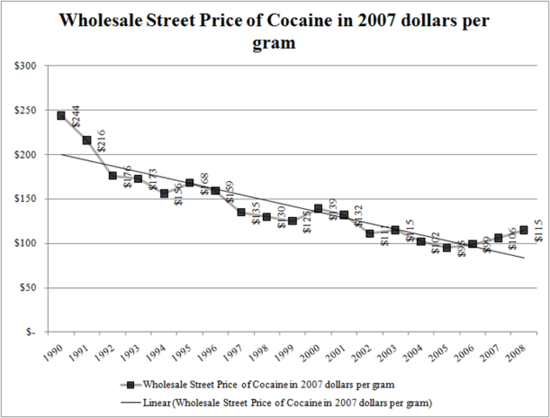
Drugs Win Drug War

CocaineStreetPrice

Steven Taylor produces the above graph on cocaine prices:

[W]e are spending billions of dollars a year to try and stop cocaine production and the trafficking of said substance into the United States.  We are not getting what we are paying for.  The numbers above clearly demonstrate that even with increased crop eradication and constant “record seizures” of the drug by land and at sea are not accomplishing the stated goals of the policies and therefore calls into serious question whether they are worth the expenditures in question.  Indeed, it is quite clear that the ability of coca famers to produce enough coca leaf to overtake whatever successes that are accomplished in crop eradication and cocaine seizures is quite clear.  Such overproduction is simply the cost of doing business.  This is a lesson, by the way, that we need to keep in mind in Afghanistan, where the policy direction it towards crop eradication of opium poppies.  I predict now that even if thousands upon thousands of hectares or opium poppies are eradicated, that the poppy farmers will be able to out produce the eradicators.

Jacob Sullum notes a damning AP article from Friday chronicling the drug war's numerous failures.

“An Epidemic Of Not Watching” Ctd

Goldblog will be publishing a back and forth with Beinart soon, but for now he laments the placement of the piece in the New York Review of Books, "the one-stop shopping source for bien-pensant anti-Israelism." In the day of the web, what does it matter where an argument is placed? The point is the argument, not any associations. The era of media authoritah is over. Ackerman understandably balks at the characterization and dives into the substance:

Peter is right that it’s the moral task of Zionist liberals like, well, himself and myself and the J Street generation to save Zionist liberalism. But if you’re Malcolm Hoenlein or Abe Foxman, why should you care what pischers like us think? You’ve got aspirant Republican officeholders tripping over each other to profess their deep faith in Israel. That should underscore the urgency of the J Street generation.

Ezra Klein notes the disparity between the understandably apocalyptic psyches of many among the older generation and, well, reality:

Today, Israel is far, far, far more militarily powerful than any of its assailants.

None of the region's armies would dare face the Jewish state on the battlefield, and in the event that they tried, they would be slaughtered. Further stacking the deck is America's steadfast support of Israel. Any serious threat would trigger an immediate defense by the most powerful army the world has ever known. In effect, Israel's not only the strongest power in the region, but it has the Justice League on speed dial.

That is not to say that the Jewish state is not under threat. Conventional attacks pose no danger, but one terrorist group with one nuclear weapon and one good plan could do horrible damage to the small, dense country. That threat, however, is fundamentally a danger born of the Arab world's hatred of Israel. It follows, then, that hastening the peace that will begin to ease that hatred makes Israel safer. Exacerbating the tensions that feed it, conversely, only makes the threat more severe.

Thank God for the blogosphere. This debate would have been squelched without it.

On Ambition

Bernstein counsels:

I'm pretty confident that this suspicion of ambition is what's at the core of the unease with Kagan expressed by David Brooks and Andrew Sullivan (see also an interesting reaction from Ta-Nehisi Coates).  My advice for them is simple: get over it. 

Of course SCOTUS candidates are going to be ambitious and organize their lives around the pursuit of a seat on the court, just as presidential candidates, or Speakers of the House, are going to do the same.   It's not just an effect of the post-Bork rules, either; change the process, either by reforming the rules or otherwise, and you'll get highly ambitious nominees who play by those rules.  Make strong public position-taking important, and then you'll get people like Kagan and Roberts who publish lots of provocative arguments.  Same ambition, just tailored for whatever the norms demand.  Of course, presidents used to put actual politicians, people who had run for office, onto the Court, but I think we can safely assume that Taft and Warren were just as insanely ambitious as Kagan and Roberts.

It's not ambition that concerns me in any specific case. It's how people handle their ambition, and whether they act ethically within its demands.

“Porn Has Become De Facto Sex Education,” Ctd

A reader writes:

Cindy Gallop seems to frame this as a recent phenomenon among straight people as access to sex education has declined. I've actually noticed the opposite among gay men. Gays in their thirties and older tend to want to have sex exactly the way it's done in hardcore gay porn, while gays in their twenties – who have come of age in a world where gay love isn't nearly as invisible as it once was – are much more interested in kissing, cuddling, body contact, and all the activities that Gallop notes have declined in the young men she's dated.  It's one unscientific personal sample against another, but I thought it was interesting since it's been the exact antithesis of my own experience.