There were too many emails to fit in one post, so here is a second batch of responses. A reader shares:
I agree with Drum in that death is one of many defining characteristics. Our ability to have close friendships, our bipedalism, opposable thumbs, and our ability to use language to describe complex thoughts seem quite unique and quite defining.
I do agree with you and Montaigne that to philosophize is to learn how to die…and, in turn, to learn how to live. The latter being much more important in my mind. I have to side with Drum though; there are some people who just don't care about it. I am not one of them. I, like Drum, and am atheist, but unlike him, learning how to think and approach death has been a constant focus of mine (I've always taken comfort from reading Montaigne and Seneca). It has brought me great peace to my life, which is why it can be frustrating to see other people seemingly live their whole lives without a concern at all about their impending deaths.
I know that the history of humanity has left evidence that we've always cared about what happens at death; however, I still believe that a large portion of humanity just doesn't care (or successfully ignores it). They just don't leave any evidence of their ambivalence behind. I can live with this, despite it irritating me on occasion, but I find myself drawn to people that actually think about this issue, and I presume that it is a similar case with other like-minded people. I can't help but think of Bertrand Russel's smug quote "Most people would rather die than think; in fact they do."
Another reader sketches out a secular view of heaven and hell:
My best friend died six years ago. A few years later, I got into an argument with a friend when I told him I no longer believed in Heaven and Hell. It was a big issue because we had both been struggling with the death of our friend and while I didn't think our friend was "in Heaven" in the traditional sense, he did believe that. He took great offense that I could say our friend wasn't in Heaven, as if I was saying he didn't deserve to be. I tried to explain what I thought Heaven and Hell meant now that I no longer believed in the traditional concepts or that they are places your soul goes after death.
I didn't say exactly this, but my argument was basically that Heaven is the emotional legacy you leave behind in the souls of others. By leaving the world a better place and touching the lives of others in positive ways, those good works ripple away from you for eternity. Hell on the other hand is hurting others and having those negative ripples go on forever. So if you're doing good things, helping others, making people smile, being a decent person, all of those actions are leaving a mark on the souls of those people you help and they and the world are better off for your having helped them. On the flip side, hurting others marks the soul of others, as well. And because your actions will impact the actions of another and their actions do the same and so on for eternity, in a way one can reach eternal life by doing good deeds.
Another reader argues that fear of death can be overcome:
I was raised Methodist, and my Mom remains a Methodist. My Dad is a deist. His belief is less specific, but he is a definite believer in God. I grew up absolutely terrified of my own mortality. I started thinking about it around the age of 4. I am now a hardline atheist. Simply put, there's no way to know what happens when we die, and it's generally terrifying to think that there is nothingness waiting. No safety nets, no way of truly knowing. Even for the devout, there's always that shred of doubt.
And this brings me to why I chime in. I'm not afraid anymore, Andrew. I truly am not. I faced the fear, I addressed it, and I decided it's unjustified. Because I believe that my consciousness/ego will cease to exist when my physical body expires, I am in constant awe of the life I live. Any time I think about it (more rarely, as time goes on), the colors get brighter, the smells get sweeter, food tastes better, music becomes almost achingly beautiful, I feel more love for my partner, our dog, and our cat. I've only got a grand total of 70 years, statistically speaking. Which leaves me a little less than 45 years left. The first 25 went by so quickly, I'm driven to experience as much of life as I can, and above all, to live positive and be a positive influence on those around me.
My mind would not, and I believe cannot, accept religion. It's just part of who I am. But the fear of death was as well, and I think it's simplistic to believe that we're either born with or born without a fear of death or the ability to believe. What makes us human is our capacity to change and adapt to circumstances in a range of ways.
A reader challenges the importance of thinking about death:
As a scientist and a small-a athiest, I'd assert that your statement "To be human is to be aware of our own finitude, and to wonder at that" is only half true. To be human is to wonder, but the choice of what to wonder about has no bearing on one's essential humanity. Like Kevin, I don't wonder much about my finitude, or yours, or his. Are Kevin and I less human?
From their writings, it's clear that believers tend to feel that athiests are somehow missing a sense of wonder, or joy, or higher purpose. We aren't. We feel those same feelings — just not always about the same issues as you.
Many readers made this point:
I always took comfort in Mark Twain's saying: "I do not fear death, in view of the fact that I had been dead for billions and billions of years before I was born, and had not suffered the slightest inconvenience from it."
Another reader focuses on animals:
You said:
"For me, this last thing is our first thing as humans. It is our defining characteristic, even though some animals may experience this in a different way. And our ability to think about this casts us between angels and beasts. It is our reality. Facing it is our life's task."
What, then, is the task of a deer's life? Or a rabbit's? What about gorillas and all other sorts of primates?
This is the central challenge I've developed when it comes to religion or spirituality of any form. I am equally in awe of the existence of life and all that has accompanied it. I've followed you for years and I know that you don't deny science such as evolution, an amazing demonstration of the natural wonder in our world.
But knowing what evolution means and understanding it's implications, how can any person assert that humans would have a particularly different "task" or conclusion in life than the "beasts" we've come from? We're as far removed from our origins as chimpanzees, and are equally subject to our world's condition and fate.
Yes, we've absolutely displayed new and fascinating progress for a species on Earth when it comes to things communication and habitat manipulation and civilization. But so what? So do countless other creatures all over the planet. Our desire to describe a God that has a unique plan for "us" as individuals or as a "human race" comes from a selfish, myopic viewpoint that we're somehow more special than the life all around us.
On the same subject:
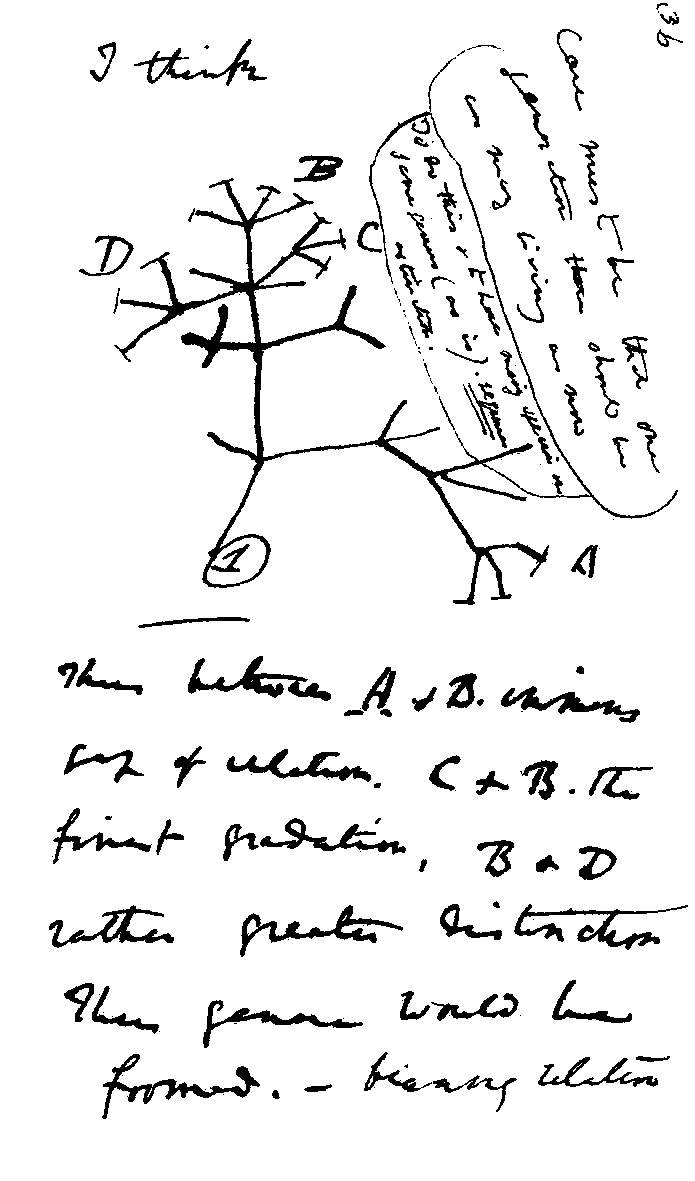
Animals have this annoying way of ruining our uniqueness. It's what happens when we stop thinking like this, and start thinking like this (Darwin's first sketch of the tree of life).
A reader goes a different direction:
To turn your question to Kevin back around to you: What would you do differently tomorrow if it were somehow revealed to you that you are 100% wrong about the existence of god/soul/afterlife?
Would you cease your many contributions to society through your blog, your published works, your lectures? Would you abandon the relationships with other humans and animals that have enriched your life and the lives of your friends and family? Would you suddenly ignore the notion of legacy and the societal progression of knowledge?
Clearly, my opinion is that you would not. Putting aside our knowledge of death and returning to the core notion that started this debate, tragic atheism, I struggle to see how it is not apparent that other wholly sufficient motivations exist beyond the supernatural and that what it is to be human in this world may have very little or nothing to do with gods.
Another reader is in similar territory:
Personally, I think that the drive toward religion is an extension of the self-preservation instinct. You spend your life avoiding fires or walking in front of buses because you would like to be around tomorrow, for whatever reason (be there to raise your son, be there to defend your legacy, etc).
By extension, the final insult of death from old age may as well be a fire or a bus, even though you may be a hundred years old. You’d like to be around the day after your stroke or heart attack. Entire cultural institutions, imho, have been built around this seemingly simple fact.
To me, the central empirical question is: if you don’t expect a heavenly reward for your miserable life, do you act differently? I don’t think we’ve had a sufficient experiment to test this yet.
A related point:
Though an atheist I agree with your feelings on death more than Drum's. I personally cower at the emptiness I expect awaits me. But that is far removed from the initial dispute over atheism and religion. The central problem that Hart and Linker, and now you, are ignoring is that there is no pre-condition that the universe be pleasant. Just because atheism is a terrifying, or tragic, viewpoint doesn't mean it is wrong. As obnoxious as the "New Atheist" attempts to destroy religion are, their central point—there is no reason to believe in god—is unaffected by that. If, like myself and most atheists, you do not feel god within you there is no other evidence or compelling factual reason to believe in one. This may lead to unpleasant realities when it comes to death, but what other option is there? Though, unlike Drum, I wish I could believe in eternal life and happy-go-lucky Heaven, I cannot because I know there is no reason for me to do so outside of wanting to believe. My own attempts to believe would thus be rendered pointless by my own awareness that they are really attempts to self deceive.
It is in turn not hard to see, especially for those who live within a scientific community, why these unpleasant realities of tragic atheism are easier to live with than self delusion and baseless belief (which is how new atheists view religion). Likewise, it is not hard to see why someone who values a positive viewpoint and order, like Hart argues Christianity offers, over analytical and reasoned belief would choose religion. That Hart applies logic and reason to make his point is perhaps ironic, but it is understandable. What is not understandable is why any atheist should, essentially, be criticized for failing to take the negative realities of their view into consideration. There may be criticism of them as theorists and philosophers, but I see none as advocates for believing there is no god (of course when they argue there cannot be one they go to far). They do not believe there is no god because of the consequences, but because they do not believe there is any evidence or reason to believe in god (a pleasant future after death not being a reason). However tragic atheism is that does not speak to whether or not it is the accurate belief. If you are trying to argue against a sunnier, but incorrect, theory you can hardly be blamed for focusing your book on accuracy and not consequence. Because they lack an equally optimistic viewpoint to replace salvation with does not mean the atheist viewpoint is wrong. It simply means the new truth is not as pleasant as the old one. But, if it's the truth, does that matter?
Yet another reader:
The thought of my own non-existence is not troubling in a vacuum. The thought of my children’s non-existence before their time is mind-numbing. There is nothing redemptive (in and of itself) in the tragedy of loss, no evolutionary benefit to existential consciousness. If there is no God (which I am inclined at this moment to accept), and this life is it (which at this moment and all moments I am inclined doubt), there truly are very good emotional and logical reasons for ceasing to procreate entirely as a species. I think it would be interesting to study the correlation between agnosticism/atheism and parenthood. Are atheists and agnostics more or less likely to procreate than their believing counterparts?
Another reader:
There is some empirical evidence that highly religious people actually fear death more. They're more likely to seek aggressive treatment/ heroic measures at the end of life.
As an atheist, the though of the world turning without me after I'm gone is about as disturbing as the thought that the world was around before I came on the scene: strange to think about in an existential way, but not actively upsetting. It would bother me far more to have some God purposely snuff me out than to accept that death just happens, just like most people would rather die of a heart attack than be murdered.
Death isn't pleasant to think about by any means, but it's a comfort to know that at least when it's over, it's over. No eternal torture, no eternity of singing His praises, no haunting, nothing to worry about. In all likelihood, when I die I'll be very sick and in a lot of pain. It will probably be a relief to know it will soon be over.
Another:
I think it would interest you to read about Terror Management Theory (TMT). TMT agrees with you that "facing [death]" is our life's task and what separates us from the animals. TMT argues that the realization we will inevitably die would psychologically paralyze us, save for our ability to suppress such thoughts through telling ourselves we will "live forever" either literally (religion) or figuratively (our culture).
Yet another reader ponders the great beyond:
The prospect of my death fills me with a terror unlike any other. I admit this. My knowledge of the physical world, as I understand it, leads my to believe my eventual annihilation is permanent and complete. But therein lies the rub: as I understand it. In admitting that humanity's comprehension of the universe is limited, I allow the possibility that there may be more. What is my death? A moment in time in which my brain ceases to function. What is time? That's trickier… Hawking has said that time may have no beginning. Others have theorized that time is happening all at once. If so, where does that leave death? I'm always dead and am forever alive. What does that mean?
Like everyone, I have to live my life as best I know how. So I go forward assuming the only time I'll have is with air in my lungs. Still, for all the existential terror, I think this gives me more worthwhile hours than those hoping to interpret Heaven. But whatever hope I do have for an afterlife comes not from any Holy book, but from the quest for knowledge of my fellow man.
A final reader:
I am an atheist, but I always marvel at the fact that all of the public atheists claim to be unbothered by death. It bothers me a lot! The idea of my own non-existence is basically intolerable, and can make existence itself seem almost meaningless. (I'll die in the end, I will have no more memories, people might remember me for a little while but not that long, eventually human life will end, the planet will be destroyed, the entire universe decay into entropy. What is the point, exactly?) I would really like to believe there is an afterlife, or at least that something is out there that might remember my life in some way. I just don't, really.
I don't mean to make it sound like I'm depressed or find no meaning in life – I have the usual hopes, goals, plans, joys, and so on. I'm generally a happy person. But death is definitely a big flaw in the system as far as I'm concerned, and the idea that my death allows others (future generations) to live, or that all my ancestors have died and I am no different, is a pretty meager comfort.
Not all atheists are sanguine about death.


 The Dish