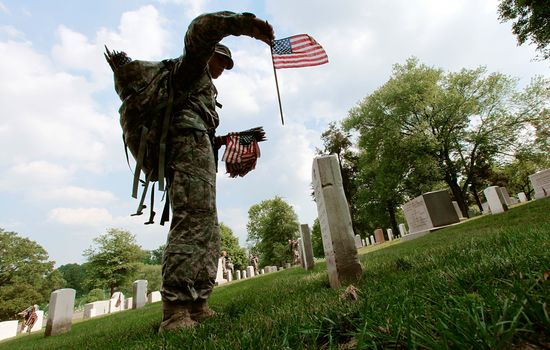
A soldier from the U.S. Army Old Guard places a flag on a grave at Arlington National Cemetery May 27, 2010 in Arlington, Virginia. About 1,300 soldiers, sailors and Marines in about three hours placed a flag at each of the more than 300,000 gravestones at Arlington ahead of the Memorial Day weekend. By Mark Wilson/Getty Images.
Contra Dreher, Joe Klein approves of building a mosque near the site of the World Trade Center:
It is an instant, international symbol that mocks the closed, vicious religious insanity of the terrorists who took the buildings down. Dreher worries about the families of those who lost their lives that day; I would expect that they will accept this, among the many other memorials on the site, as part of their loved ones' legacy–a renewed national sense of what this country stands for, and what it stands against.
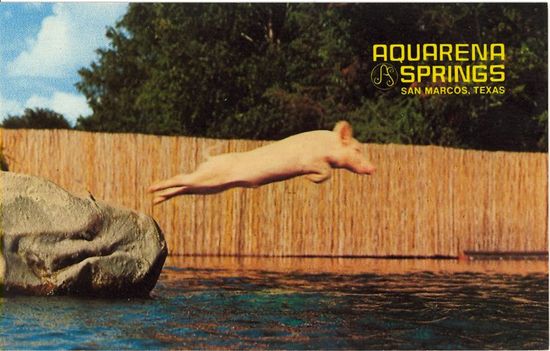
Anyone who’s ever lived in Texas knows there are many pigs that swim, but only one diving pig, and he’s named Ralph – Ralph the Diving Pig.
Perhaps my best New Year’s Eve ever was spent at a bar in Austin, Texas. Joe Ely was the main musical event (and no matter what anyone else says, Joe Ely was then the best live rock-and-roll show in the world. And he’s still going.) But the centerpiece of the evening was Ralph, who scaled a ladder and plunged from about 20 feet into a pool in the middle of the bar at midnight. It looks like Ralph’s still going, too.
Thanks for all your attention to this important matter.
Theresa May, a member of the British coalition government, says that she has changed her mind on gay adoption. Burke's Corner applauds:
The social revolutionaries of liberal- and not-so-liberal left and the reactionary Christian Right share a hostility to the temperate, measured modesty of the Burkean tradition. Having observed the love, the domesticity, the ordinariness of same-sex couples, the Burkean will affirm them, recognising in their experience the virtues seen in other manifestations of the little platoon. Theresa May was being authentically conservative in her confession. A conservatism without the means of change, after all, is without the means of its conservation.
To expound on what the other reader said, torture in 24 was, in later years, the first-resort. Moreover, it always worked. The incident I most remember was in Season 4, where the show gave us the "right" kind of torture. By that, I mean there was a clear and imminent threat. There was a direct order through the chain of command. There were medical personnel on hand. There was a clear question they needed answered — not just "What do you know?" and it was a "humane" form of torture. If I recall, it was some hallucination machine.
It failed. The suspect didn't crack and later gave bad intel. Only when Jack got involved and literally started just snapping someone's fingers, did CTU get the info. This was porn for the Beck crowd.
Another reader offers a nuanced take:
As someone who has watched every season of 24, I don't think its depiction of torture was in and of itself advocacy of torture.
Indeed, in the final season, all of Jack Bauer's colleagues were aware of, and horrified by, his propensity to torture. The statements of your reader are simply untrue, within the structure of the show. Most everybody associated with CTU protested against torture and excessive violence. One of the themes of the show has always been that once Jack gets under pressure, he becomes an unstoppable monster, which is, in the world of 24, the kind of person you want "running point" in these "ticking time bomb" scenarios.
Last season, his FBI protégé, Renee Walker, used a tactic she thought Bauer would approve of: torturing a suspect. She was caught, her career ruined, and was, as we found out this season, suicidal and homicidal. In a pivotal scene, Jack told Renee that she "went to a dark place you can't come back from", and he said it with all the weight of someone who knows they have done heinous things to extract information.
Simply because people use 24 as an example of what we need to do to get our information, does not mean the show is responsible for it. Nobody ever said Jack Bauer was a "good guy," only that he is a "hero."
Another is more blunt:
Oh please, will everyone just get off 24's case? One fact keeps getting lost in the midst of all this criticism: it's a fucking fictional television show! I loved it, my girlfriend loved it, all my friends loved it, even my parents (who are about as liberal as they come) loved it. And we're all intelligent, educated people. And why did we love it? Because it was entertaining and exciting! Am I now confused as to whether torture is evil? Gimme a break. I love to watch Dexter and The Sopranos. It doesn't mean I now support serial killing and organized crime.
This whole conversation is ridiculous. If someone is swayed to believe that torture is actually morally defensible in reality because they watched a few seasons of Kiefer Sutherland dishing it out on TV, how is that the fault of the show? I would say it's the fault of the American educational system and the media at large for not doing what is so simple and easy: telling people that torture is fucking wrong and evil.
Another:
In law school, in a legal writing class, a professor passed around a portion of a brief written by a lawyer in which he cited to an L.A. Law episode, right down to the fictional ruling by the judge character, to reinforce an argument for which he had no actual case law to support. We all chuckled at the prospect that a lawyer would be so embarrassingly removed from reality or obtuse that he would think to do so. Years later I watched a presidential debate in which four GOP candidates were favorably citing 24 as support or even inspiration for their proposed national security standards. I had watched 24 and found it an entertaining television program up until that point.
Another points to the most positive legacy of the show:
The first 24 president was David Palmer, played by Dennis Haysbert, who is black. And Palmer wasn't just the president, he was a GOOD president – smart, moral, courageous, loyal, but also tough. A few seasons later he was succeeded by his younger brother, Wayne Palmer, played by D.B. Woodside. Wayne was not as competent or decisive as his older brother, but he was still a smart, decent guy determined to do the best he could for his country.
I have long believed that these two positive portrayals of black presidents helped pave the way for public acceptance of Obama's candidacy.
If a President does not actively “take charge” and is not seen as “doing something,” he is ridiculed as weak and ineffective, when according to any vision of a less activist, less interventionist, less intrusive government the President would not involve himself closely in most events similar to this oil spill. It is a bit more absurd in the conservatives’ case. They are horrified by the tyranny of the individual mandate, but most otherwise seem content to demand the firm smack of a strong executive and the protections of an omnicompetent managerial state. Having mocked Obama’s more enthusiastic supporters for wanting him to be a savior of sorts, some Republicans seem genuinely annoyed that he has not been able to work miracles.
Andrew Sprung digs up some research against Michael Walzer's uncomfortable notion that democracies should just keep on walking past evidence of war crimes.
Ackerman gets his hands on a forthcoming study that posits:
As of 1 April 2010, there have been a total of 127 confirmed CIA drone strikes in Pakistan, killing a total of 1,247 people. Of those killed only 44 (or 3.53%) could be confirmed as civilians, while 963 (or 77.23%) were reported to be “militants” or “suspected militants.”
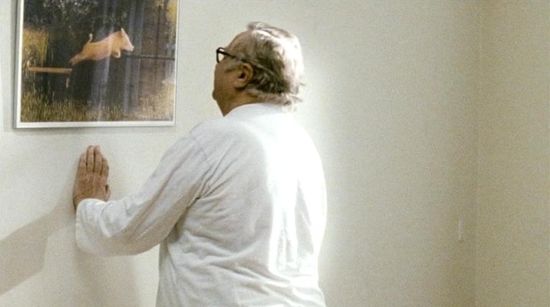
FYI, this painting is the subject of a 2009 Oscar nominee for best live action film – a Danish submission called "Grisen," or "The Pig". The felicitous leaping swine becomes a source of contention between a patient undergoing various colorectal procedures who has been charmed and comforted by the image and his Islamic hospital roommate who is religiously offended by it and insists that it is removed. It's cute and mildly thought provoking, and well worth a watch, if you can find it.
Help me with this: someone "undergoing various colorectal procedures" is comforted by a leaping pig? Ooookaaay. And for the record: I'm with him, not the Muslim.
Congestion pricing really isn’t that hard. Congestion is a classic negative externality. When a driver gets on the road, he doesn’t have any reason to think about the additional traffic he is creating, and since the same is true for everyone using scarce, valuable road space, drivers opt to drive until traffic grinds to crawl. We confront problems like this all the time. We tax cigarettes because of the public health costs of smoking. We have used market pricing to limit emissions of various pollutants, and other countries have done the same for carbon. If you set the price to use a valuable piece of road high enough, then you don’t get congestion.
Will this lead to the end of driving? Obviously not. The idea is to allow cars to use the road as intended, at appropriate speeds, predictably and efficiently. If driving falls below the level at which congestion is a problem, you drop the price. In the mean time, we cut out the billions in annual losses due to time and gas wasted in traffic.
Triple amen. And use the money to build bullet trains.
 The Dish