Brown Will Resign As Labour Leader – And The Plot Thickens

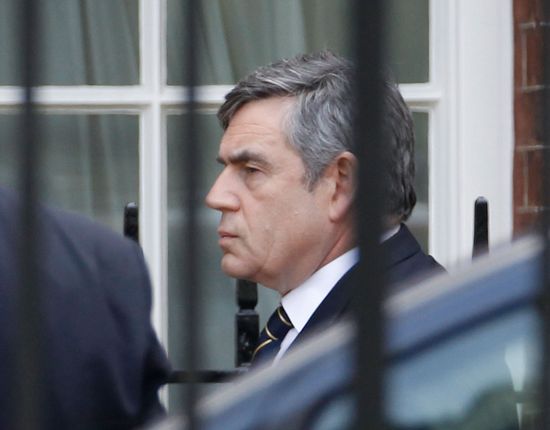
BROWNOVERChristopherFurlong:Getty

Nick Robinson looks at Labour's scheming:

One group in the Cabinet is arguing that the Tories won the election, that they could govern as a minority as Harold Wilson did and that Labour should relish going into opposition in such a strong position.

Another larger group argues that if there is a chance of forming a "progressive alliance" then Labour should take it. It is clear, though, that the presence of Brown is a block to any such deal. Thus, what is being discussed is for the Prime Minister to announce his intention to resign after seeing through the transition to a new coalition government, managing the current economic crisis and passing the instant legislation he promised to change the voting system. Those proposing this solution argue that it allows Labour to say that the Lib Dems aren't choosing their leader whilst meeting their demands for a change.

On cue, Gordon Brown resigns. From Politics Home's live-blog:

Laura Kuenssberg reports that Liberal Democrat insiders have said that the next step will be to enter formal discussions with the Labour Party.

More live-blogging at the FT.

(Photo: Christopher Furlong/Getty.)

Barring The Military From Campus

This will, inevitably, be an issue in the Kagan nomination. Peter Beinart explains his position here. And, for what it's worth, I agree with him. The Obama administration's policy – which was Clinton's and Bush's – is that servicemembers can still be fired solely because of their sexual orientation. It's wrong, counter-productive, harmful to national security, and based on bigotry. But barring the entire military from recruiting at Ivy League schools as a response seems deeply wrong to me. We can still honor the military while disagreeing with its recruitment policies. And ensuring that the best students are available for recruitment is one way to reform the military, not enable it in one specific area.

So Is She Gay?

It is no more of an empirical question than whether she is Jewish. We know she is Jewish, and it is a fact simply and rightly put in the public square. If she were to hide her Jewishness, it would seem rightly odd, bizarre, anachronistic, even arguably self-critical or self-loathing. And yet we have been told by many that she is gay … and no one will ask directly if this is true and no one in the administration will tell us definitively.

In a word, this is preposterous – a function of liberal cowardice and conservative discomfort. It should mean nothing either way. Since the issue of this tiny minority – and the right of the huge majority to determine its rights and equality – is a live issue for the court in the next generation, and since it would be bizarre to argue that a Justice's sexual orientation will not in some way affect his or her judgment of the issue, it is only logical that this question should be clarified. It's especially true with respect to Obama. He has, after all, told us that one of his criteria for a Supreme Court Justice is knowing what it feels like to be on the wrong side of legal discrimination. Well: does he view Kagan's possible life-experience as a gay woman relevant to this? Did Obama even ask about it? Are we ever going to know one way or the other? Does she have a spouse? Is this spouse going to be forced into the background in a way no heterosexual spouse ever would be? A reader asks Jeffrey Toobin the obvious question:

From the description of your relationship with Ms. Kagan, I would bet that you have some insight on the claims of her sexual identity. One month ago there were reports that Ms. Kagan was gay and those reports were quickly followed by stern – offensive? – rebuttals by the Obama administration. This is apparently a big deal even though we aren't supposed to talk about "it." Mr. Toobin, did Ms. Kagan bring a date to your wedding? Why can't we discuss this matter? If she were married – to a man – there would not be silence. Would there be if she were married to a woman? Would she be nominated if she were?

To put it another way: Is Obama actually going to use a Supreme Court nominee to advance the cause of the closet (as well as kill any court imposition of marriage equality)? And can we have a clear, factual statement as to the truth? In a free society in the 21st Century, it is not illegitimate to ask. And it is cowardly not to tell.

Kagan Reax: “An Exquisite Curator Of Her Own Career”

SCOTUSBlog is the go to place for news of this sort. Here's their 9,750 word profile of Kagan. Contra Greenwald:

Some have criticized Elena Kagan for supposedly favoring a strong view of executive power.  They equate her views with support for the Bush Administration’s policies related to the “war on terror.”  Generally speaking, these critics very significantly misunderstand what Kagan has written.

Kagan’s only significant discussion of the issue of executive power comes in her article Presidential Administration, published in 2001 in the Harvard Law Review.  The article has nothing to do with the questions of executive power that are implicated by the Bush policies – for example, power in times of war and in foreign affairs.  It is instead concerned with the President’s power in the administrative context – i.e., the President’s ability to control executive branch and independent agencies.  That kind of power is concerned with, for example, who controls the vast collection of federal agencies as they respond to the Gulf oil spill and the economic crisis.

Ambinder:

The more intense fire will come from the activist left, whose representatives have already voiced objections to Kagan's record of jurisprudence, her Cantabrigian clubbiness, her record on diversity, and the way that she seems to have constructed her career to leave as little in the way of a paper trail as possible. Remember, all judicial battles are fought on the right's terrain, so Democratic judges always have to pledge fidelity to a legal formalism they don't really believe in. As long as the Democrats have the votes, Republicans will have to grudgingly accept that this is the reality behind confirmation-process appearances. The critique from the left has been assisted by Ed Whelan, an influential commentator on the right, who appeared to compare Kagan's pragmatism to prostitution, borrowing a quip from Bernard Shaw. … BTW: seven GOP Senators voted for her confirmation as SG.

Chait:

Paul [Campos] makes a good case for why Kagan's credentials are unusual for a Supreme Court justice. It's certainly true that she has avoided expressing views about legal questions. I disagree, though, with the conclusion that this makes her a blank slate. There is a lot you can glean about a person based on professional and personal interaction. In some ways, these experiences can teach you more. Nothing about Antonin Scalia's judicial record would prepare you to expect him to produce a sweeping activist ruling like Bush v. Gore. But if you knew him personally, understood his conservatism and deep resentment of the left, then you might not be shocked. All this is to say that I believe it is possible, through the kind of engagement Obama and others have had with Kagan, to paint a portrait of a legal mind no less accurate than the portrait we have of many Supreme Court nominees.

Adam Sorensen:

Never having served on the bench, Kagan's record is relatively thin (no Connecticut firefighters this time) but here are the issues likely to come up during confirmation: Some on the left take issue with her minority hiring record while dean of Harvard Law and charge she was too complacent on the Bush/Cheney approach to executive power and national security. (More from Glenn Greenwald here.) Some on the right will make hay of her outspoken opposition to "Don't Ask, Don't Tell" and her subsequent resistance to allow military recruiting at Harvard. (More from Ed Whelan here.)

Marcy Wheeler looks at the bright side:

Given that Republicans will try to oppose Kagan on perceived sexual orientation, it’ll make potential gay bashing of Vaughn Walker over the Prop 8 trial much less effective and–assuming Kagan is confirmed–potentially counter-productive for the haters.

Dave Weigel sketches out the opposition's argument:

We're already seeing a line of criticism develop. If I can sum it up in the bluntest possible language, Kagan is a New York, Ivy League elitist, a critic of the military during wartime, who was picked because President Obama is all of those things. It will be less difficult for conservatives to drum up skepticism about her than it was the self-made Sonia Sotomayor, who tripped up conservatives when they went overboard in accusing her of benefiting from her race.

Ed Morrissey:

For “the most transparent administration in history,” Kagan has a very thin paper trail to give clues to her beliefs.  She has not published much — a rarity among Harvard Law deans — which Ed Whelan argues doesn’t meet Kagan’s own standards for Supreme Court justices.

What does all this mean?  It signals that the White House doesn’t want a big fight over a Supreme Court confirmation.  They don’t want to appoint someone with a track record of judicial activism or a record of strong political advocacy.  Obama wants a stealth candidate, someone who can win a relatively quick confirmation battle.  Of the names floated by the White House after Stevens’ retirement, Kagan attracted the least amount of public opposition.

It is also worth mentioning that Kagan has critics on the left who believe that she is almost a closet conservative. I highly doubt that is in fact the case. Kagan has a long record of liberal views and involvement with liberal causes. It is significant that there aren’t any noteworthy conservative or libertarian legal scholars or activists who believe that Kagan is somehow one of them or even believe that she is a centrist. Ed Whelan’s recent “baffle[ment]” at claims that Kagan “might secretly harbor some conservative legal views” is representative of the dominant view of her on the right, including among right of center legal scholars who know her well, such as Harvard’s Charles Fried. Still, there is at least a small chance that Kagan’s left-wing critics have divined her true views correctly. Even if she isn’t any kind of conservative or libertarian, she might be less liberal than administration supporters hope. With Kagan, that possibility at least exists. Not so with most of the other plausible nominees. The small but not infinitesmal chance that Kagan might actually turn out to less liberal than I expect is another strike in her favor.

Drum wishes Obama had gone for a more "solidly progressive nominee::

When Obama compromises on something like healthcare reform, that's one thing. Politics sometimes forces tough choices on a president. But why compromise on presidential nominees? Why Ben Bernanke? Why Elena Kagan? He doesn't have to do this. Unfortunately, the most likely answer is: he does it because he wants to. Some socialist, eh?

Jeffrey Toobin and Elena Kagan are old friends:

As it happens, this weekend I was finishing “The Bridge,” the new biography of Obama by David Remnick, our boss here at the magazine. Since Kagan’s nomination was imminent, I was struck by certain similarities between the President and his nominee. They are both intelligent, of course, but they also share an ability to navigate among factions without offending anyone. Remnick’s Obama is very… careful. He takes no outlandish stands or unnecessary risks. He is an exquisite curator of his own career. All of this is true of Kagan as well.

But on the Court, Kagan will have to do something she’s not done before. Show her hand. Develop a clear ideology. Make tough votes. I have little doubt she’s up to the job, but am less clear on how she’ll do it. 

Matt Steinglass:

People are simply not going to entertain the idea that the former dean of Harvard Law School is unqualified for the job of Supreme Court justice. And that's not really a good thing… [T]he increasing concentration of Harvard and Yale grads is a problem. When the names of these elite universities serve as an inoculation against accusations of insufficient qualifications and grant their graduates qualified immunity in confirmation battles, those universities acquire a quasi-governmental power. It's a kind of Ivy-judiciary complex. It might be nice if the next nominee came from someplace else, to break up the duopoly a bit. I hear there are a couple of decent law schools west of the Hudson River.

Jonathan Bernstein:

[W]e have estimates from various pundits and experts about the points on an ideological line where the various rumored nominees will fall.  I think we're all kidding ourselves, however, if we think these are anything other than very, very, rough estimates.  Not only is it impossible to know exactly how any potential nominee will vote once on the court (even if she has an extensive paper trail; writing a law review article, giving a speech, and even writing a lower court opinion are just very different things than participating at the Supreme Court level), but the truth is we really have no idea what the key issues are going to be over the term of a nominee.  Especially when the president follows the current partisan incentives and chooses a young nominee.
The Executive’s Handmaiden

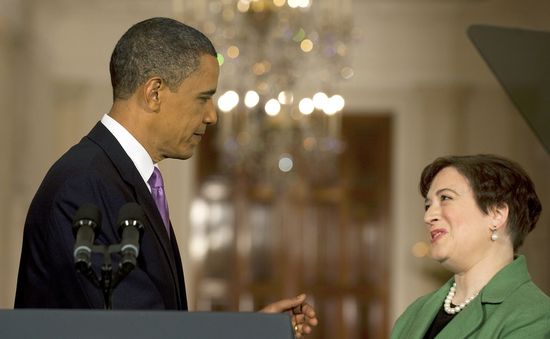
KAGANOBAMAJimWatson:Getty

Balko delivers the bad news:

She’s a cerebral academic who fits Washington’s definition of a centrist: She’s likely defer to government on both civil liberties and regulatory and commerce issues. And though libertarians allegedly share ground with Republicans on fiscal and regulatory issues and with Democrats on civil liberties issues, neither party cares enough about those particular issues to put up a fight for them. Which is whyKagan sailed through her first confirmation hearings, and is widely predicted to sail through the hearings for her nomination to the Supreme Court.

A person who will back executive power comes after two of the most radical pro-executive Justices (Alito and Roberts) in recent history. The onward march of the dictatorial presidency – in a time of constant threats from abroad – continues.

(Photo: US President Barack Obama (L) nominates Solicitor General Elena Kagan to the Supreme Court during an event in the East Room of the white House in Washington, DC, May 10, 2010. By Jim Watson/Getty.)

Kristol’s Smear On Kagan

Every now and again, the vileness of Bill Kristol's McCarthyite tendencies are simply impossible to miss. So his first assault on Elena Kagan is the assertion that she is somehow "anti-military." The way in which he does this is the classic modus operandi of the ideological propagandist. First concede the obvious point, so your smear cannot be immediately rebutted:

Kagan has professed at times her admiration for those who serve in the military.

Kagan has a long record opposing discrimination against honest homosexuals in the US military (only liars are currently allowed to serve without fear of persecution). This is a perfectly honorable position, backed by a huge majority of Americans, and has nothing to do with hostility to the military as such. In so far as this position seeks to back all the troops, and not just the heterosexual ones, it is arguably much more pro-military than Kristol's own exploitation of homophobia for short-term political ends. But here he goes:

Consider these words in particular from her letters to "All Members of the Harvard Law School Community": On Oct. 6, 2003, Kagan explained that she abhorred "the military's discriminatory recruitment policy….The military's policy deprives many men and women of courage and character from having the opportunity to serve their country in the greatest way possible. This is a profound wrong — a moral injustice of the first order." On Sep. 28, 2004: "…the military's recruitment policy is both unjust and unwise. The military's policy deprives…" etc. And on March 7, 2006: "I hope that many members of the Harvard Law School community will accept the Court's invitation to express their views clearly and forcefully regarding the military's discriminatory employment policy. As I have said before, I believe that policy is profoundly wrong — both unwise and unjust…," etc.

Notice, time and again: "the military's discriminatory recruitment policy," "the military's policy," "the military's recruitment policy," "the military's discriminatory employment policy."

But it is not the military's policy. It is the policy of the U.S. Government, based on legislation passed in 1993 by (a Democratic) Congress, signed into law and implemented by the Clinton administration, legislation and implementation that are currently continued by a Democratic administration and a Democratic Congress. It is intellectually wrong and morally cowardly to call this the "military's policy."

Yes, this is the thin reed on which he and his cohorts will nonetheless seek to spread a canard through the FNC propaganda machine. And, of course, it is a subtle but powerful way of attacking Kagan because she is, according to large numbers of people who have known her, a lesbian. A lesbian who hates the military. It's always worth listening to Kristol first. You get the contours of the coming smear.

Yglesias Award Nominee

"Wow, I rarely find myself disagreeing with PZ, Melissa, and Samhita, but I have to say that I don’t really see the problem with the American Academy of Pediatrics advising doctors to offer a “ritual nick” in lieu of the more serious forms of female circumcision that are often on offer in some other parts of the world.  The practice is something that is done in modern places that want to have a link to tradition without actually doing any real harm to little girls, from what I understand.  All they do is prick your genitals, or make a small cut that heals over, but nothing is removed.  You’re basically scratching the girl.  It’s not awesome—and from what I understand, in some places they just wave the razor over the girl’s genitals but don’t touch her at all—but comparing it to more severe forms of female circumcision troubles me," – Amanda Marcotte.

Dome Fail

Brad Johnson sums up the last efforts to stem the spill:

The giant box, known as a cofferdam, was lowered onto the leaking wellhead [Friday], with the intent of pumping the leaking oil up a pipe to the sea surface a mile above. … After the [100-ton, four-story concrete-and-steel box] was lowered onto the leak site, a slurry of methane crystals formed on the inside of the dome’s surface, making it bouyant and clogging the outtake at the dome’s roof. The giant box has been moved 200 meters from the disaster site, and is sitting on the sea bed.

The methane hydrates — natural gas that under the extreme pressure and low temperatures of the ocean floor is in a semi-frozen state — have also been implicated in the oil rig explosion, according to rig worker testimony acquired by the Associated Press. The liberal blog FireDogLake was the first media source to discuss the role of hydrates, noting a presentation from November, 2009 by Halliburton, who was responsible for cementing the Deepwater Horizon well, that warned of blowouts caused by hydrate destabilization

TreeHugger looks ahead to the next strategy: island building.