
Billings, Montana, 7.20 am
Billings, Montana, 7.20 am
D.T. Max reports on the mysteries and secrets of sleep:
If we can't sleep, perhaps it's because we've forgotten how. In premodern times people slept differently, going to bed at sunset and rising with the dawn. In winter months, with so long to rest, our ancestors may have broken sleep up into chunks. In developing countries people still often sleep this way. They bed down in groups and get up from time to time during the night. Some sleep outside, where it is cooler and the effect of sunlight on our circadian rhythm is more direct. In 2002, Carol Worthman and Melissa Melby of Emory University published a comparative survey of how people sleep in a variety of cultures. They found that among foraging groups such as the Kung and Efe, "the boundaries of sleep and waking are very fluid." There is no fixed bedtime, and no one tells anyone else to go to sleep. Sleepers get up when a conversation or musical performance intrudes on their rest and intrigues them. They might join in, then nod off again.
Nick Robinson has a useful primer on what the options for getting a parliamentary majority now are:
No party has enough seats to win votes in parliament without the support of members of other parties.
The Conservatives are the largest party with a total of 306 seats in the Commons – which would go up to 307 — if they win the delayed election in Thirsk and Molton – until now, at least, a safe Conservative seat.
If they tried to govern alone they would, in theory, face a combined opposition of 343 MPs.
In reality it’s somewhat different. Sinn Fein won 5 seats – and they don’t take their seats in the House of Commons – so the opposition benches reduce to 338.A Con/Lib Dem coalition would give them a total of 364 – enough to govern comfortably.
A looser arrangement in which the Lib Dems agreed not to vote against a Tory Budget or the Queen’s Speech would mean 306 or 307 Tories facing a depleted opposition of 281 (that’s 338 – 57 Lib Dems)
If a Lib Dem/Conservative deal fails, Gordon Brown will try to form a government.
If Labour and the Lib Dems joined forces – the extra 57 votes are not enough to make them the biggest force even with the support of the Northern Irish SDLP (who sat on the government benches in the last parliament) and the one new Alliance MP who is allied to the Lib Dems. Together that’s 319 votes.
With the support of the nationalists from Scotland and Wales they would reach 330.
If the DUP joined too and the independent unionist and the new Green MP this alliance would have 338 votes in the Commons.
A Lib-Tory alliance is the obvious first choice. If I were Cameron, I would offer a real fusion – a few cabinet posts for the Liberals, and a commitment to single transferable vote in one-member constituencies. But he should keep the economic policy intact, and start tackling the debt immediately. He has a chance if he embraces some kind of electoral reform to gain momentum as a reformist Tory.
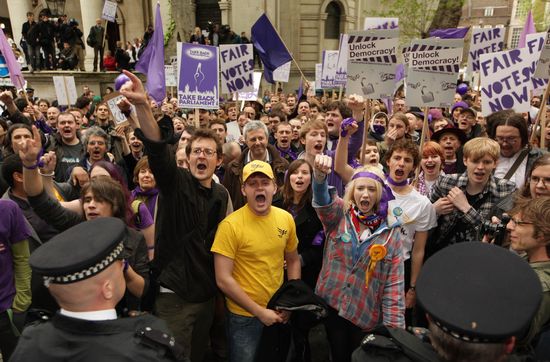
(Photo: Protestors calling for electoral reform besiege Transport House where Liberal Democrats are holding a meeting on May 8, 2010 in London, England. Over 1000 protesters have gathered in Westminster calling for proportional representation as the Liberal Democrat leadership discuss a possible coalition with the Conservative Party. By Peter Macdiarmid/Getty Images.)
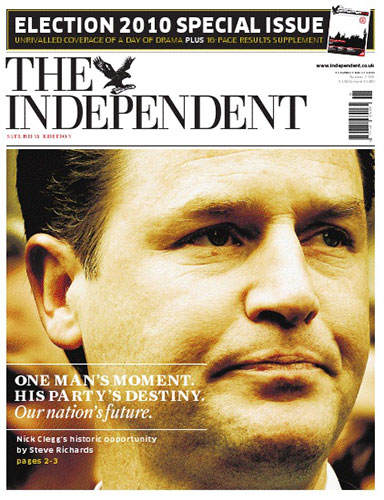
That's the word from a senior Liberal:
The source told the BBC's Jon Sopel that during the leaders' conversation last night, the tone went "downhill" at the mention of resignation.
It was claimed Mr Brown's approach was to begin "a diatribe" and "a rant" and the source said the Labour leader was "threatening in his approach to Nick Clegg".
Mr Clegg was said to have came off the phone assured that it would be impossible to work with Brown because of his attitude towards working with other people.
Both parties are now denying it – but they would, wouldn't they? The question of the hour is how strongly Clegg will insist on electoral reform as a condition for a new government with the Tories. And that is affected by the strongly democratic nature of Liberal Democratic politics. Clegg cannot get too far in front of his party. Meanwhile, #dontdoitnick (i.e. don't surrender on proportional representation) is rising on Twitter and an unruly crowd has assembled in London to demand electoral reform. Rick Hertzberg needs to get on a plane soon, don't you think?
A reader writes:
I saw the post about your reader who was horrified about the dog-killing raid and looking for “other documented examples…compiled into a single place.” And I despaired. This is a blog reader, presumably internet-savvy, and he is shocked, shocked, to discover the things that Radley Balko has been writing about with clarity and passion for years. Maybe you can put a perma-link to Balko’s "Overkill" on your sidebar? Seriously, none of this is new, and it isn’t just dogs being butchered, but people. Here are just a few that I know about off the top of my head:
Kathryn Johnston.
Jonathan Ayers.
Sal Culosi.
Tarika Wilson.
Gonzalo Guizan.
My partner of 20 years suffers from depression, fibromyalgia, and cervical dystonia. All of those conditions are highly treatable with cannabis. But we don’t dare. Instead, she takes a half-dozen different medications and visits a neurologist every couple of months for muscle-paralyzing shots. We have six dogs of our own, and usually have at least two fosters in the house; a raid on our house would end with all of them dead and both of us dead or in prison for defending them. We can’t take the risk.
Another writes:
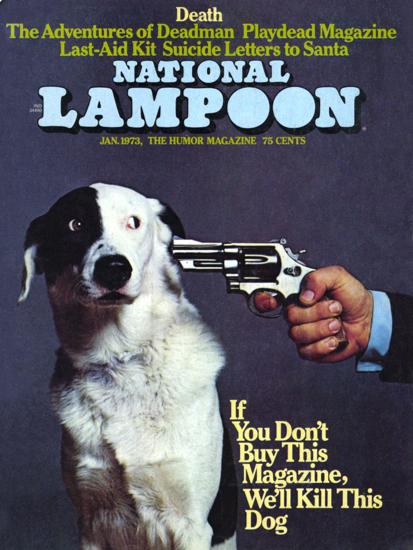
It's crazy that it takes something from a National Lampoon cover to get us to wake up to the realities of the failed war on drugs. Maybe now that it's becoming known that it is standard operating procedure to shoot pets during a drug raid – and we have the video to prove it – people will realize just how out of control the drug war is. Perhaps it's easier for us to sympathize with our neighbor's pets than with our neighbors.
But real people die in these raids all the time. Their names are Tarika Wilson (killed with her baby–who was also shot but lived–in her arms), Alberta Spruill, and Kathryn Johnston (a 92 year-old shot 39 times). Google their names. These are just a few. And if you still haven't gotten your fill of dead pet stories, google Cheye Calvo, or Pam and Frank Myers. Again, these are examples of what happens all the time.
And don't forget that the police officers conducting the raids are often caught in broken system. They are in danger too. But they have to meet their drug arrest and seizure quotas so the mayor can get re-elected for being "tough on crime." Promotions and raises depend on it. Someone has to put food on the table.
Keep shining a bright light on this issue. Perhaps we'll finally realize that the drug war is doing more harm than the drugs themselves.
Esther Duflo asks:
Today on the Dish we rounded up reaction to Britain's historic election and likely hung parliament. Cameron courted Clegg, voters were clear on Cameron's mandate, Patrick Dunleavy looked ahead, Simon Tisdall scrutinized coalitions, and Hertzberg backed proportional representation. Drunk-voting update here.
Analysis of the new jobs report here, here, and here. Coverage of the Greek crisis here, Iraq updates here and here, and a dispatch from the Gitmo trial here. Palin take-downs here, here, and here.
In assorted coverage, Steve Chapman made the case against surveillance cameras, Steinglass circled back to death panels, Nick Carr commented on the Internet's timesuck, Beth Fulton showed us the mania of television, and Orr reviewed Iron Man 2. Von and more readers sounded off on the puppycide video, more still on the race/intelligence debate, and another contributed to the Cannabis Closet. A dog beatboxed for us, hipsters threw water-filled condoms at each other, and we watched a hathos-filled sword slaughter.
Andrew was on Colbert last night if you missed it. Readers berated his beard choice. But his beagle loves him regardless.

(Joe Raedle/Getty Images)
Thursday on the Dish, Massie provided a reading guide to Election Day, Nate Silver sketched out scenarios, Cameron sounded confident, and Andrew made a final push for the Tories. We tracked the exit polling here, here, here, here, here, and here. First results here and the latest here.
The Lib-Dems looked in trouble, a Lib-Lab coalition seemed doubtful, Julian Glover figured Brown was toast, Cameron and Brown kept their seats, James Forsyth sized up the spin, Bagehot assessed the high turnout, and Nick Robinson griped about all the problems at the polls. Henry Farrell worried about a Tory collapse, Tunku Varadarajan blundered, a reader sent a view from Ireland, Paul Mitchell glanced at hung parliaments around Europe, and Andrew wondered about the uncertain outcome.
Drunk-voting coverage here, here, and here. More antics here.
Wednesday on the Dish we rounded up commentary on the eve of the election. The Tories continued to surge, Johann Hari harangued Cameron, the WSJ illustrated Labour's big-government record, Chris Bertram endorsed the party out of class sympathy, Larison distinguished the British left from the American left, Bernstein kept up talk over electoral reform, and Chris Brooke prepped us for a hung parliament.
In terror talk, Goldblog sized up the perception of the Times Square bomber, Andrew marveled at the madness of McCain and Lieberman, David Brooks gave props to the president's poise, and Steve Coll talked sense. We also learned that a Muslim immigrant had alerted authorities about the bomb.
Palin antics here. More scrutiny of the Arizona law revisions here and here. Even the Phoenix Suns sounded off. DC passed a medical marijuana bill. A horrific video from the drug war here. A forerunner of reparative therapy unloaded some gay baggage. Anna Lappé countered Robert Paarlberg on organic farming in Africa, Tom Laskawy tore into superweeds, and readers contributed to the race debate.
A letter from Nashville here. Epistemic closure watch here. Hewitt award here and creepy ad here. Bear-blogging here and here. Conan expletives here, tea with Tyson here, and kick-ass couch forts here.

Rancho Santa Margarita, California, 9.11 am
Tuesday on the Dish we compiled the day's commentary on the looming British election. Labour made their final ad pitch, one of their MP candidates knocked Brown, Nate Silver looked at the Tories' nightmare scenario, Michael White taught us a thing about hung parliaments, reader input here, and Wife In The North grew tired of the race. Also, a poor bloke got locked up for merely speaking his mind.
Times Square terrorism updates here and here. McCain sunk even lower, Thiessen itched to torture the bomber suspect, and John Bolton got trigger happy with Iran again. The torture trial in Britain moved forward, the Iraqi government continued to teeter, and a gay soldier wrote to the president. Oil spill coverage here, here, and here. Andrew broached the morality of fossil fuels while Cheney popped over to see his pal, King Abdullah. We also highlighted the other big disaster happening down south.
In immigration coverage, Gerson chastised conservative pundits who rallied around the Arizona law, bloggers critiqued the new revisions, and Max Fisher compared the immigration concerns of Brits and Americans. Thoreau and Dish readers tackled the new Bell Curve controversy, Jon Rauch examined how "family values" play out in red vs. blue states, Robert Paarlberg dismissed organic farming as a solution in Africa, and Andrew thought Beyond the Valley of the Dolls was super gay. Malkin award here. Cool ad here and creepy one here.
Monday on the Dish we compiled extensive commentary from the fourth-to-last day of the British election. Latest electoral projections here. Cameron considered full equality for gays, the Corner chimed in on Cameron, and some British Muslims supported the Tories. Niall Ferguson assessed the UK's finances.
Times Square bomb commentary here, here, and here. We also rounded up perspectives on the politics of the oil spill. Andrew chewed over Mearsheimer's latest take on Israel/Palestine (and addressed Goldblog's take), checked in on the Vatican sex scandal, and compared the GOP's anti-gay posture to its attitude toward Latinos. Reader reaction to Mearsheimer here. More Palin lies here.
Bill Maher stood up for South Park and free speech, TNC challenged Frum over profiling, and a Harvard Law student resurrected the Bell Curve debates. Yglesias award here, Malkin here, and more ugly rhetoric here. Creepy ad here.
— C.B.
Hertzberg defends proportional representation:
More accurate representation is one of the goals of P.R., but so is responsiveness. And there are plenty of others. A partial list: boosting the legitimacy of democratic government in the eyes of people whose candidates or parties lose as well as those whose candidates win; increasing participation; opening the policy debate to more points of view; discouraging irresponsibility, special interest influence, and scorched-earth negative campaigning; fostering civility, coöperation, and consensus; and giving fair representation to all kinds of minorities, ideological and political as well as racial, ethnic, and gender, while still guaranteeing that the government represents a majority of voters.
Beth Fulton provides the visuals for Todd Alcott's poem, "Television":
Of course, one could easily change the title to "Internet."
Simon Tisdall looks at the downside of coalitions:
Proportional representation in Britain, by increasing the likelihood that parties such as the BNP would win seats, could one day bring a repeat of the situation in Austria in 2000 when the mainstream conservative People's party formed a ruling coalition with the neo-Nazi Freedom party of the late Jörg Haider. In Italy, too, prime minister Silvio Berlusconi, no blushing liberal he, is sustained in power by those even further to the right.
Coalitions run the world's largest democracies, notably India, Pakistan, Brazil and Japan. In the US, both the Democratic and Republican parties are, in effect, grand coalitions embracing a wide range of groupings across the political spectrum – with all the contradictory, internal tension that implies. In Israel, fractious, multiparty coalitions are a constant, and constantly bedevil attempts to advance key aims such as the peace process.
 The Dish