What Next?

Patrick Dunleavy's analysis from earlier this morning:

There are three possible outcomes, in decreasing likelihood of their occurring:

-  Cameron minority government: expect a new election in October 2010 or May 2011.

-  Labour-Liberal Democrat coalition – should last at least two years, because constitutional change takes time. Gordon Brown has offered legislation to create fixed four-year terms, which might imply a government that lasts until 2014.

-  Conservative-Liberal Democrat coalition – without PR being included, it’s hard to see this lasting longer than May 2011.

Are The Democrats Oversold? Ctd

Bernstein is encouraged by the jobs report:

I suspect we're now pretty much at the point that Democrats will feel safe to start actually talking up the economy.  They've been very hesitant to do so to date, for lots of good reasons: most Dems still want jobs legislation, and talking up the economy undermines the case for it; the overall unemployment situation has still been terrible, and Dems don't want to sound insensitive to hard times for their constituents; and, most important of all, the Democrats certainly don't want a "Mission Accomplished" moment.  These reasons are now fading, as the economic situation improves.

The Mandate

This is important:

The results of a Comres flash poll, reported by the BBC, say that 81% think that the leader of the party with the most votes in the election should be prime minister. Other results include: 51% say that the leader of the party with the most seats should be prime minister. 'In the event of a hung parliament I would prefer David Cameron to be prime minister' – 48% to 45%.

61% say they would not prefer Gordon Brown to be prime minister in the event of a hung parliament.

All Eyes On Clegg

05Clegg
Anne Perkins sums up the dilemma:

[T]he longer David Cameron is politely barred from Downing Street, the more such momentum as he has from winning the most votes and the most seats ebbs away. Meanwhile, Brown is holding out to Clegg what could be the last best chance of getting voting reform this generation. But if Clegg grabs the chance, he will also appear to be doing exactly what he promised not to, and preventing voters shaping the result they voted for in the greatest numbers.

Alex Massie:

Cameron is putting the ball in Clegg's court. Electoral reform is not, no matter what people may claim, a pressing issue. If Cameron offers Clegg a real deal can the Lib Dems really refuse it? The purity of opposition is all well and good but if you're given the chance of power can a serious party really refuse it, even if it demands a number of compromises, some of them unpalatable?

Guido:

If the Tory right is too small minded to allow Cameron to do a deal with Clegg then they are as stupid as they are short-sighted.  This is an historic opportunity to realign politics along a liberal-conservative axis.  It is the chance to destroy the Labour Party as a party of government forever. If the price is real reform of the electoral system then that is a price well worth paying to free us from the economic destruction wrought time and time again, decade after decade, by a statist, big government Labour Party.

Tony Travers :

Labour’s sudden conversion to a referendum on PR derives directly from its desire to stay in office, despite having done badly in the election. There had been no such offer during the past 13 years. The Conservatives, given their antipathy to PR, are unlikely to be able to give Clegg an equivalent offer. Several complex issues would have to be decided before a Lab-Lib deal could be concluded. Such issues include: the type of PR to be offered in a referendum; timescales (eg, would the referendum take place at the end of a full Parliament, or perhaps within a shorter period); and how to ensure that neither the Commons nor the Lords could scupper the necessary legislation.

In the end, Nick Clegg will have to decide whether he wants to risk being accused of keeping Labour in office after 13 years of power, and with the Conservatives ahead in terms of seats and votes. There are big risks for the Liberal Democrats whoever they choose to side with. Another general election within a year or so now seems very likely.

Alex Barker:

Clegg’s hand on pushing for electoral reform is significantly weakened by his poor election showing. So while they won’t rule out a deal with Labour, it will mainly be to strengthen their position with the Tories. An AV referendum is probably out of the question. But the Tories could offer up some other concessions: cutting the number of (Labour) MPs, recall elections, and even fixed term parliaments.

Labour’s only chance of getting together with the Libs will be in six months or so, under a new leader. If the Tories fail at “governing in the national interest”, if they prove unpopular enough for Clegg to ditch, then a Lib-Lab coalition deal is back in play. That’s all Clegg has to scare the Tories with.

Iain Martin:

Nick Clegg has just been absolutely humiliated. (This inconvenient fact is being mostly skimmed over by the BBC today for some reason). Clegg’s new politics is a smoking ruin. Cleggmania is destined to be an amusing trivia question in years to come. He has actually lost seats. His vote share has barely gone up. He is in no position to dictate terms to anyone, and I stronly suspect he’s bright enough to know it.

The Tory leader’s smartest course of action on electoral reform would be to offer not a sausage, nothing, hee-haw.

Hopi Sen:

If Cameron thinks he can bundle Clegg over the goal-line, without making any big concessions, naturally he will. If I were Cameron I would try and dare the Lib Dems not o support me, initially. Why wouldn’t he? If I were Clegg, I’d say tell, Cameron, politely, make a proper offer and demand to sit down and talk it through properly.  This again is quite reasonable.

If the Tories and Lib Dems find it impossible to find common ground, then Labour come into play. Of course, both the Tories and Lib Dems know that we are sitting on the sidelines, waving hopefully.

James Macintyre:

[O]ne senior Whitehall source says that Clegg is merely setting up a "bidding war", of which this could merely be the early stages. It is worth noting that Clegg said the "first" opportunity for a deal goes to the Tories. But not the only one.

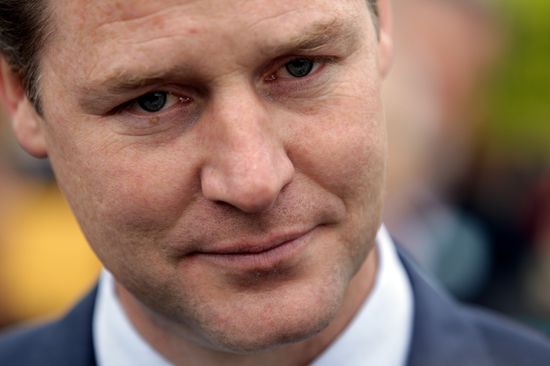
(Image: Leader of the Liberal Democrats Nick Clegg speaks to party supporters during the last day of campaigning before polling day on May 5, 2010 in Eastbourne, United Kingdom. By Dan Kitwood/Getty Images)

Jobs Go Up, Unemployment Goes Up?

EmployRecessApril2010
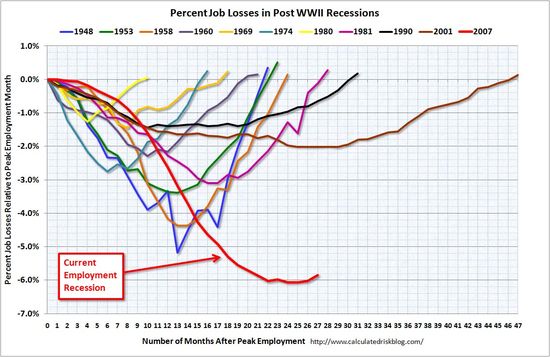
Leonhardt calls today's jobs report excellent. He explains:

[The unemployment rate] rose last month because of a something of a statistical quirk. The Labor Department counts people as officially unemployed only if they are not working and looking for work. Between March and April, there was a surge in the number of out-of-work people who started looked for work. That — not job losses — is what swelled the ranks of the officially jobless and caused the unemployment rate to rise to 9.9 percent, from 9.7 percent.

Daniel Indiviglio adds:

If this report tells us anything, then it says we shouldn't expect a significant drop in the rate this month either, as the seasonally adjusted rate tends to remain above the unadjusted rate in May. But when summer hits, we'll likely see the rate decline again to 9.7% or less — assuming job growth continues the current trend.

(Image: Calculated Risk)

Cameron Reaches Out To Clegg

The die is cast. With only 305 seats, and needing 326, Cameron makes a bold gesture (audio here) to reshape the center-right:

David Cameron has made a "big, open and comprehensive offer" to the Liberal Democrats to help build a "strong and stable government". He said he would be open to looking at electoral reform and set up an all-party committee. He restated many Tory policies and said that there were areas where the two parties could find agreement, such as education and cutting taxes. He also highlighted areas of disagreement such as Afghganistan and Trident, immigration and the EU. He concluded saying: "I hope we can reach an agreement quickly." He said the urgent priority facing a new government was reducing the deficit.

Already some conservative resistance:

In entering coalition talks, Cameron tests his authority within party. Inquiry into electoral reform? The Spectator cannot support this.

Brown is hoping to stay in the game too – but this offer seizes the initiative in forming a government. But anything can happen:

The last time a general election produced a hung parliament, in 1974, the historian Peter Hennessy suggested that the way to proceed was determined during a stroll in the park by the three most discreet men in the realm – the Queen's private secretary, the Cabinet secretary and the private secretary at No 10.

Race And Intelligence, Again, Ctd

This thread is attracting quite the response from readers. One writes:

I come to this as a scientist. No topic is out of bounds as long as the discussion is rooted in facts and analytic objectivity. So, no, it is not fair for the student to be hounded and humiliated. Certainly a lot of the backlash is knee-jerk PC over-reach.

But for God's sake, she is just blundering all over a topic with no substantive core. It's like watching school children debate how Santa gets into chimney-less homes. As has been said before, there is no "race" at least not at the genetic level. There is a continuum of genetic diversity, but racial categories are a cultural construct. There is no objective "intelligence." Sure math and science are important, but they were not the key to survival in the evolutionary past and they are not the key to success in the modern economy that I participate in. Who knows what is that unnameable spark that makes someone synthesize disparate information, understand the interests of others, predict future trends, and create influence with others? That's the key to success but it can't be measured or predicted, and it certainly can't be allotted to one "race" over another. 

So when the student ignorantly bumbles into this false question, dropping one red herring after another, all in the name of making a non-sensical but offensive proposition "respectable", who can blame folks for wondering what the real agenda is behind such blather? Because it isn't some intellectual search for truth. It's either spectacular ignorance, or, dare I say it, racism.

Another writes:

Other readers are hitting most of the points that I want to see in

response to the race and intelligence question (namely, the

questionable existence of a single, measurable "intelligence"), but

this particular reader deserves a short, direct reply:

The "descendants of fishermen from the coast of Africa" who came to North America weren't a natural population in any sense of that term. They were slaves. They were selected, either for their physical strength, or because they lacked the skills necessary to escape capture. These Africans were brought here for hundreds of years, prevented, by law, from intermarrying with the non-African population and were segregated from the general population by law and custom until very recently.

I do not deny for one minute that there may have been some kind of selective pressure on genes based on who was captured, who survived the awful journey, and who managed to live and have babies through the ordeal of centuries of slavery.  Aside from that, there's good history to suggest that a relatively small number of tribes in inland West Africa accounted for a substantial majority of the captured and enslaved.  That's a vital topic for investigation.

However, to suggest that there was no genetic intermingling between enslaved persons with those of European descent is to be drastically ignorant of the sexual history of slavery.  Anyone can easily notice when meeting people from sub-Saharan Africa how much darker their skin tone is than the group we call "African-Americans."  The reason is well known — almost no person descended from enslaved Africans lacks for a substantial amount of European descent.  Give any person, particularly (but not exclusively) men, absolute power over the lives of others, and see what's likely to happen.

Perhaps nowhere has this been expressed so pithily as by James Baldwin in one of his debate with James Kilpatrick over miscegenation: "You're not worried about me marrying your daughter – you're worried about me marrying your wife's daughter. I've been marrying your daughter since the days of slavery!" Modern Americans descended from slaves not only have substantial contributions from the European gene pool, it would have been disproportionately from the southern elite.

Another

Your reader who talked about how blacks were 'selected' as slaves simply does not understand how evolution works.  There is absolutely no way to select for 'intelligence' by the single test 'who gets caught by slavers.'  If this were repeated over many, many generations, and no other genes were allowed into the gene pool, then maybe – just maybe – you'd be selecting for 'gets caught by slavers.'  This doesn't necessarily select against intelligence, of course.  Even the horrible conditions of the slave ships, where many died, only select – once – for 'survived a crossing in a slave ship.'  This might select FOR intelligence. 

And don't talk about 'slaveowner breeding programs' – they were virtually non-existent, and included plenty of slave owner genes invading the gene pool.  I'm sorry, but even the 400 years or so that black slavery existed were simply not enough time for these kinds of differences to haphazardly breed in to the group, and certainly not in the absence of a stringent and active program.

These arguments remind me of Charles Murray's idiotic "Jews bred for intelligence" arguments about how Eastern European Jews selected for scholarly-ness, or that you had to be able to read in ancient Judea to be a Jew.  Please.

Another:

I come to this as a scientist. No topic is out of bounds as long as the discussion is rooted in facts and analytic objectivity. So, no, it is not fair for the student to be hounded and humiliated. Certainly a lot of the backlash is knee-jerk PC over-reach. But for God's sake, she is just blundering all over a topic with no substantive core. It's like watching school children debate how Santa gets into chimney-less homes. As has been said before, there is no "race" at least not at the genetic level. There is a continuum of genetic diversity, but racial categories are a cultural construct. There is no objective "intelligence." Sure math and science are important, but they were not the key to survival in the evolutionary past and they are not the key to success in the modern economy that I participate in. Who knows what is that unnameable spark that makes someone synthesize disparate information, understand the interests of others, predict future trends, and create influence with others? That's the key to success but it can't be measured or predicted, and it certainly can't be allotted to one "race" over another. 

So when the student ignorantly bumbles into this false question, dropping one red herring after another, all in the name of making a non-sensical but offensive proposition "respectable", who can blame folks for wondering what the real agenda is behind such blather? Because it isn't some intellectual search for truth. It's either spectacular ignorance, or, dare I say it, racism.

Another:

I read The Bell Curve many years ago and was impressed with its methodology and analysis. Since then I've become much more skeptical, mainly because in my own experience I see that those with the higher IQs do not generally end up at the top of the heap in professions or in business. Having a high IQ and scoring well on the standardized tests get you a good first job due to a self-perpetuating and thus meaningless set of assumptions, but success over the long term has much, much more to do with what is loosely called emotional intelligence, the ability to understand, connect, and communicate with other human beings. In fact the longer you play out the reel the less important pure "intelligence" seems to matter.

But this calls into question the very definition of "intelligence," and for me that's where the bottom falls out for Murray's theories. Suppose that, rather than using the loaded term "intelligence" we said "the ability to score well on this particular test without regard to other aptitudes" or "the ability to hop on one leg while eating." No one would then care about the theory or its racial implications. And when you come right down to it, that about sums up the importance of Murray's book.

I think for many the discussion of race and "intelligence" is exciting because it seems so edgy, controversial, and even intellectually daring. But once you narrow the definition of "intelligence" enough to make the outcomes comport with reality, it's actually boring.
Timesuck Engaged

Nick Carr looks at the downside of our digital existence:

There's been much written about how the Web provides new opportunities for people to express themselves. That's true, and welcome. But the Web is also an enormous global timesink, sucking up massive amounts of time that might have gone into more productive, thoughtful, and fulfilling activities. It's difficult to measure the cost of this wasted time, because it's impossible to know what people might have done if they weren't surfing and tweeting and youtubing and huluing and foursquaring and emailing and IMing and googling and etc. The Web often gives us the illusion of having an incredibly diverse set of pursuits when it's really narrowing the scope of our thoughts and activities. There is still a whole lot more that people can do offline than online – something that's easy to forget as we peer into our screens all day.

Carr also responds to a commenter who wonders if we are replacing TV time with internet time:

In some cases, yes, but not in most. The average time that people spend watching TV, in both US and Europe, has been going up steadily throughout the Web era. The idea that the time people spend online comes out of time they would have otherwise devoted to TV viewing is largely a fallacy, if a pleasant one.

Why The “Death Panel” Myth Won’t Die

Matt Steinglass revisits the epistemic closure debate by pointing to Brendan Nyhan's paper on how misconceptions spread and resist correction:

Mr Nyhan suggests at the end of his paper that the best response to this problem may be "naming and shaming" public figures and media sources that spread mis- or disinformation. He points to the widespread discrediting of Ms McCaughey in 2009 as an example. I'm not sure how promising this is as a strategy. Organisations that begin with the aim of correcting false information, and devote themselves simply to criticising misrepresentations, tend with time to be seen by the public as tied to a partisan agenda of one sort or the other.

That's what has happened to Media Matters, for example; because it is dedicated to critiquing distortions by conservatives, its critiques carry no weight with conservatives. The way to maintain credibility as an arbiter of claims is to try to direct one's critiques fairly equally at both liberals and conservatives. But this can generate the same kind of false equivalency and he-said/she-said-ism that Mr Nyhan thinks contributes to the proliferation of public misperceptions of fact. It preserves incentives for each camp to try and skew the needles by pushing more outrageous ideological claims. I think Mr Nyhan is right that we need to invest some social capital in reinstilling a sense of responsibility in our political and media elite. But I'm not optimistic about any strategies for doing so.

Scenes From The Drug War, Ctd

Von at Obsidian Wings reflects on this video:

Put aside the wisdom or morality of the drug war.  Balko and Sullivan both pivot that way.  I want to talk about something different.  Something a bit larger.  Folks talk about the banality of evil.  It's one of those cliches that you hear from time time.  But I don't think that folks stop very often to think about what that phrase means.  Or what it looks like in action.  Evil becomes banal when people — good people — stop recognizing it, stop appreciating it, and come to accept it as normal.  When evil becomes so routine that good people accept it as the way of doing business.

I am not comparing the cops in the video to Nazis (whence the phrase comes). But it's hard for me to see their actions, here, as anything other than evil. 

Maybe I'm overly influenced by having kids; maybe I'm not thinking straight.  But my reaction to watching these cops, dressed to kill, bashing down a door and shooting two dogs (a pit bull and a corgi) in front of a seven year old child all because his father had a little bit of pot … well, my initial reaction was shock.  This video literally took my breath away.  Followed, quickly, by anger.  This kid could easily have been killed for nothing; he certainly will be scarred. 

Mark Thompson goes another direction:

I will believe that conservatives and the American Right view the words “liberty” and “tyranny” as something other than politically effective platitudes when they make putting an end to 40,000 raids like this a year a higher priority than whether they are taxed to provide someone else with health care or the unrealized hypothetical consequences of cap and trade.

John Cole:

I can’t get over those assholes that shot that man’s pets over a miniscule amount of pot (and more than likely based on faulty information from an informant with whom they cut a deal). I’ve only had Lily 11 months (today!), but I would be out for blood if someone shot her, cop or otherwise. I’d be a helluva lot less rational than that guy was. At the very least there would have been a tasing on that video or another shooting (of me) as I lost my shit all over the place.

Pete Guither follows up on the story.