The Corner Solution

Jason Kuznicki is wary:

A corner solution arises whenever, when faced with a tradeoff among two or more variables, we declare that one of the variables is to be minimized regardless of the state of all of the others. In public policy, some corner solutions are justified, but most are not.

We have to control our borders” is one example of a corner solution. It posits that unauthorized border crossings are to be minimized, and it says nothing about the other factors that probably ought to be relevant to sound border policy — factors like expense, loss of civil liberties, collateral damage, our international reputation, and the sheer fact that without illegal immigrants, many sectors of the economy might entirely collapse. The corner solution ignores all that. In so doing, it obtains a clarity that may or may not be real, but that is politically very useful.
Iraq’s Power Struggle

Musings In Iraq studies the new Shiite political coalition:

For now the main goal of the new Shiite coalition is to maintain their control of the state, and keep Iyad Allawi out of power. That doesn’t mean his National Movement won’t have a seat at the table of a new government, but Allawi will not be allowed to become prime minister again. Unfortunately, that doesn’t mean that Iraq’s politicians are any closer to forming a new regime. The new Shiite alliance said that they would next turn to the Kurds to join them. Other smaller parties may be brought in as well. That still leaves one major hurtle to overcome, how to outmaneuver Maliki, which will likely be the last move before a new Iraqi government is announced. 

Joe Klein senses danger.

The Situation In Greece

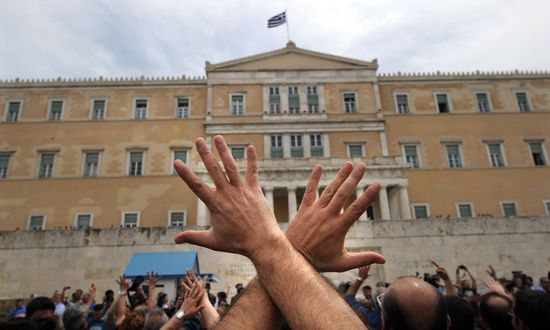
GreekProtestersDimitarDilkoff:AFP:GettyImages

Brian S. Wesbury and Robert Stein think the Euro is undervalued. Ramesh summarizes what sounds like a rational argument:

By making it impossible for the Greek government to solve its problems through devaluation, it forces the public sector to bear more of the pain of economic adjustment.

But this happy thought feels rather far from reality after reading Peter Boone and Simon Johnson's argument that only allowing the Euro to depreciate will save Greece: 

This new program calls for “fiscal adjustments” — cuts to the fiscal deficit, mostly through spending cuts — totaling 11 percent of gross domestic product in 2010, 4.3 percent in 2011, and 2 percent in 2012 and 2013. The total debt-to-G.D.P. ratio peaks at 149 percent in 2012-13 before starting a gentle glide path back down to sanity.

This new program is honest enough to show why it is unlikely to succeed.

Daniel Gros, an eminent economist on euro zone issues who is based in Brussels, has argued that for each 1 percent of G.D.P. decline in Greek government spending, total demand in the country falls by 2.5 percent of G.D.P.  If the government reduces spending by 15 percent of G.D.P. — the initial shock to demand could be well over 30 percent of G.D.P.

Video of clashes here.

(Image: Protesters shout anti-government slogans in front of the Greek Parliament in Athens on May 5, 2010. Athens police chiefs mobilized all their forces, including those not on active duty, to restore order on May 5 amid rioting during protests against a government austerity drive. Police were put on a 'general state of alert' to deal with the clashes after three people died in a bank that was firebombed on the margins of the demonstrations. By Dimitar Dilkoff/AFP/Getty Images)

Deadlock In Britain

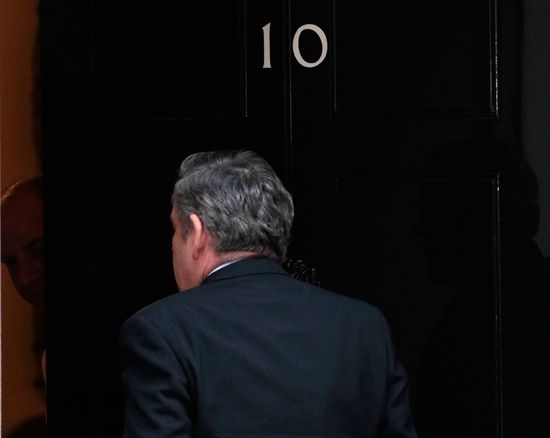
BROWNMChristopherFurlong:Getty

This just about sums up the state of play right now:

A hung parliament is virtually inevitable. With more than 500 seats counted, the BBC is predicting that the Conservatives will end up with 306 seats, Labour 262 seats and the Lib Dems 55 seats. The Conservatives are currently on 37% of the vote, Labour on 28% and the Lib Dems on 23%.

Gordon Brown has said that it is his "duty" to try to form a stable government. Constitutionally, he is right. Given that the Tories do not have a majority, he is entitled to form a government and to try to get a Queen's speech through the Commons. He only has to resign if the Queen's speech is voted down. (Effectively it's a confidence vote.) Although some reporters travelling with him think he seems gloomy about his long-term prospects, he claims to be "energised" by the result and Labour have started semi-public negotiations with the Lib Dems about a coalition. Ministers such as Lord Mandelson and Alan Johnson have indicated that they would like to do a deal over PR.

I can't imagine Brown taking this as a mandate to carry on. But the intrigue is just beginning. Latest results here.

Big Bother

Steve Chapman argues that surveillance cameras are overrated:

Leave aside those airy privacy concerns for the moment. Installing, maintaining, and monitoring thousands of these devices, as in New York and Chicago, costs millions of dollars. Absent cameras, that money could be spent on beat cops, patrol cars, forensic equipment, jail cells, you name it. The point of any law enforcement tool is not just to do some good but also to do some good at a reasonable cost compared with the alternatives. It’s by no means clear that surveillance cameras even come close to meeting that standard.

He points to a 2005 report by the British government concluding that its four million cameras “produced no overall effect” on crime. Carol Rose came to the same conclusion regarding the latest bomb scare:

New York City’s “steel ring” of 3,000 surveillance cameras (including 82 in Times Square alone) played virtually no role in capturing the alleged bad guy, according to New York Police Commissioner Raymond Kelly. Instead, it was a couple of alert citizens, responsive cops on the street, effective police detectives following a trail of low-tech clues — VIN numbers, house keys and a cell phone number that Shahzad gave to the woman he bought the truck from — that helped nab Shahzad before he escaped to Dubai.

However, while the man in the surveillance footage ended up not being Shahzad, publicizing it as such “may have had the effect of falsely reassuring the real suspect that he wasn’t a target,” according to the AP.

An Election Wrap: This One Goes Up To 11

Edit Post - The Daily Dish | By Andrew Sullivan | TypePad_1273218248094

The Beeb predicts a hung parliament:

The BBC projection suggests David Cameron's Conservatives will have 306 seats. If there are 10 Unionists elected in Northern Ireland then Mr Cameron might be able to command 316 – probably still slightly too few for him to be sure of winning a Queen's Speech. But Labour and the Lib Dems together would have 317 seats, according to the BBC figures, which even with three SDLP MPs would still leave them at 320 – again probably just a few votes short.

Expect a ton of analysis and commentary on the Dish later today. But first a quick summary of yesterday's coverage:

Massie provided a reading guide to Election Day, Nate Silver sketched out scenarios, Cameron sounded confident, and Andrew made a final push for the Tories. We tracked the exit polling here, here, here, here, here, and here. First results here and the latest here.

The Lib-Dems looked in trouble, a Lib-Lab coalition seemed doubtful, Julian Glover figured Brown was toast, Cameron and Brown kept their seats, James Forsyth sized up the spin, Bagehot assessed the high turnout, and Nick Robinson griped about all the problems at the polls. Henry Farrell worried about a Tory collapse, Tunku Varadarajan blundered, a reader sent a view from Ireland, Paul Mitchell glanced at hung parliaments around Europe, and Andrew wondered about the uncertain outcome.

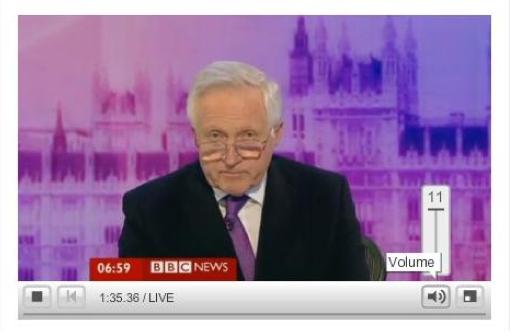
Drunk-voting coverage here, here, and here. More antics here. Regarding the image above, a reader writes:

Thanks for the post where you provided a link to the BBC. But did you notice the volume control on the streaming video app? I took a screenshot.

Context.

— C.B.

Messy Messy Messy

Brown has first dibs at trying to form a coalition. This is interesting:

Nick Robinson, the BBC's political editor, is claiming that talks between Labour and the Lib Dems about forming a coalition government have already begun. The Tories will end the night with more seats, but convention dictates that the party currently in power gets the first chance to show it can form a new government.

But it's unimaginable that Brown would stay on – which is why the Tories' current message is that th election was a referendum on Labour and they lost. Could Clegg be PM and head a 'progressive' Lib-Lab government? Unlikely, especially after his party's poor showing tonight. But the results could still surprise us in the morning. The Telegraph again:

It's such a mixed picture. Tories are picking up seats they didn't necessarily expect to win, and failing to take some slam-dunks. The Lib Dem vote is – bafflingly – down in many places, but they've picked up a couple of seats. There has been a 12pc swing against Labour in some of their heartlands, but elsewhere they've gained vote share. Messy messy messy.

The knife-edge Tory-Lib-Dem marginal of Guildford, where my sister and mum live, swung strongly to the Tories:

The seat was No1 on the Lib Dem target list (they only needed a swing of 0.09pc) but Tory candidate Anne Milton increased her majority to 7,782. Tonight may be even worse for the Lib Dems than the dreadful early exit poll indicated.

Brown And Cameron Retain Their Seats

It seems as if the Lib-Dem surge might have crashed – or certainly failed to translate into nearly as many seats as some had expected. The swing does not appear to be uniform at all – with individual seats being far more unpredictable than usual. The Tories do look like being easily the biggest party – but the impact of marginal seats has yet to be calculated.

While we wait, it’s worth noting one lovely ritual of election night in Britain. Even the party leaders have to stand on a stage with the other candidates vying for their seat and listen to the results. They are just members of parliament at this point. They are not heads of state – or even really “prime minister”, which is a convention in British politics rather than part of a Constitution set in stone. They are one of several candidates. So the first candidate to congratulate David Cameron was his rival from the Monster Raving Loony Party. Here’s Gordon Brown’s speech upon being re-elected in his constituency although almost certainly not as prime minister: