The First Result

From Coffee house:

The first result of the night is in, and Labour hold Houghton and Sunderland South. Bridgit Philipson wins with 19,137 votes (over 50 percent). The Tories are in second with 8,147 votes (21 percent).  The swing to the Tories, from the last election, is 8.4 percent – over the total that they need nationally for a majority.

Lucas advises:

Not much to read into this, as it appears a lot of the swing is due to the independent candidate who ran on local issues.

If The Exit Polls Are Right…

Paul Mitchell examines instances of hung parliaments across Europe:

Looking across 17 west European countries in the post 1945 period, nearly two thirds (64 per cent) of all government’s were coalition cabinets.  The rest were obviously single party governments, but of these 23 per cent were one-party minority governments. Only 13 per cent (one in eight) were single party majority governments, produced by ‘non-hung’ parliaments. Of these 53 one party majority governments, 20 of them were British. Only Norway, Greece and Ireland have ever had more than 5 single party governments since 1945.

Renard Sexton has more along these lines.

Citizens Have Rights: Deal With It

Countering the WSJ, Bainbridge defends Faisal Shahzad's constitutional rights:

The so-called privilege against self-incrimination emerged in English law during the 1600s in response to the brutalities of royal "justice." By the end of the 1600s it had become not just a privilege, but a basic constitutional right. Moreover, it was a right not only to remain silent, but also virtually a right to be protected against classes of forbidden questions. To effectuate that right, the exclusionary rule forbade introduction of evidence obtained by coercion, threats, promises, or torture. Yet, that rule should be understood not only as a rule of evidence. It was also intended as a prophylactic ban on coercion and torture in interrogations. The Miranda warnings followed in due course as a further prophylactic ban on coercion.

This is now the struggle – between law and coercion. The GOP leadership favors coercion and spent eight years trashing core values of Anglo-American civilization, ostensibly in its defense. History will not be kind.

More On The Exit Polls

538exit
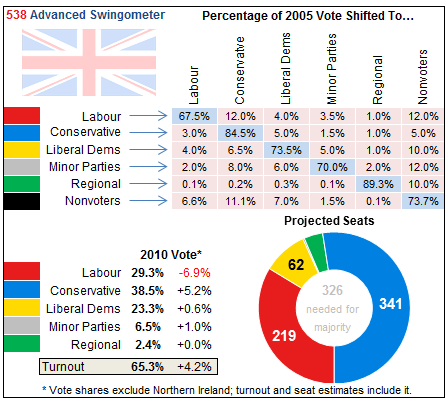
Nate Silver plugs the exit poll numbers into his model:

Here is what our model would project on a popular vote of Conservatives 38.5, Labour 29.3, LibDems 23.3:

Iain Dale thinks the exit polls are off:

So the exit poll shows the Tories on 307 seats, 19 short of an overall majority. Don't panic chaps and chapesses. My view is that by 4am this poll will have been shown to be wrong. It seems too incredible to be true that the LibDems are only predicted to get 59 seats. I'll run naked down Whitehall if that turns out to be true.

The FT's Westminster blog is live-blogging:

Turnout is expected to be higher than usual – party observers around London have reported higher than usual numbers of voters coming through, even at traditionally quiet times of day. Turnout could even reach 1997 levels of 71 per cent, in contrast to 61 per cent in 2005. Kiran even spotted a 17-year-old attempting to vote in Bethnal Green – and who says the young are disengaged!

The Lib Dems Lose Seats?

Scott Lucas reacts to the exit poll:

The surprise is that the Liberal Democrats come out so low, losing three seats since 2005. But that in turn turns out to be bad news for the Tories: there is not much lower that the Lib Dems can go in an actual result, so the Conservatives have to hope the Labour vote is inflated in the exit poll to have any shot at a majority.

From Coffee Houses's life-blog:

The exit poll contrasts with the mood from both the Tories and the Lib Dems. One Lib Dem source told me a few hours ago they were expecting to get close to a hundred seats and this exit poll has them losing seats.

A possible explanation at Bagehot's place:

Vince Cable on the BBC is pointing out that exit polls don't include postal votes, which this time around could be as many as a quarter of the total. Meanwhile: rumours are doing the rounds that Labour is worried about Sunderland, which ought to be a stronghold and prides itself on being the first seat to report.

The Police State And The Cannabis Closet

A reader writes:

That Scenes From the Drug War post really freaked me out. I watched the video all the way through and was so bugged that I posted it to my Facebook page. Six hours later I came back and found two comments. One was from a buddy of mine who is an FBI agent doing anti-gang work in New York City. He urged me to join mpp.org and advocate for decriminalization. The second was from a lawyer friend of mine who wrote "it has happened before," and posted this link.  After reading a second story about a police raid over drugs that aren't found and involving pets murdered in front of family members, I started to get concerned. If there are other documented examples of this kind of behavior, they need to be compiled into a single place so we can get a handle on exactly what kind of society we are running here.

You see, I just started smoking marijuana about eight months ago and I recently had a drug dealer over to my apartment. Now I'm wondering whether there is a possibility that the police will break down my door, shoot my dog, and arrest me. I have seriously started to wonder whether I've been wrong for my entire life about who the good guys are and who the bad guys are in society, at least when it comes to drugs. I come from a Christian home and I've always admired the police. But this is scary and it has me bewildered.

Eight months ago I probably would have been neutral to mildly supportive of the war on drugs. But in October of 2009 a neighbor of mine got me smoking weed with her and then we stayed up late on several occasions and talked while high. I am 35 and had only smoked on about two occasions prior to that, both times since I turned 30. This time I smoked with this friend on about 20 different occasions, figured out how to do it right, and we often spent several hours in deep conversation.

The experience caused me to dramatically re-evaluate my life and it resulted in the end of a depression that I've been in for several years. I've not been depressed for about three months solid, and it is one of the weirdest experiences of my life. I haven't been this enthusiastic in a decade. At first I chalked it up to making a job switch and doing some thinking. Shortly after I started smoking pot with my friend I got the name of her supplier, bought a bit of my own, and then read a couple books on marijuana including Understanding Marijuana: A New Look at the Scientific Evidence. A couple of times the author mentioned that marijuana has been used to treat depression.

Then, a few weeks later I Googled "indica vs sativa" and happened upon a website that claimed sativa is used to treat depression. I still didn't think anything of it. A week later I asked my supplier for some sativa, assuming we'd been getting indica all along since it is more common. He told me that we had in fact been smoking a primarily sativa variety. Now I wonder if I have in fact unwittingly benefited from medical marijuana. Maybe my job change and my thinking had a good deal to do with the lifting of my depression, but I've changed jobs before and I've done a lot of thinking all my life. What did seem to correspond exactly with the lifting of my depression was a couple of months smoking weed and talking things over with a friend.

I guess it's about time for someone to kick down my door, shoot my dog in front of a child, terrorize my housemates, and arrest me – for the good of society.
Numbers To Watch For

Mark Blumenthal urges caution on exit polls. They got it totally wrong in 1992 (see above). The Economist's pre-result primer:

As for performance benchmarks, it may be easiest to think in terms of large round numbers. If Mr Cameron wins at least 300 seats, he will almost certainly be prime minister. If Mr Brown wins more than 200, he will have avoided the kind of rout that could have brought Labour’s long-term viability into question. If Mr Clegg gets his party past the 100 mark, he will have smashed a psychological barrier and earned himself enormous clout in Parliament.

“Because We Are Nashville,” Ctd

A reader writes:

I know this quote was supposed to be a nice statement about how great Nashville is, but what came through for me was really a guy remarking on the barbarism of the residents of other flooded cities. Coming from a place that is routinely flooded every couple of years, I can tell you that looting is a desperate reaction to poor government response.  Do people think that the reason why NOLA residents looted after Katrina was because they were bad people, or because their government had abandoned them and they were looting out of desperation?  And did Nashville actually handle the floods on its own?  Not really.  They had help from the Tennessee National Guard and FEMA.  That is why these institutions exist.  So, before we go off and explain the niceness of Nashville in the face of disaster as compared us heathens elsewhere, let's at least recognize that state and federal disaster managers have done a good job this week.  When they don't, there's no accounting for what people will do.

In fact, Nashville was not without looting.