Nashville: Still There

A reader writes:

Just want to say thanks so much for mentioning Nashville yesterday. I know there's a lot of other stuff going on right now that news outlets are choosing to cover but we really do need the attention, support and prayers of everyone to get through this.

There are so many stories. The Grand Ole Opry stage (which has a cutout circle of wood from the original Opry where Hank Williams once stood and played) is under water. The massive hotel and convention center known as the Opryland Hotel is sitting in ten feet of river water, diesel fuel and sewage. The city takes in something like 12.5% of its hotel tax from this one 2,880-room establishment, which will be closed for months for repairs. A restaurant with aquariums lining the walls at the mall across from the hotel has broken tanks and piranha are swimming around the mall in five feet of water. People are still being rescued. The football stadium, hockey arena, symphony center, and many other historic businesses and buildings in Nashville are flooded and have untold millions in damage. Worst of all, this flooding happened outside of high-risk areas so most people are without flood insurance. The entire city stinks of wet. We're conserving water, so we're calling today Stinko de Mayo – be stinky for Nashville's sake & don't shower.

Choosing Between Abuse And Deportation

Laura Tillman fears that the Arizona law will keep battered women from getting the help they need:

The law requires police officers to question those they suspect of being in the country illegally about their immigration status. A change to the law made late Friday specifies that these questions be asked only when an officer is stopping, detaining or arresting a person while enforcing another law or civil ordinance. This provision makes it unclear whether the perpetrator of the crime or both criminal and victim would be asked in the process of, say, responding to a complaint of domestic violence.

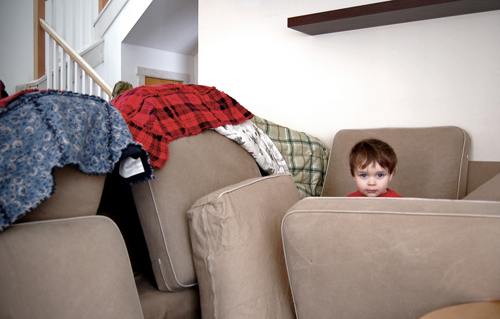
Couch Forts: A Critique

Couch-Cushion-Fort-21

BUILDblog scours the Internet in search of new talent:

At first glance the composition appears unintentional and the construction shoddy. But further investigation reveals a clear delineation between indoor/outdoor space with a design focus on protection through the use of barrier. Planes are shifted off the orthogonal to accommodate function; as a side effect it relieves inhabitants from a harsh Euclidian geometry. Grade B

The next review, after the jump, would make Maddox proud:

Couch-Cushion-Fort-161

Good God gentlemen, you’re a mess! You need walls, you need a roof. Get to work man!
Grade: F

Educating Congress on Marijuana

DC's medical marijuana bill passed yesterday:

The DC medical marijuana program would allow members of Congress to get a first-hand look at how such programs work and ease the passage of medical marijuana legislation at the federal level, [Karen O’Keefe, director of state policies for the Marijuana Policy Project] suggested. "A well-working medical marijuana program in the nation’s capital will also provide members of Congress who have never seen such programs up close with a unique opportunity to do so, she said. Once they see for themselves that these laws do nothing but provide compassionate care for seriously ill patients, hopefully they will understand the need to create a federal policy that no longer criminalizes patients in any state who could benefit from this legitimate treatment option."

Underdogs

Daniel Engber looks at why we root for them:

[It] may be smarter to gamble your emotions on the team that's most likely to reward you with a stirring victory—and that's least likely to crush your soul. For Frazier and Snyder, that means betting on the underdog: If they win, it's the greatest feeling in the world. And if they lose—well, you kind of knew that would happen all along. The same reasoning applies in reverse: If you're pulling for the favorite, then a loss cuts extra deep, while a victory merely delivers what you thought you deserved. "Thus a utilitarian model would indeed predict the underdog effect," the authors observe.

In response, Jonah Lehrer points out that refs are immune to this effect and instead tend to favor the home team:

[W]hile the rest of us are rooting for the underdog, the referees are just trying not to get booed. And since the underdogs rarely have home-field advantage, the data suggests that refs and umps actively counter our desire for underdog victories. They make the superstars more likely to win.

The Tories Go Big

Massie writes that "launched their most ambitious, 'biggest' manifesto in thirty years" but that there is "a discordance between the Tory message and the moment in which it is delivered":

The Conservatives have been caught between their rhetoric of "Broken Britain" and their promise of a brighter, optimistic future. The more thoroughly Britain is broken the more unlikely, even impossible, that future seems. If the Tories are right about Labour's record then their plans seem too airy-fairy, too intellectual, too unlikely to survive contact with brutal reality and useless Britain; if they're wrong then they seem necessarily apocalyptic.