Larison counters Michael Barone who argues that "left parties are in trouble in the Anglosphere":
It is…important to distinguish between the fates of Labour and the Democrats. New Labour has been in power uninterruptedly for thirteen years. The Democrats have only been in the majority in Congress for three years, and have had unified control of government for a little more than a year. Brown’s government is responsible or is being held solely responsible for Britain’s fiscal and financial woes, to which Brown contributed as Chancellor under Blair, and Labour cannot pin any of this on its political opponents. Labour could have called and then likely won a general election after Brown assumed the leadership in 2007. Had he done so then, Brown would not be in his current predicament. This is first and foremost evidence of the failure of Brown’s political leadership. What Barone cannot really show is that Labour is suffering politically today because of a lack of “third way” political positioning or a lack of “centrism.” Were Blair still leading his party into another general election this year, there could be no question that the electorate was rejecting a relatively “centrist” Labour government.
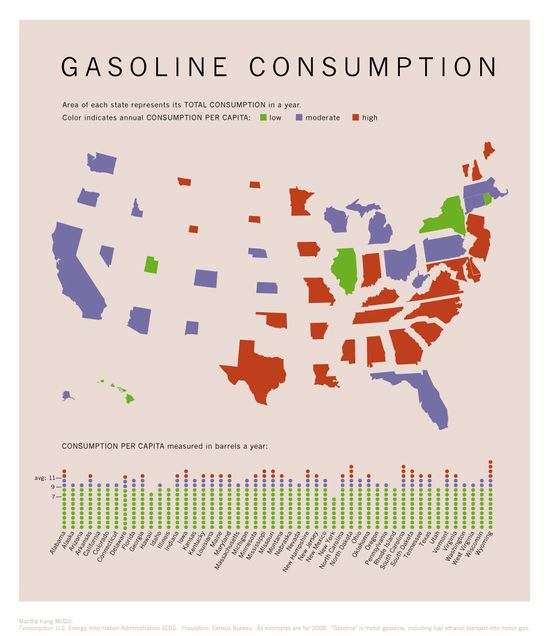
If you were to sum up the cost of IQ losses from leaded gasoline (now gone, of course, but the effects live on), the asthma epidemic among today's kids, military protection of the Middle East, global warming, garden variety smog, plus all the more prosaic things like traffic jams and so forth, I wouldn't be surprised if the real cost of a gallon of gasoline would have to go up by three or four dollars to pay for it all.
Map on per capita state gas consumption by Martha Kang McGill of Infrastructurist.com.
Today on the Dish we compiled the day's commentary on the looming British election. Labour made their final ad pitch, one of their MP candidates knocked Brown, Nate Silver looked at the Tories' nightmare scenario, Michael White taught us a thing about hung parliaments, reader input here, and Wife In The North grew tired of the race. Also, a poor bloke got locked up for merely speaking his mind.
Times Square terrorism updates here and here. McCain sunk even lower, Thiessen itched to torture the bomber suspect, and John Bolton got trigger happy with Iran again. The torture trial in Britain moved forward, the Iraqi government continued to teeter, and a gay soldier wrote to the president. Oil spill coverage here, here, and here. Andrew broached the morality of fossil fuels while Cheney popped over to see his pal, King Abdullah. We also highlighted the other big disaster happening down south.
In immigration coverage, Gerson chastised conservative pundits who rallied around the Arizona law, bloggers critiqued the new revisions, and Max Fisher compared the immigration concerns of Brits and Americans. Thoreau and Dish readers tackled the new Bell Curve controversy, Jon Rauch examined how "family values" play out in red vs. blue states, Robert Paarlberg dismissed organic farming as a solution in Africa, and Andrew thought Beyond the Valley of the Dolls was super gay. Malkin award here. Cool ad here and creepy one here.
[It] doesn’t seem a co-incidence that the amnesty point is being rammed
home over and over by senior Conservatives in the last few days. I’m told that Cameron mentioned it at least four times yesterday. For the Tories, greater scrutiny of this Lib Dem policy has been useful because it allows Cameron to look tough on immigration without looking as if he’s obsessed by it.
But they are still short a majority. Politics Home's latest projection:
The Conservatives are now 35 seats short of an overall majority, having fallen back by six seats since the last projection. Labour are projected to win 230 seats (up five), and the Lib Dems 97 (up 1). The projected Tory share of the vote is 35.1%, compared to Labour’s 26.7% and the Lib Dems’ 28.6%.
The most obvious option is the one previously used by many minority governments – get an alliance with Ulster Unionists. And so Cameron dutifully went to Norther Ireland to suck up. Their likely condition for backing the Tories? Exemption from spending cuts. Yes, the sausage-making could be awful on Friday.
Meanwhile, after supporting Labour for 23 years, the Financial Timesbacks the conservatives.
The editorial reasons that "Labour needs a spell in opposition to rejuvenate itself" and that the Lib Dem's economic policy "is an uneasy mix of sanctimony and populism". Larison likes Cameron's general tenor:
What is so surprising about the “Big Society” manifesto is how unlike the centralizing “reform” or “compassionate” conservatism it is. Where Bush was constantly inserting the federal government into the work of charitable institutions, schools and local communities where it had not been before, Cameron is proposing that social institutions take over for an intrusive state. Maybe it will never happen, and maybe the society Cameron wants to entrust with these responsibilities has atrophied so much on account of dependence on state institutions that it will not be up to the task, but as far as the concentration of power is concerned it is nothing like the modernized Toryism I was expecting.
I was put off by Cameron's focus on what historian Daniel Boorstin once described in a visionary book of the 1960s as "The Image." He seemed more focused on the rebranding of the Conservatives than on the contents of the package. He reminded me of a former Republican senator I once lunched with who could only talk about politics and looked at me with a blank stare when I asked him what he thought about an issue, as opposed to how it would "play."
Neither feeling was dispelled when I met up with Cameron in Derby the morning after the final debate. Unlike Clegg, who simply walks into a room and engages people in conversation, Cameron's appearances are staged, benefitting from the work of an advance team with an eye to how a camera will regard him. Press access to the candidate is limited, lest something unanticipated overshadow the message of the day.
The big danger in the Cameron project is that Cameron has addressed the Conservatives’ political problem, but not their policy problem. Thatcher had an approach to elections yes, but above all an approach to government. Does Cameron? Not so clear. How does a modernizer respond to a budget crisis as extreme as that which now faces Britain?
The extremity of the British crisis has simultaneously destroyed Labour (the government that presided over the crisis) and weakened the Conservatives (because voters fear how the Conservatives might respond to the crisis). The extremity of the crisis has turned Cameron’s appealing freshness into a potential liability, with anxiety over whether he will be equal to the crisis.
Frum is dead-on here. The trouble is the recession has not led to the kind of popular revolt against Labour that gave Thatcher her opportunity. And thrice, the Tories tried to run on warmed-over Thatcherism and thrice, they were pummeled. Clegg was Hitchen's intern, long ago when Hitch worked for The Nation. Hitchen's view of the election:
It is, ultimately, as a status quo party that Labor is being defeated. Brown comes before us as a man who has spent his entire life intriguing with gnawing, neurotic energy for power for its own sake, only to find, when he attains the prize, that it doesn't soothe his demons after all. A party with a history of radicalism, however attenuated, simply cannot afford to present itself as the party of safety first and a steady hand on the Treasury tiller.
Arguing that his party is ahead of Labour "not of course in terms of bums on seats but in the battle of ideas" on the "progressive tests" of "liberty versus authority, individual versus the state, nationalism versus internationalism, individual mobility versus dependence on the state, political transparency versus the hogging of power", he adds: "I've always rejected the complacency and the assumption by many people in the Labour Party that they have the first claim on the progressive instincts of fairness of the people in Britain. I really don't think they do."
Hertzberg posts the above pitch for proportional representation, "explained twenty-seven years ago, by the great John Cleese, in a ten-minute “party political broadcast” he made for the SDP/Liberal Alliance in the 1983 general election.":
The Alliance—a mariage de convenance between the Social Democratic Party, a short-lived breakaway of moderates from Labour, and the historic Liberal Party of Gladstone and Lloyd George—is the immediate ancestor of today’s Lib Dems. In 1983, with Cleese’s help, it nearly tied Labour in the popular vote, 25.4 per cent to Labour’s 27.6. Mrs. Thatcher and the Tories got 42.4 per cent, which, although lower than Michael Dukakis’s stateside percentage five years later, yielded 55 per cent of the House of Commons. Sadly, the Alliance turned out to be a dead parrot, but some of us hope that the Liberal Democrats have only been resting. Beautiful plumage!
Daniel Korski advocates for a Tory-Lib Dem economic coalition:
The Tories, even if they move passed the magic number of 326 seats, would do well to think about a economic coalition with the Liberal Democrats, even if a broader pact remains somewhere between unnecessary and unattractive.
Far better, surely, to besmirch the Lib Dems with Conservative cuts than go it alone. As a Lib Dem supporter told me earlier today, plenty of party stalwarts hope for a go-it-alone Tory government as this selection will put a lot of candidates in second place, thus making them poised to overturn the Tories at the next election (assuming Labour remains in the doldrums).
While Paul Waugh argues that Cameron doesn't need Parliament:
Maybe, just maybe, a minority Cameron Government simply wouldn't produce much legislation to carry out its campaign of change.
Cutting the number of ministers? Doesn't require legislation. Merging departments? Doesn't require legislation. Cutting budgets, back office staff? Doesn't require legislation. Setting up a new 'War Cabinet' or shifting policy on Iran? Doesn't need legislation. Cutting bureaucracy in the police, schools and NHS? Can be done through secondary legislation, ministerial directive or guidance.
Iain Martin has the complete video (above) from Brown's speech yesterday. Martin isn't sold:
Brown’s style is very much son of a preacher man, or more accurately Son of the Manse. It’s a very Scottish style and is accompanied by a high moral tone. It is not a surprise that he was fired up Citizens UK, an organisation featuring many faith groups, or that they in turn were fired up by Brown.
However, there is no history – certainly in the television age – of this kind of Scottish or Welsh tub-thumping being a remotely electorally appealing proposition in England (where the vast majority of UK voters live). It appeals to a very vocal niche – some people who work for the Guardian, some people who read the Guardian and a few other romantics who wish that that English politics was conducted with a different electorate. But not to many others.
Labour seem to have reached for tactical voting as the latest apparent solution to their plight. They argue that there is an "anti Conservative majority" in this country and that people should bote tactically to keep Tories out in Labour-Tory marginals. The cheeky buggers then try to avoid the question of what Labour voters should do in LibDem-Tory marginals.
Dizzy is confused by Labour 's mixed messaging on this front. Charlie Becket warns the BBC against promoting it:
It is perfectly legitimate for the BBC to cover the general story that politicians are advocating tactical voting. With the polls suggesting a hung parliament it is the hot issue over the next few days. But I agree with Iain that the BBC in particular needs to leave the finer detail to the campaigning websites and the newspapers and get back to the policy issues.
Tony Blair has urged against tactical voting, and lacerated the Tories, but you have to wonder if part of him wants his old rival and partner to lose. It would leave Blair as the only recent Labour leader to win an election. Henry Farrell dissents from Blair's high-mindedness:
What seems a bit odd to me is the implicit claim that strategic (or ‘tactical’) voting is somehow dubious or politicized. There are a number of heroic assumptions underlying democratic assumptions about voting – that voters are well informed about issues, that they want someone who is the best match to their pre-defined policy preferences, that individual voting decisions count in some significant way and so on. But putting these aside – more information is better than less information, no? The case for the BBC declining to tell its viewers about tactical voting choices seems to me to be no better than the case for the BBC declining to tell its viewers that the Tories support this policy, and Labour that one. Both provide voters with information which should (in an ideal world) make their voting decisions better informed.
Massie thinks Labour's partial endorsement of tactical voting was a mistake:
[T]he advice from Ed Balls and the others that tactical voting is the smart thing to do is an admission that Labour no longer believes it can win. Given the state of the polls that' hardly a startling conclusion but the problem, from Labour's perspective, with conceding it publicly is that it cannot possibly motivate Labour voters to get to the polls. Quite the reverse in fact. The message "Abandon Ship! Save Yourselves!" is no way for the party to hold its nerve.
Despite having more money than they know what to do with, the Tories' broadcasts have been dreadful. Despite having next to no money, Labour's have been terrific…Eddie Izzard's 'Brilliant Britain' film [below] has been watched online more than any UK election broadcast ever.
Of course, Alastair Campbell makes Dick Morris look intellectually honest. Yglesias defends Brown:
Under the circumstances, it’s worth pointing out that whatever Brown’s flaws and despite the very real problems with the Labour government (Iraq, e.g.) he’s largely being punished for an economic crisis he didn’t cause, couldn’t have stopped, and has actually handled quite well. The global financial meltdown was not unique to Britain and the United Kingdom’s status as a country that’s unusually exposed to the ups-and-downs of the financial industry is extremely longstanding. The country has mostly been suffering from bad luck.
Krugman seconds him. But the debt and spending that Labour had racked up before the crisis hit? If you bash Bush for it, you also have to bash Blair and Brown.
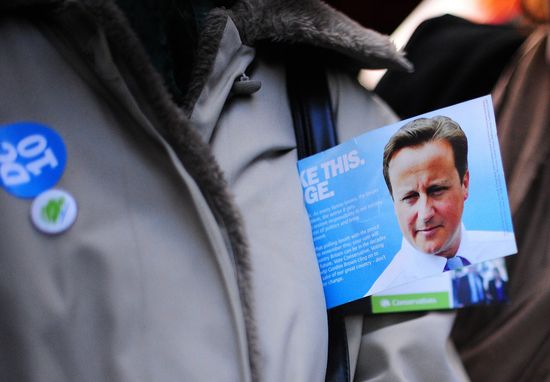
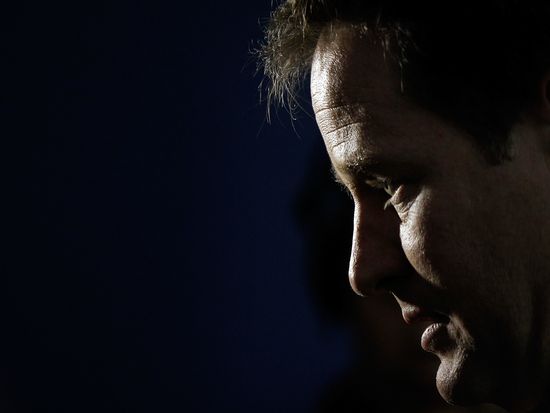
(Images: Conservative supporters wait for Conservative Party Leader David Cameron at a campaign event on May 3, 2010 in Feltham, West London. By Carl de Souza /AFP/Getty Images. And Nick Clegg takes part in a question and answer session with community groups at the Frontline Church on May 4, 2010 in Liverpool, England. By Christopher Furlong/Getty Images)
About that bomb-training. The fertilizer used in the bomb was non-explosive. The crude firecracker detonators didn't work. The clocks and wires seemed to have been completely extraneous. Makes you wonder.
Even though the secular party of Allawi narrowly won the most votes, the Shiite parties have now done a deal to form a government without him. The Kurds seem eager to go along. And so, the Sunnis seem marginalized again:
The willingness of Sunnis to accept a limited role in a Shiite-dominated government could determine Iraq’s political stability in the coming years.
“No doubt this could lead to a resurgence in violence and provide a fodder for extremism,” said Sheik Abdul-Rahman Munshid al-Assi, who leads a Sunni political council in the disputed region of Kirkuk. “There must be participation in the government by any means. Otherwise we will return to square one.”
The only reason to read Shahzad his Miranda rights would be to preserve what he says as evidence in his criminal trial. But our first priority should not be preserving evidence for his trial—it should be getting intelligence from him.
Isn’t it strange that Mr. Thiessen writes as if it’s impossible to read someone their Miranda rights and subsequently gather intelligence from him? I certainly agree that an interrogation is optimal here, but so is preserving the ability to convict and jail the perpetrator of this plot. Perhaps the suspect was totally willing to talk until he heard the familiar words, “You have the right to remain silent,” but it seems far more likely that the boilerplate phrases wouldn’t in fact be the determining factor in his willingness to cooperate.
Thiessen is euphemizing here. He wants to torture the guy. Bainbridge, meanwhile, defends Miranda. As does Joyner. Drum sighs. It appears that the newly revamped Obama interrogation team has indeed got the suspect to talk. And at some point, because of Miranda, he and others may actually get convicted of their crimes – something Thiessen's thugs never quite managed very often.
A patient going by "Rafael" poses after undergoing a face transplant at Sevilla's Hospital Virgen del Rocio on May 4, 2010 in Sevilla. The second patient to have undergone a face transplant in Spain appeared before the media to thank the family of the donor for making the surgery possible before leaving the hospital. Rafael suffers from neurofibromatosis, a genetically inherited disorder in which the nerve tissue grows tumours. These tumours had severely disfigured Rafael's face. By Cristina Quicler/AFP/Getty Images.
A board member of the National Association Of Research And Therapy of Homosexuality – the Bill Kristol-backed group that claims to "cure gays" – and fellow founder of the Family Research Council with James Dobson … returns from vacation with a close friend found on rentboy.com.
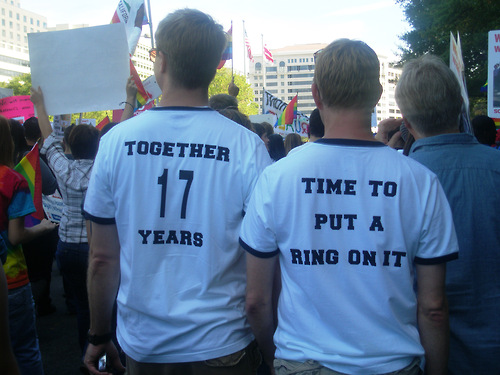
Weigel, a typically impartial reporter, gets blowback from readers after calling those who oppose marriage equality "bigots." He regrets the word choice, but adds:
[W]hy was I willing to be so disrespectful to one group of activists? Unlike with most activists, I don't really see the direct impact on their lives, or on the lives of the people who agree with them, of the cause they oppose. Antitax protesters are threatened by higher taxes. Anti-health-care-bill protesters fear their coverage will get worse. Anti-meat-eating protesters believe animals are being murdered and the environment is being made worse. Even the birther movement has always made a kind of sense — oust Obama from office, and you get a chance to reverse what damage you think he's done to your country.

 The Dish