The Daily Wrap

Today on the Dish we discovered that an American died on the flotilla and that Israel backpedaled on its claims of an Al Qaeda connection. Yaacov Lozowick called on Bibi to make the case for the blockade and Wieseltier responded to the row. Dissent of the day here. Andrew despaired over the Church's decision to target gays in the workplace. Bush said he'd torture again.

In Gulf coverage, Michael Coren wondered if BP's gonna pay up, John Calfree explained the downside of investigating them, Dickerson and Lehrer thought about thinking about the spill, and Copyranter went to town on the company's PR campaign. Palin penned the foreword for a think tank study, the Wasilla paper apologized to McGinniss, and Sarah haunted Andrew's dreams.

In assorted commentary, Douthat delved into the finer points of empathy, Andrew and Dreher discussed tradition and culture, Andrew addressed the rudeness of Brits in pop culture, Virginia Postrel processed Obama's glamor, Steinglass studied the shifts in Western conservatism, Liz Halloran tallied up the new women running in the GOP, and the Economist imagined car-less cities. Nate Silver made a deal with the NYT and Taegan Goddard shared his thoughts. The Dish recognized the Green Movement's birthday.

Malkin awards here and here. More retirement talk here. Readers kept the job-hunting talk going and Drum chimed in. Another serving of crack and cleavage here and another dose of Dishness here. MHB here, VFYW from Israel here, and FOTD here. Feel-good video here. And one of Andrew getting tackled by his beagles here.

— C.B.
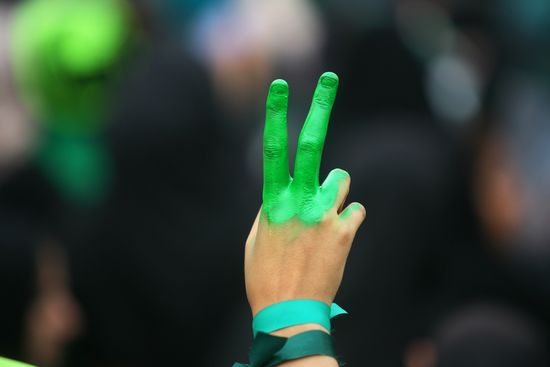
The Anniversary Of The Green Movement

  FingersMousaviMajidGetty

Iran's election was a year ago this month. Karim Sadjadpour marks the occasion:

Mousavi and Karroubi’s excessive reliance on street protests is misguided. While their courageous supporters espouse tolerance and practice non-violence, they are overwhelmed by armed government forces who are willing to kill and die to retain power.

If the Green Movement is to mount a serious challenge to the government it must incorporate support from bazaar merchants, workers in major industries, transportation unions, and government workers. Sustained strikes by these groups would bring the country’s economy to a halt. This is a tall order, however, given that Iran’s labor groups, while deeply discontented, are just as amorphous as the Green Movement itself.

What’s more, Mousavi and Karroubi, perhaps chastened in part by the unfulfilled promises and excesses of the Islamic Revolution – are seemingly in no hurry to see abrupt change. Instead, they have pursued a gradualist approach that aims to co-opt and recruit disaffected members of the traditional classes, including clergy and Revolutionary Guardsmen, to the Green Movement.

(Photo: Supporters of presidential candidate for Iran, Mir Hossein Mousavi, gather during a campaign rally at Haydarniya Stadium on June 9, 2009 in Tehran, Iran. By Majid/Getty Images.)

Gangsters > Government

Johann Hari reviews Daniel Okrent's Last Call: The Rise and Fall of Prohibition:

By 1926, [Al Capone] and his fellow gangsters were making $3.6 billion a year—in 1926 money! To give some perspective, that was more than the entire expenditure of the U.S. government. The criminals could outbid and outgun the state. So they crippled the institutions of a democratic state and ruled, just as drug gangs do today in Mexico, Afghanistan, and ghettos from South Central Los Angeles to the banlieues of Paris. They have been handed a market so massive that they can tool up to intimidate everyone in their area, bribe many police and judges into submission, and achieve such a vast size, the honest police couldn't even begin to get them all. The late Nobel Prize winning economist Milton Friedman said, "Al Capone epitomizes our earlier attempts at Prohibition; the Crips and Bloods epitomize this one."

Experience (Not Always) Needed

Kevin Drum sympathizes with a Dish reader searching for work who wrote that "If you've done exactly the job advertised before, you'll be considered. But you'll be considered incapable of learning anything new":

This is a surprisingly widespread attitude, even in the white collar sector. Back when I had a real job and frequently hired new staff members, I always looked for people who had the right general background (product management, say, or tech writing) but I didn't worry too much about whether their background precisely matched what they'd be doing for me. This was, however, decidedly not the attitude of most of my peers.

Many of my job candidates were interviewed by a few others in the company as well as by me, and I was always surprised by the number of people who would say "But he only has a hardware background" (we were a software company) or "she's never worked in document imaging" (we were a document imaging company). And the folks who said this were consistent when they were hiring for their own departments: they were really meticulous about looking only for people who had exactly the background they needed, whether that meant selling high-volume scanning software (for a sales job) or knowing the precise set of technologies we used to build our software (for a programming job).

This attitude wasn't universal, but it was surprisingly common. And it betrays a real laziness.

Steinglass half agrees.

Investigating BP

John Calfee isn't happy about it:

[Obama] endorsed Attorney General Eric Holder’s already high-profile criminal investigation into the behavior of BP in the run-up to the drilling platform explosion and the consequent massive leak from 5,000 feet below. It is hard to imagine a more counterproductive strategy. In two other areas where human error can have disastrous consequences—medical practice and airline operations—it has become clear that in the essential task of finding out what happened and how to prevent it, a crucial tool is the absence of an immediate criminal or civil penalties investigation. The reason is simple. In diagnosing and fixing errors, information is at a premium, and the faster it is found and used, the better. Because that information is typically embedded in a mass of details that can only be untangled by experts—often the same experts who could be implicated in civil or criminal litigation—it is counterproductive to have those experts thinking about how to avoid severe penalties while also trying to uncover the best that science offers.

Face Of The Day

101586959_

Members of Darren Rewcastle's family lay flowers and grieve in Duke Street at the point where he was killed yesterday on June 3, 2010 in Whitehaven, England. 12 people were shot dead yesterday and a further 25 people injured after a 52 year old man named as Derrick Bird went on a rampage with a shotgun in west Cumbria before killing himself. By Oli Scarff/Getty Images.

The GOP Gets A Shot Of Estrogen? Ctd

Liz Halloran counts the heads:

Fourteen Republican women are in the running for the U.S. Senate. In 2008, just three Republican women competed in the general election, according to the Center for American Women and Politics. And 94 are still vying for House seats, compared to 46 at about the same time in the primary cycle two years ago. Also telling? Sixty of the 106 women who are challenging incumbents for House seats are Republican.

Encouraging, no?

On Cracks And Cleavage

A reader writes:

You wrote, “Not to mention the possible evolutionary connection between breasts and posteriors.” Take it away, David Brent.

Another writes:

Jeff Murdock, from the great British sitcom “Coupling,” had an unforgettable quote about this:

Fact is, some women don’t have large breasts, and they’re people too. Maybe they’d like the freedom to show us their bottoms instead of their breasts. Maybe they’d enjoy a more flexible arse-friendly beach that says: ‘Hey, so long as you’ve got cleavage, who cares which way it’s facing.’