A Vacation From Thinking

John Dickerson delves into the difficulty of finding creative solutions to stop the BP leak:

Federal officials who have been in big crises all talk about a moment when someone figured that the answer was not to apply more of the same remedy (or even "historic" amounts of it) but to look for an entirely new approach altogether. This sounds great in theory, but is very hard to do in the moment because the immediate needs take up 25 hours of the day. There's no time to think, and even if you have a great idea, there may be no organizational capacity to carry it out. There's also the problem that every hour someone spends on your creative idea is an hour they're not spending producing outputs that can be measured by the media and your political opponents. Also, creative ideas open you to ridicule. Why are you wasting your time on that and not ordering more boom?

Jonah Lehrer advises the engineers to stop thinking about the problem:

I imagine the poor engineers trying to fix this catastrophe back at HQ are working around the clock, swilling coffee by the gallon and trying to stay focused amid all the pressure. Their bosses are probably driving them crazy, demanding instant solutions to a seemingly impossible puzzle. And so the engineers drink more coffee. They pull yet another all-nighter. After all, a problem this difficult requires every ounce of their conscious attention.

This post is about why those poor BP engineers should take a break. They should step away from the dry-erase board and go for a walk. They should take a long shower. They should think about anything but the thousands of barrels of toxic black sludge oozing from the pipe.

The reason for this counterintuitive advice is that there appears to be a tradeoff between certain kinds of creativity and the frantic sort of focus that comes when people are put in high stakes situations.
The View From A Career Counselor, Ctd

A reader writes:

The career counselor nails it. I've been looking for a job for about two months now and have come to the conclusion that Human Resources is, without question, the most useless, bureaucratic, least efficient department in ANY organization. HR has, ironically, perfected the extrication of any sort of human contact imaginable when applying for a job – no names, no contact info, no phone numbers, no nothing. I even went to one job fair where an HR rep for a company refused to accept a resume I was trying to hand her. "We only take resumes online for jobs posted," she said.

Another writes:

Your reader attempts to offer some good advice for getting a job in today's market, but I feel like the his/her outlook is beyond cynical and really gets to the heart of the matter of the jobs crisis in this country: no longer is it sufficient to be driven, motivated, competent, and skilled at one's job; one must also be a professional marketer and kiss-ass.

I have a great distaste with the idea of having to "brand" or "market" myself in order to even land an interview. I have made available my work record, my marks in school, professional and personal references, a cover letter tailored to each individual position for which I am applying … since when do my qualifications not speak for themselves? It makes me think that the only people who are going to get jobs are those who, while perhaps not as qualified or competent as me, have connections and know how to bullshit their ways into positions. I have an ethical problem with that (not to mention that I'm a terrible bullshitter).

Another:

I very much agree with the general thrust of what this former career counselor has to say. Tomorrow I will be starting a new job – a temporary position managing a small project for 3-4 months with a decent chance of becoming permanent by autumn. I didn't get the job through Monster, CareerBuilder, the Washington Post's job section, or any other online or print resource, but through two friends and former co-workers working on my behalf – one who works at the company that laid me off last year, the other at the company which hired me last week.

Ever since getting laid off 15 months ago, I have strongly suspected that the only chance of finding a new job would come through people I know. I used every contact I could think of, "cold-e-mailed" every company who seemed to have projects up and running or in the pipeline, talked directly to the people running some of the largest construction projects in the metro area where I live, had friends circulate my resume – everything. I applied for maybe 200 jobs over the past year, and landed a grand total of zero interviews.

In short, I have come to believe that unless you are a superstar who can choose your job offer and name your salary, then personal contacts are not just the most important factor when it comes to finding a new job, they are pretty much the ONLY factor.

The Daily Wrap

Today on the Dish we learned that BP has been criminally culpable for years and that Palin has more chutzpah than we thought. With the help of Noah Millman, Andrew took a long look at the Israel dilemma. Readers dissented en masse. We also heard from a friend of the young American who lost her eye protesting the flotilla, we learned how harmless its cargo was, and we watched some right-wingers rub it in. Larison laid into Israel for blockading Gaza, Jim Henley clarified his point about Israel "winning," Thomas P.M. Barnett turned the klieg light on Turkey, and Pareene parodied Palin.

In other coverage, Phillip Smith saw some good signs for legalization in California, an NRO contributor gave props to Obama for his drone policy, and we rounded up some racial commentary on Artur Davis' loss in Alabama. Maureen Dowd demanded that Obama be more like daddy, Reihan rolled his eyes at the call for an oil spill czar, Leonhardt looked at worst case scenarios, Bernstein balked at majority rule, and Andrew agreed that we should prune benefits for senior citizens.  David Runciman examined the UK's unraveling and ITN reported on a rampaging gunman.

Paul Bloom discussed our attachment to fictional characters, P.J. O'Rourke recommeded live obituaries, and Michelangelo sketched brains on God. Steve Jobs dissed blogging, Steve Coll had some parting words on the medium, Nick Carr criticized links, and Dave Coverly drew an accurate conclusion. Ken Layne spotted manbearpig. Beard sighting here. Cracks and cleavage here. Recession view here and cool ad here. MHB here, VFYW here, and FOTD here. Holy shit! moment here.

— C.B.

Worst Case Scenarios

Worstcasescenario

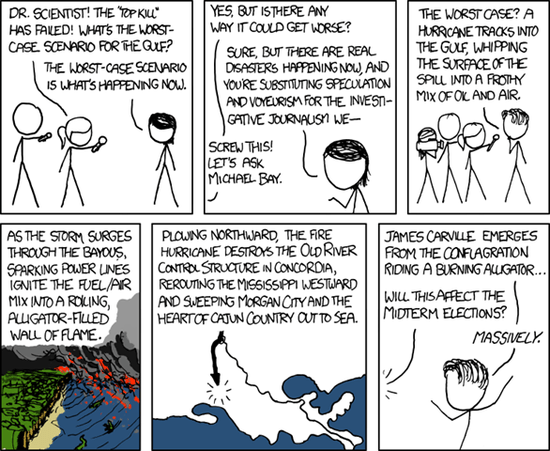
Leonhardt shrewdly observes:

I have an essay in this weekend’s Times Magazine about one of the lessons of the BP oil spill: the difficulty that people have estimating the odds of low-probability, high-cost events.

The BP spill is a good example of when people tend to underestimate such odds. When an event is difficult to imagine, we tend to underestimate its likelihood. The manager of the oil rig in the Gulf of Mexico probably never had a rig explode on them before, which led them to assume it would not happen. They tried to save money by skipping safety procedures, and we’re all now paying the price.

But there are also times when people overestimate the chances of a low-probability event: when that event easily comes to mind, as is the case with plane crashes. One example I didn’t have room to mention in the magazine is what economists refer to as the “favorite-longshot bias.” It holds that gamblers tend to over-bet underdogs and under-bet favorites.

(Image from xkcd)

Face Of The Day

101552821_

A Chinese girl screams when she takes part in a 'Who has the loudest voice' competition, in Hangzhou, east China's Zhejiang province, as locals celebrate Children's Day on June 1, 2010. A dramatic rise in prosperity has created previously unheard-off possibilities for upward mobility and in turn stoked pressures on children to do well at school. STR/AFP/Getty Images.

The Housing Trap

Felix Salmon wants to avoid it:

The difference between Germany and Spain, when you get down to it, is that Germans work for companies which provide goods and services that the rest of the world wants. In doing so, they make good money, which they save up. That’s how they became rich. The Spanish, by contrast, have massive unemployment, and most of the country’s GDP growth in recent years has come from the construction industry. Their main export is tourism, if that counts as an export, and the main way that Spaniards have become rich in recent years is by sitting back and watching the value of their real estate grow exponentially.

The U.S., going forwards, needs to be less like Spain and more like Germany. So let’s not subsidize housing. That way lies fiscal disaster.

From The Annals Of Chutzpah

71862426

Palin accuses environmentalists of endangering the Earth because they won't allow drilling in ANWR:

Extreme deep water drilling is not the preferred choice to meet our country’s energy needs, but your protests and lawsuits and lies about onshore and shallow water drilling have locked up safer areas. It’s catching up with you. The tragic, unprecedented deep water Gulf oil spill proves it. … There’s nothing clean and green about your misguided, nonsensical radicalism, and Americans are on to you as we question your true motives.

Chait picked apart this argument when Krauthammer made it last week. He gives Palin the same treatment.

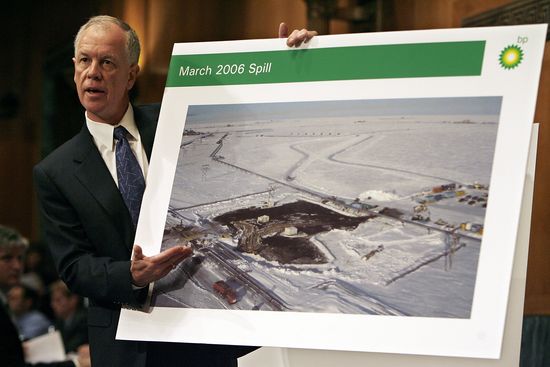
(Photo: BP Exploration Alaska President Steve Marshall holds up a photograph of a March 2006 oil spill while testifying before the U.S. Senate Committee on Energy and Natural Resources about BP pipeline failures in the Prudhoe Bay Oil Field, Alaska, on Capitol Hill September 12, 2006 in Washington, DC. Marshall and BP American President and Chairman Robert Malone took full responsibility for the pipeline failure and outlined what they planned to do in the future to prevent accidents in the field.  By Chip Somodevilla/Getty Images.)

The Voice Of The People

Bernstein continues his crusade against majority rule:

Because there really aren't natural majorities in the U.S., at least most of the time and on most issues, it is difficult to argue that (for example) the Democrats should, on democratic grounds, be able to automatically pass their legislative agenda after winning the 2008 elections. All we know from the elections is that a particular set of candidates won. We don't know whether people supported Obama and the Democrats because of their positions on health care, or Iraq, or terrorism, or torture, or gay rights, or abortion, or climate, or energy, or any number of other issues.

And of course a good number of people may have been just throwing the bums out and didn't think about specific policies, and others may have supported Obama for reasons of ethnic solidarity, or because they thought he would be a more pleasant TV presence than John McCain, or for any number of other non-policy reasons. So we cannot conclude that a popular majority supports any particular policy proposal. Nor does the argument based on accountability make sense. Even if the majority party was able to easily enact whatever they wanted, there are simply far too many issue areas, and only one vote per person. Suppose a voter wants to reward the president for his actions on health care and DADT, but punish him for his actions on Afghanistan and the economy. Only one vote! It just doesn't work. That doesn't mean that elections are useless — I certainly don't believe that — but it does mean that they're a blunt instrument, and more useful in providing the proper incentives for pols than they are for giving voice to what The People want.

Artur Davis And The Unraveling Of Identity Politics

Davis

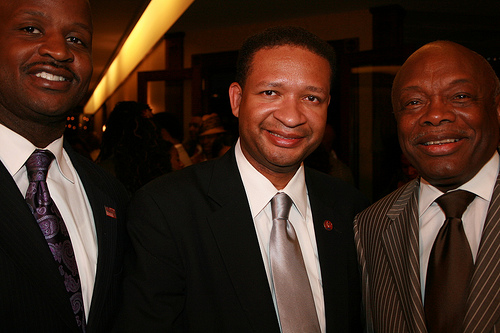
Steve Kornacki eulogizes the gubernatorial bid of the man who some thought might become the country's first black president (before Obama came on the scene):

In the House, Davis was given a frosty reception by members of the Congressional Black Caucus who had been close to [the unseated] Hilliard and who resented the post-Civil Rights brand of politics favored by Davis (and celebrated by his many white supporters). It didn't help that Davis worked hard to create a moderate image, distancing himself from the liberal CBC in an effort to make himself appealing to the conservative white voters he'd someday need in a statewide race. He also maintained the alliance with the pro-Israel community that had been so helpful to him in '02, providing public support to their cause when they most needed it.

All of this helped Davis enhance his national profile last decade. But it came back to haunt him in this campaign.

Davis voted against healthcare reform in the House back in March, calculating that a "yes" vote would kill him with the Alabama general election audience of 2010. This may well have been accurate, but he forgot that he also faced a Democratic primary — and Democratic voters were none too happy to see him siding with the GOP and against Barack Obama (even if the White House was privately understanding of Davis' vote). His years of tacking to the middle made it impossible for him to get the benefit of the doubt. Leading civil rights groups ended up backing Sparks, who is white, over Davis. When the returns came in on Tuesday night, it wasn't even close.

TNC reads reports of low turnout among African Americans:

The underlying premise seems to be that Davis was somehow entitled to black votes. This despite the fact, as Michael Tomasky points out, that Davis reps a majority black district where one in five people lack health-care, but voted against the health care bill. You don't get to just stand in front the people and say "Hey I'm black and smart" and then wait for the torrent of civic pride.

Abigail Thernstrom looks closer at the racial politics of the race and concludes:

Davis is a young man (41). He lost his first congressional bid and came back to win two years later. His political career is not necessarily over, and [John] Lewis may yet see Davis occupy the office once held by the man who declared “segregation forever.” Politics, not race, defeated Davis; different politics on a different day may hand him the victory he sought yesterday.

Ben Smith highlights the local issue that could have trumped everything else. 

(Flickr photo by Pendarvis Harshaw.)