Deeper and Deeper

Oildepth 

Niraj Chokshi runs the numbers on the amount of oil in the Gulf of Mexico:

Calculations based on the BP and government estimates reveal that somewhere between 0.94 and 1.48 percent of the Macondo reservoir has been depleted.

Tulane University Professor Eric Smith cautions that the 50 million barrel figure is not a terribly good estimate, though. BP's well was a preliminary "discovery well," said Smith, who is also an associate director at the Tulane Energy Institute. And calculating the amount of oil in the reservoir is difficult: "it's a geometry problem to define what the enclosed volume is."

Left unattended, the Macondo prospect would fully deplete because the pool of oil sits under the weight of thousands of feet of ocean and rock, he said: "The earth is providing the pressure."

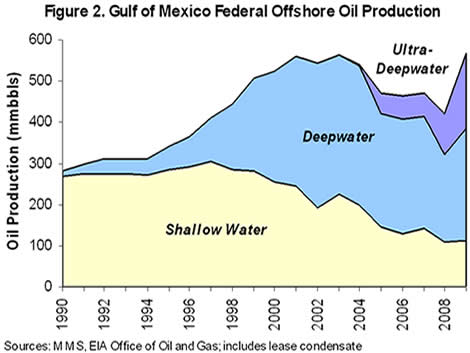
Paul Kedrosky provides the above graph on depth of oil rigs. TPM takes a closer look at the last major spill in the gulf:

The Mexican company running the Ixtoc I rig attempted a slew of now-familiar remedies — they pumped mud into the well, capped it with a metal "sombrero," shot lead balls into the well and drilled relief wells — but it took 10 months to stop the leak even though the drilling was taking place just 160 feet below the surface.

The Deepwater Horizon, which blew on April 20, was drilling 5,000 feet underwater.

The Plutonomy And The iPad

Reihan thinks that Apple's days as the largest tech company are numbered. But that depends on Steve Jobs' keeling over. Meanwhile – wheeee:

The rise of Apple illustrates a number of social trends. Consider that Apple, a company that serves relatively affluent consumers and a handful of electronics-obsessed imbeciles (that's me), is now worth more than Walmart, a company that serves a far larger number of working- and middle-class Americans. Apple's success amidst the downturn, fueled by robust sales of the iPhone and more recently the iPad, is an almost perfect illustration of Plutonomics at work.

As Ajay Kapur first observed in 2005, in a report written for Citigroup, the United States has become a Plutonomy, in which the richest fifth of the population is responsible for as much as three-fifths of all spending. And if anything, the painful economic transition we're living through now will only reinforce this tendency. Middle-class households are carrying an extraordinarily heavy debt load.

One study, citing 2007 data from the Federal Reserve, found that while households in the top tenth had a manageable debt-to-disposable-income ratio of 116 percent, the next 40 percent of households had a debt-to-disposable-income ratio of 205 percent. Basically, it is that top tenth that is buying the bulk of Apple's products. As long as this slice of the population fares well, there's reason to believe that Apple really will live up to the outsized expectations of investors.

Guilty Of Being Gay, Ctd

Over the weekend, Tiwonge Chimbalanga and Steven Monjeza were pardoned by the Malawian president after he met with the UN secretary general. Joe My God is joyous. Queerty cautions:

[W]hile pardoning them and asking for their unconditional release, [president] Mutharika made sure to add, "These boys committed a crime against our culture, our religion and our laws." Malawi culture still considers their engagement ceremony an unnatural act of gross indecency and just because they're released doesn't mean that other Malawi LGBTs won't ever face a similar fate. … [Chimbalanga and Monjeza] may still love their country. They should get out of it while they can.

Indeed, the couple is considering asylum to escape retribution from neighbors. Come to America.

The Nine Deaths Of Al Qaeda No. 3

Joyner's take on the news that Mustafa Abu al-Yazid has been killed:

There was a point some years back when it was a running dark joke that al Qaeda must have a lot of “number 3″ officials, as so many have been killed.  But it’s worth noting that it has now been quite some time since the organization launched a major, successful attack.   While the group seems to have no difficulty replacing its foot soldiers, there may be limits to the number of competent planners it can produce, especially when under constant surveillance and assault from U.S. military and intelligence forces. And, yes, this marks the upside of the controversial drone strikes that many of us deride as doing more harm than good because of the propensity for killing non-combatants.

Increasingly, I feel the drone attacks may be our strongest technique against the enemy. As long as civilian casualties are kept as low as humanly possible. They are certainly more promising than an endless counter-insurgency in defense of a corrupt government.

Jindal Rises To The Occasion

Jesse Zwick thinks Bobby Jindal has matured in response to the oil spill:

The first thing Jindal did right was acknowledge the scope of the catastrophe. This might not seem deserving of praise—until one looks at how other Republicans have reacted. Nervous about a populist backlash against offshore drilling, or even growing momentum for a climate bill—and contemptuous of environmental science in general—many Republicans have downplayed the disaster. For example, Jindal’s gulf state GOP colleague, Haley Barbour, was quick to urge tourists not to cancel their trips to Mississippi’s beach towns, comparing the deluge of crude to the sheen of gasoline from a motor boat. “We don't wash our face in it, but it doesn't stop us from jumping off the boat to ski,” he told the AP. …

As a result, Jindal’s drawn flack from some Democrats, like State Representative Sam Jones, who’ve noted that his response doesn’t square with his routine calls for limited government. But emergencies rightly require a departure from dogma, and Jindal seems prepared to spend as much as it takes.

Sounds like he's come long way since that volcano comment.