Ross On Afghanistan: Getting Warmer

AFGANGRAVESBayIsmoyo:AFP:Getty

It's such a relief to have my former colleague, Mr Douthat, writing intelligently from the right-of-center in the NYT. How does one begin to tackle the likes of Krauthammer or Kristol on the new empire? They are never wrong, never revisit any previous dogmas, and believe that a priori, American force is always right. Better to have some modicum of honesty to engage with. Ross' core argument as to why, after ten years, we are still increasing troops and resources in Afghanistan, is as follows:

First, the memory of 9/11, which ensures that any American president will be loath to preside over the Taliban’s return to power in Kabul.

This strikes me as his weakest logical link. What we're talking about here is a "memory". Do we commit men to arms because of a memory – or because they have a chance to achieve an advancement of American interests in a dangerous world? I fear this primary domestic political argument is what is really fueling this war. Which is to say: even if the war should end, it cannot. Even if it contributes not a whit to national security, no president could afford to withdraw and then explain a subsequent terror attack on the US. The right would play the Dolchstoss card; and the Democrats are far too weak-kneed to counter or withstand it. This, to my mind, is not a solution to the problem; it's a restatement of it.

Second, the continued presence of Al Qaeda’s leadership in Pakistan’s northwest frontier, which makes it difficult for any American president to contemplate giving up the base for counterterrorism operations that Afghanistan affords.

But this means that even if the war in Afghanistan were successful, we still could not withdraw because of the Qaeda bases in Pakistan. And we were told this weekend, for good measure, that there are a mere 50 or so al Qaeda operatives in all of Afghanistan. So we are occupying a country to tackle another country, which we cannot occupy and which is technically an ally. How do you tell the families of the fallen that this is what their son died for?

Third, the larger region’s volatility: it’s the part of the world where the nightmare of nuclear-armed terrorists is most likely to become a reality, so no American president can afford to upset the balance of power by pulling out and leaving a security vacuum behind. This explains why the Obama administration, throughout all its internal debates and strategic reviews, hasn’t been choosing between remaining in Afghanistan and withdrawing from the fight. It’s been choosing between two ways of staying.

But since Pakistan's nukes are not going away, and Islamist fervor is stoked by US occupation of Afghanistan, this means that the US will be there forever. Ross talks as if this presents no structural challenges. But it seems to me it does reveal the core reality of post-9/11 America: it enabled and entrenched a permanent US occupation of Af-Pak with over 100,000 troops for ever. (By for ever, I do not mean eternity, merely an occupation without a foreseeable end within the next five years, and a bipartisan consensus in Washington that we cannot afford to leave.)

The question remains: does occupying Afghanistan recruit more than 50 terrorist for al Qaeda? At 51 new Jihadists, we are creating more terror than we are defeating in Afghanistan. And since the only way to tackle al Qaeda in Pakistan is by exactly the kind of tactics that Biden – and not Petraeus – has suggested for Afghanistan, one has to ask if pursuing counter-insurgency in one place and counter-terrorism in another is … well, spectacularly incoherent. You get all the human and fiscal cost of counter-insurgency occupation and all the blowback and Jihadist-recruitment of counter-terrorism.

Then there's the factor that Ross doesn't even mention: what if the core object of counter-insurgency in Afghanistan is, in the best of all possible worlds, simply impossible? What if that failed state, after a generation of religious and ethnic warfare, cannot be turned into a functional state at any price in any foreseeable time-frame? Washington doesn't like to believe there are some things it simply cannot do. Even now. Even after Iraq, they still believe in their power to do anything.

This is how great powers destroy themselves. By the pride of elites and the fears of the masses. 

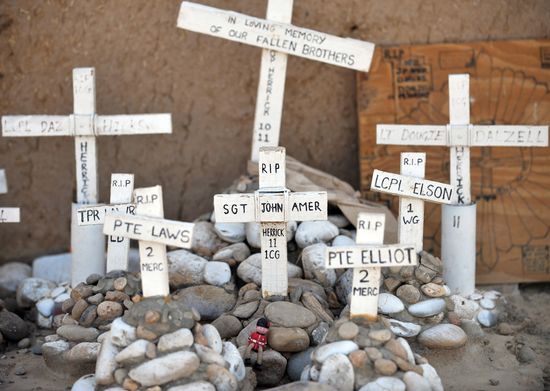
(Photo: This picture shows a commemorative memorial to British soldiers killed in action on previous tours of Afghanistan, at a patrol base in the Nahr e Saraj, Helmand on June 28, 2010. The death toll for foreign soldiers in Afghanistan neared the grim milestone of 100 for June alone as the CIA chief warned the anti-Taliban war would be tougher and longer than expected. By Bay Ismoyo/AFP/Getty.)

Quote For The Day

4733609567_56c17b7ece

"Oh my god I feel like I just stepped off of a roller coaster! Go round and round and up and down and shit flying out of everywhere and standing. Remember when you had to write a report as a college student and you just tried to jam in as many quotes as possible? You know, from as many random things you could get, you know, that’s what I got. I got she didn’t ever finish a statement," – a journalist on an open mic, uttering the truth immediately after Sarah Palin's recent speech at CSU-Stanisalus.

He must be glad he doesn't work for the Washington Post. The campus was all but shut down to prevent any students protesting the farce.

How Struggle Makes Us Stronger

Jonah Lehrer explains:

For me, the lesson of stuttering is that obstacles can also be advantages, that who we become is deeply influenced by what we cannot do. (Or, to quote the sage words of Kanye, "Everything I'm not/made me everything I am.") The secret is to struggle through, because the very act of raging against a disadvantage generates its own set of skills.

That, at least, is the message of this new paper on Tourette's Syndrome and cognitive control.

Telling You What You Want To Hear

David McRaney tackles confirmation bias:

Punditry is a whole industry built on confirmation bias. Rush Limbaugh and Keith Olbermann, Glenn Beck and Arianna Huffington, Rachel Maddow and Ann Coulter – these people provide fuel for beliefs, they pre-filter the world to match existing world-views. If their filter is like your filter, you love them. If it isn’t, you hate them. Whether or not pundits are telling the truth, or vetting their opinions, or thoroughly researching their topics is all beside the point. You watch them not for information, but for confirmation.

The Blogosphere Slows?

This is news to me:

Earlier in the decade, rates of growth for both the numbers of blogs and those visiting them approached the vertical. Now traffic to two of the most popular blog-hosting sites, Blogger and WordPress, is stagnating, according to Nielsen, a media-research firm. By contrast, Facebook’s traffic grew by 66% last year and Twitter’s by 47%.

870 Iowa Jobs vs The World’s Poor

Laura Freschi makes the case against mandating that food aid come from US growers:

Current US food aid policies are NOT an effective or efficient way for the US to achieve what should rightly be the primary objective for food aid. According to the government’s own accountability office, buying food locally in sub-Saharan Africa (which is where the majority of US food aid goes) costs 34 percent less than shipping it from the US, AND gets there on average more than 100 days more quickly, AND is more likely to be the kind of food people are used to eating.

Islamism Realpolitik

Marc Lynch shows the error of Paul Berman's view that "it is not violent Islamists who pose the greatest danger to liberal societies in the West but rather their so-called moderate cousins, such as Tariq Ramadan":

Secular Muslims, such as Ayaan Hirsi Ali — the Somali-born writer and former Dutch politician — are a sideshow to the real struggles taking place between reformers and traditionalists, Muslim Brothers and Salafists, rulers and oppositionists. The real challenge to the integration of Muslims in the West comes from Salafists who deny the legitimacy of democracy itself, who view the society around them as mired in jahiliyya, and who seek only to enforce a rigid, literalistic version of Islam inside whatever insulated enclaves they are able to carve out. The liberals to whom Berman is drawn represent a vanishingly small portion of Muslim-majority societies. They are generally drawn from well-off urban elites that have become ever more detached from their surrounding environments and would not fare well in the democratic elections that the United States claims to want. Meanwhile, granting such prominence to ex-Muslims who support Israel and denounce Islam discredits other reformists in the real terrain where figures such as Ramadan must operate. Supporting them may offer the warm glow of moral purity — and they may be more fun at parties — but this should not be confused with having an impact where it counts.

The Tree Of Knowledge, Not Understanding

  Birds

Errol Morris finishes his series on anosognosia with a parable:

When God created man (and woman), he gave them the ability to perceive the world, but withheld from them the ability to understand it.  We could come up with one cockamamie theory after another, but real understanding would always elude us.  It was mean-spirited on God’s part.  And to make matters even worse, God gave us the desire but not the wherewithal to make sense of experience.  One might easily foresee that this would lead to unending, unmitigated frustration and suffering.  But here’s where self-deception, anosognosia and the Dunning-Kruger Effect step in.  We wouldn’t be able to make sense of anything, but we would never be aware of that fact.

This quote from David Dunning, from earlier in the post, is also worth reflection:

Here’s a thought.  The road to self-insight really runs through other people. So it really depends on what sort of feedback you are getting.  Is the world telling you good things? Is the world rewarding you in a way that you would expect a competent person to be rewarded?  If you watch other people, you often find there are different ways to do things; there are better ways to do things.  I’m not as good as I thought I was, but I have something to work on.  Now, the sad part about that is — there’s been a replication of this with medical students — people at the bottom, if you show them what other people do, they don’t get it.  They don’t realize that what those other people are doing is superior to what they’re doing.  And that’s the troubling thing. So for people at the bottom, that social comparison information is a wonderful piece of information, but they may not be in a position to take advantage of it like other people.