The Out Of Touch MSM

Nice-try-once-again-old-media-25947-1277263391-34

A reader writes:

The appropriateness of the Weigel's comments about Drudge aside, I'm much more horrified by the suggestion, on Goldblog and elsewhere, that this is somehow the Washington Post's fault for hiring journalists who, you know, have opinions about stuff.  When will news outlets give up on the charade of neutrality in reporting? 

In an era of monopolistic news reporting, if you are the only newspaper in town, or one of three channels on the tube, you are you going to be a lot less concerned with providing a superior product and a lot more concerned with not saying anything that might alienate a member of your captive audience.  It's not important to have the smartest reporters or the sharpest analysis – after all, people are pretty much forced read the news you give them.  Instead, it's just important to have reporters that are careful (or dense) enough to stop thinking about a subject before they risk suggesting that one interpretation of events might be superior to others.  

End result: a perverse culture that values manufactured or feigned neutrality above all else, endless "he said/she said" reporting, and a mainstream media that is afraid to actually let its own reporters use their brains.

Thankfully, the internet is ripping the heart out of our mid-20th century media culture.  We're going back to old-old-school reporting, way back to the era of when newspapers had open party affiliations.  If I want to learn about an issue, I don't watch cable news debate theater, designed to ensure both sides go in endless circles.  And I certainly don't read a David Broder column.  I go read an honest, intelligent partisan, an Yglesias or Klein or a Frum or a Salam, and then I go read a response from the other side.  Even if there isn't a response, at least I know what I'm getting — I have a sense of the worldview I'm hearing and the assumptions that are going into the argument.  I don't have to worry that the writer is burying some secret conclusion out of sight.  Full disclosure beats selective omission, every time. 

Good reporting requires honesty, integrity, and analytical rigor.  Good reporting is not editorializing.  But a good reporter should not be neutral.  A good reporter should tell me what he thinks, why he thinks it, and why it's relevant.  

(Image via BF)

Extending Our Brains

Scott Adams is enthralled by what he calls the "exobrain":

Everything we create becomes a de facto data storage device and brain accessory. A wall can be a physical storage device for land survey data, it can be a reminder of history, and it can be a trigger of personal memories. 

A business is also a way to store data. As a restaurant owner, I was fascinated at how employees came and went, but their best ideas often stayed with the business, especially in the kitchen. The restaurant was like a giant data filter. The bad ideas were tested and deleted while the good ideas stayed, most often without being written down.

Before Stonewall

The invisibility of the real history of the civil rights movement for gays and lesbians continues at the Smithsonian:

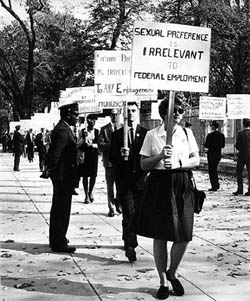
A dozen picket signs on old wooden sticks carry the DNA of the gay civil equality movement in America. Forty-five years ago, this month, in 1965, these pickets were held high by men and women considered among the first generation of LGBT activists in front of Lyndon Johnson's White House.
2010-06-25-bgittings65.jpg
With the men wearing jackets and ties and tailored skirts for the ladies, all arrived neatly dressed to disarm the looks of fellow citizens, while their hand-lettered signs proclaimed unimaginable things like "First Class Citizenship for Homosexuals". Despite their professional appearances, this handful of men and women on this history-making picket line, knew perfectly well that their conduct literally put themselves and their jobs on the line, in broad daylight.

Today, however, those brave pickets are stored in the dark of a Smithsonian vault, where they have been held for they past four years, ever since they first were presented to The National Museum of American History.

In 2006, the original protest pickets were donated to the Smithsonian by The Kameny Papers Project, funded in part by former Congressman Michael Huffington and other generous friends and allies. Frank Kameny is often considered the still living father of the gay civil equality movement in Washington, D.C. and led many such picket lines in his day. Fired by the federal government in 1957 because he was gay, Kameny responded in righteous fury that such an action could be taken against him, a World War II veteran who had seen combat in Germany, a Harvard-educated astronomer determined to work for America's nascent space program.

I was honored to carry one of those original posters at the Equality March last fall. And look at that photograph: the dignity and courage there puts us all to shame. On Gay Pride Day, here is something I am truly proud of – the gay men and women who made my life – and that of so many others – possible.

Big Brother Is Watching: Yay?

Professor of Philosophy Emrys Westacott wrestles with surveillance:

Kantians should welcome surveillance, since ultimately it leads to the achievement of the very ideal they posit: the more complete the surveillance, the more duty and self-interest coincide. Surveillance technology replaces the idea of an all-seeing God who doles out just rewards and punishments, and it is more effective, since its presence, and the bad consequences of ignoring it, are much more tangibly evident. Consequently, it fosters good habits, and these habits are internalized to the point where wrongdoing becomes almost inconceivable.

How The Brain Argues With Itself

Blue

Errol Morris continues his mediation on anosognosia:

[V.S. Ramachandran] has used the notion of layered belief — the idea that some part of the brain can believe something and some other part of the brain can believe the opposite (or deny that belief) — to help explain anosognosia. In a 1996 paper…he speculated that the left and right hemispheres react differently when they are confronted with unexpected information. The left brain seeks to maintain continuity of belief, using denial, rationalization, confabulation and other tricks to keep one’s mental model of the world intact; the right brain, the “anomaly detector” or “devil’s advocate,” picks up on inconsistencies and challenges the left brain’s model in turn. When the right brain’s ability to detect anomalies and challenge the left is somehow damaged or lost (e.g., from a stroke), anosognosia results.

In Ramachandran’s account, then, we are treated to the spectacle of different parts of the brain — perhaps even different selves — arguing with one another.

We are overshadowed by a nimbus of ideas. There is our physical reality and then there is our conception of ourselves, our conception of self — one that is as powerful as, perhaps even more powerful than, the physical reality we inhabit. A version of self that can survive even the greatest bodily tragedies. We are creatures of our beliefs. This is at the heart of Ramachandran’s ideas about anosognosia — that the preservation of our fantasy selves demands that we often must deny our physical reality. Self-deception is not enough. Something stronger is needed. Confabulation triumphs over organic disease. The hemiplegiac’s anosognosia is a stark example, but we all engage in the same basic process. But what are we to make of this? Is the glass half-full or half-empty? For Dunning, anosognosia masks our incompetence; for Ramachandran, it makes existence palatable, perhaps even possible," - 

Live-Tweeting A Firing Squad, Ctd

Hang

A reader writes:

The first respondent you posted is a little confused about the differences between people now and people in history. As recently as a century ago, and certainly throughout most of human history, death was a constant companion for people of all stripes. Infant mortality, maternal death in childbirth, horrific wasting diseases, hand-to-hand combat – all these and more combined to ensure that most people, if not everyone, was well acquainted with death by the time they reached adolescence.

Now I'm not saying that a public execution wouldn't attract gawkers; it undoubtedly would. But I imagine there are a lot of people who support the death penalty whose minds would be changed if they had any experience of actual death.

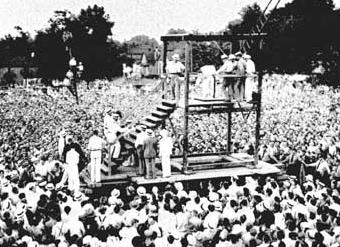
(Photo: The last public execution in the US, carried out in Owensboro, Kentucky, in 1936 after Rainey Bethea was convicted for the rape and murder of a 70-year-old woman.)