Jesus, made by bees.
Month: June 2010
The Writer Who Couldn’t Read
An enlightening short video.
The View From Your Window
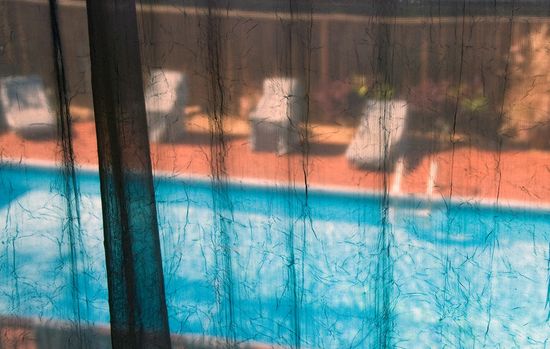
Birmingham, Alabama, 10.15 am
Blogbudsmen
TNR has a new blog staffed by Jim Manzi and Michael Kazin intent on critiquing TNR content from the right and the left. Yglesias worries about "punch-pulling" and “commenting on the not-comment-worthy.” Chait defends the project:
The point is to give our readers the benefit of smart rebuttals, and in turn to force our writers to operate under the discipline of knowing that we can't offer a poorly-constructed argument without risking this being pointed out to our readers. That's a different kind of discipline than knowing that some other blogger who my audience doesn't read might attack me.
Yglesias returns fire, calling Chait's post "almost self-refuting." It seems to me that a blog best critiques itself by airing dissent and pushback from readers and other bloggers, rather than creating some kind of internal mechanism for critiques. The latter does seem to me to reflect an old media mindset – as if online magazines can actually function as magazines in the way that print magazines do. I've long believed this is silly – because every page on the Internet is as accessible as every other page – but no one anywhere in the legacy media seems to get it yet. They keep trying to replicate the magazine model online – like trying to make counter-insurgency work in Afghanistan. It's all they know how to do. So they do it.
I guess it's understandable because, like the record companies and the publishing houses, they don't want to admit that their gig is up and their concept of a magazine is essentially defunct. You can't really blame them for that, can you?
Mental Health Break
"A non-sense escalator animation by Misterkama":
Why Would A Former Slave Praise Slavery?
TNC posts on "Clara Davis, circa 1937, waxing nostalgic about her days of bondage in Alabama." Dreher adds:
It shocks our senses to encounter a former slave praising slavery, but it's not that hard to understand, if you think about it. Why do some people in, say, the former East Germany pine for life under communist dictatorship, which was a kind of slavery? Because they miss the sense of security it provided. Yes, you were miserable, but so was everybody else you knew, so in that sense, you knew your place. You knew what was expected of you, and what you could — and could not — expect of yourself. Go to Coates' link and read the ex-slave's words: she's remembering (and no doubt romanticizing) her slave past from the point of view of the Great Depression, and all its stress and storm, as well as having been abandoned by her children, and having been geographically displaced. "Now I just live from hand to mouth," she said. "Here one day, somewhere else the next."
Compared to the stress of that kind of life — elderly, lost, forgotten by one's family, and not knowing what tomorrow will bring — is it really that far-fetched to imagine longing for the security of involuntary servitude? In the same vein, is it really so hard to imagine why some women remain with the men who beat them? I'm not justifying it, obviously; I'm just trying to understand why people do the things that they do and say the things that they say.
TNC follows up and tries to steer the conversation in another direction.
Dealing With An “Orgy Of Self-Ingulgence”
Judith Warner presents a dyspeptic view of our culture in the wake of deregulatory disasters like the housing crash and the BP spill:
Under normal circumstances, the emotional, reward-seeking, selfish, “myopic” part of our brain is checked and balanced in its desirous cravings by our powers of cognition — our awareness of the consequences, say, of eating too much or spending too much. But after decades of never-before-seen levels of affluence and endless messages promoting instant gratification, Whybrow says, this self-regulatory system has been knocked out of whack. The “orgy of self-indulgence” that spread in our land of no-money-down mortgages, he wrote in his 2005 book, “American Mania: When More Is Not Enough,” has disturbed the “ancient mechanisms that sustain our physical and mental balance.” …
What remains to be seen, as we move forward into what The Times’s Eric Lipton recently called “a new age of regulation,” is whether this new spirit of control and reform will carry over into the American psyche. For in the anything-goes atmosphere of our recent past, it wasn’t just external controls that went awry; inwardly, people lost constraint and common sense, too. Now there is a case to be made that problems of self-regulation — of appetite, emotion, impulse and cupidity — may well be the defining social pathology of our time.
(Video via BF)
The VFYW Contest: Where Is That Window?

This photo was taken in late November. You have until noon on Tuesday to guess it. Country first, then city and/or state. If no one guesses the exact location, proximity counts. Be sure to email entries to VFYWcontest@theatlantic.com, not the regular Dish account. Winner gets a free The View From Your Window book. Have at it.
If You Thought COIN Was Futile
Try getting into a staring contest with a Muppet.
Searching vs Waiting
James Sturm is in the middle of his four-month break from the internet. The Dish missed this dispatch from a couple weeks back:
Whether it's a sports score, a book I want to get my hands on, or tuning into Fresh Air anytime of day, I can no longer search online and find immediate satisfaction. I wait for the morning paper, a trip to the library, or, when I can't be at my radio at 3 p.m., just do without. I thought this would drive me crazy, but it hasn't. Anticipation itself is enjoyable and perhaps even mitigates disappointing results….Are meaningful connections easier to recognize when the fog of the Internet is lifted? Does it have to do with the difference between searching and waiting? Searching (which is what you do a lot of online) seems like an act of individual will. When things come to you while you're waiting it feels more like fate. Instant gratification feels unearned. That random song, perfectly attuned to your mood, seems more profound when heard on a car radio than if you had called up the same tune via YouTube.
Nick Carr thinks this supports his fears:
Sturm is onto something deep here. The Net – and it's not just search – does seem to encourage the willful arrangement of experience, moment by moment. As he has rediscovered, sometimes it's best to let the world have its way with you.
 The Dish