Dave Weigel Quits

And the Post accepts. A sad day for journalism. Ben Smith claims Dave is a liberal. Not from where I sit. He's a sane libertarian, which means he understood just how completely nuts the conservative movement and Republican party now are. But Ben is right about this:

There's no sign the Post really thought this through. Even as old-timers rankled at the new hires,  the paper — scrambling for relevance on the Internet — seems not to have considered what the buzzy personnel moves would mean for the paper's longstanding principles of detachment and neutrality in reporting.

One thing nobody argues is that publications should misrepresent and misidentify their own reporters. The Post set Weigel up for a fall, and themselves for embarrassment, and that's what they got today.

Goldblog relays anonymous gripes from the old WaPo guard – on Weigel's apparent "lack of toilet training", on his behaving "like an idiot", on the awfulness of "untrained kids" like Ezra Klein, and on the appalling idea that bloggers call themselves reporters. Goldblog remains, however, a believer in the value of "temperance in the expression of personal views." 

There is a war going on within American journalism. All I can say is that I have learned more from Dave Weigel's brilliant, obsessive, accurate and first-hand reporting – yes, old-fashioned, grass-roots reporting – on the conservative movement than I ever have from the pompous dinosaur "journalists" at the WaPo.


The Lesson From Rudd’s Sudden Collapse

Daniel Berman tries to find lessons from the remarkable demise of the Australian prime minister:

In many ways Rudd’s election and subsequent problems mirrored those of another candidate of change, and his difficulties may well preview the challenges Obama would have faced had he buckled and failed to pass health-care in February, as many observers urged him to do. And the lesson from Australia seems to be a reinforcement of the axiom that “one who stands for nothing, is nothing.” …

Kevin Rudd took over as one of Australia’s most popular politicians, but things seemed to move much less rapidly than many of his supporters had hoped. Rudd reiterated his determination to keep Australian troops in Afghanistan, and went so far as to block a number of progressive policies, intervening to invalidate a law passed by the local government of the Australian Capital Territory legalizing Gay Marriage.

On the major issue, global warming, and its policy heart, the Emissions Trading Scheme or ETS, effectively identical Obama’s proposed “Cap and Trade” system, the government seemed in no hurry.

Now, Labour is reduced to running for re-election by demonizing their opponent as a far right boogeyman. Voters, one suspects, are more sophisticated than that. Of course, Australia's parliamentary system means that Rudd had far more leverage than Obama and his failure to move on his agenda was therefore more damning. But the warning signs are there …

Hewitt Award Nominee

"[D]uring the worldwide Great Depression, the German Reichstag passed a law "for the relief of the German people." That law gave Hitler dictatorial powers that were used for things going far beyond the relief of the German people — indeed, powers that ultimately brought a rain of destruction down on the German people and on others. If the agreement with BP was an isolated event, perhaps we might hope that it would not be a precedent. But there is nothing isolated about it," – Thomas Sowell, who has obviously lost what was left of his mind.

Palin endorses the Nazi analogy here. She has now compared the president to Hitler. You think anyone at Fox will call her on it? C'mon, Bill-O.

Israel’s Long Campaign To Punish Gazans

Geoffrey Aronson writes that Gaza's humanitarian crisis began long before Hamas's victory:

Draconian restrictions on the entry of Palestinian labor to Israel, the failure to establish a reliable export/import regime through Karni and other crossings, and the stillborn safe passage route linking Gaza with the West Bank–all signature elements of policy before June 2007 and indeed before Hamas' parliamentary victory in January 2006–are the product of this strategic re-evaluation of Israeli interests. As such, the policies that have so stirred the international community in recent weeks are not incidental byproducts that can be solved by technical fixes of the kind now being proposed, but rather are integral to Israel's strategy. Even before June 2007, this system resulted in the creation of a "soft quarantine" that created substantial economic dislocation in Gaza and led to widespread flight of Gaza's manufacturing base.

Brian Ulrich nods.

When Do We Leave?

On Afghanistan, I wrote that  "Obama's pledge to start withdrawing troops in 2011 is now kaput … Once Washington has decided to occupy a country, it will occupy it for ever." Max Boot says I was battling a strawman:

I hope Andrew is right — not because I or anyone else is in favor of perpetually occupying Afghanistan (talk about a straw man!) — but because the only way to prevail is to show the will to stay in the long run.

[Boot] conveniently declines to specify what the long run is. But why? If Boot thinks the way to leave Afghanistan is to never say we're going to leave could he at least proffer a guess as to when the U.S. will have achieved its goals in the country sufficient enough to stop transferring American wealth and risking American and NATO lives in the country?

Dissent Of The Day, Ctd

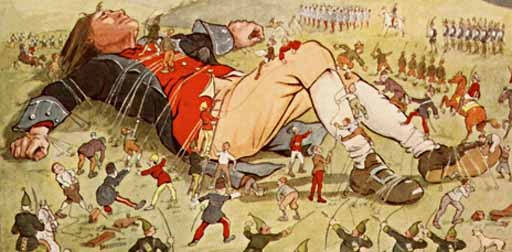
Gullivers-travels

A reader writes:

Speaking of the Iraq surge, you write that:

I did not foresee the drop in violence in Iraq – although I did foresee the failure of the surge to achieve political reconciliation.

The truth, I believe, is that the surge had little to do with the drop in violence.  Part of the drop in violence is attributable to diplomatic gains in the Anbar province (where no extra troops were sent, incidentally), and most of the rest is simply due to the basic nature of ethnic conflict: it drops off in intensity when affected areas become ethnically segregated.  What was the violence in Baghdad?  Sunni fighting Shia, Shia fighting Sunni, driving them out of their homes and killing them.  It's a pattern that we've seen time and time again: Serbs fighting Kosovars, Christians and Muslims in Bosnia, Hutus and Tutsis in Rwanda.  The groups fight, they kill each other, they drive each other out of their homes … but there are only so many people to kill, fight, and, more importantly, drive away.  Once they're all gone–once all the Tutsis are dead, once all the Kosovars are driven out of an area, once those who have not abandoned Baghdad are living in ethnically segregated ghettos–the violence drops off in intensity simply because there aren't any enemies left in convenient proximity. 

That the winding down of this process coincided with the one year anniversary of the surge is not a testament to its success.

South Park Macho, Ctd

A reader writes:

Your post on South Park macho triggered a memory from Fallujah days in 05 – which I think was probably less than a year after Team America came out … I’d ride around with the Marines throughout the city and frequently hear Fallujans referred to as ‘durka durkas’ or ‘mohammad jihads.’ i.e., ‘check out that durka durka over there.’ Everyone seemed to know the ‘America…Fuck Yeah’ song. I don’t begrudge them for trying to find some way to laugh amidst what was increasingly an absurd and absurdly dangerous situation, but wonder if Parker & Stone have ever realized the extent to which their intended irony was lost.

And when will the troops finally echo that other classic Cartman line: "Screw you, guys. I'm going home"?