"Until the American Muslim community find it in their hearts to separate themselves from their evil, radical counterparts, to condemn those who want to destroy our civilization and will fight against them, we are not obligated to open our society to any of them," – Republican Congressional candidate – and proud tea-partier – Lou Ann Zelenik, in response to a local Muslim community's need for a new mosque.
Month: June 2010
The View From Your Window

Ubud, Bali, Indonesia 12.30 pm
Quote For The Day II
"Marcus Baram: In the hypercompetitive media world, some of the reaction to your story has been a little negative, that you have "hostile views" and that you're anti-war. Some have wondered how you could jeopardize your future access to sources. How do you respond to that?
Michael Hastings: Look, I went into journalism to do journalism, not advertising. My views are critical but that shouldn't be mistaken for hostile – I'm just not a stenographer. There is a body of work that shows how I view these issues but that was hard-earned through experience, not something I learned going to a cocktail party on fucking K Street. That's what reporters are supposed to do, report the story."
Malkin Award Nominee
"The majority of [illegal immigrants] in my opinion and I think in the opinion of law enforcement is that they are not coming here to work. They are coming here and they’re bringing drugs. And they’re doing drop houses and they’re extorting people and they’re terrorizing the families," – Arizona Governor Jan Brewer (R). A mountain of evidence to the contrary here and here.
Rolling Stone vs National Review
| The Daily Show With Jon Stewart | Mon – Thurs 11p / 10c | |||
| McChrystal’s Balls – Honorable Discharge | ||||
|
||||
I didn’t realize that after covering the Iraq elections for Newsweek, Michael Hastings had then quit the magazine “and wrote a damning exposé about what he had seen and experienced during his stint.” Why am I not surprised?
When A Blogger Vents
Comments Dave Weigel made on a listserv have been made public. The most eye-catching one:
This would be a vastly better world to live in if Matt Drudge decided to handle his emotional problems more responsibly, and set himself on fire.
He apologizes to his readers and Matt Drudge here. James Joyner weighs in:
The buzz on Twitter and the blogs this morning is that this just goes to show that Weigel holds conservatives in contempt and having him cover the movement for a major newspaper is journalistic malpractice. But, frankly, his feelings toward social conservatives and Tea Partiers were hardly a state secret before now. No one who read Dave at Reason, The Washington Independent, or his Twitter feed is shocked.
Do I think someone more sympathetic to the movement would be a better fit for the beat? I do. It would be more insightful to get a broad spectrum view of a Tea Party rally, say, than a series of posts making fun of the looniest members of the crowd.
John Cole lays into whoever released the emails. Liz Mair goes to bat for Dave:
There are a couple of real stories that are being missed in all the coverage of Dave and his various remarks that range from stupid to snarky to sensible, but in some cases badly stated, but the big one is this: The Left, whether as an army or an army of one, has a problem with Dave, and a big one at that.
A lot of leaking has been done with the clear objective (I believe) of ruining Dave's career, and forcing his ouster by the Washington Post. I suspect it is happening because dave committed the cardinal sin of defending Rand Paul, a figure who has become so reviled by many on the Left that it's hard to draw a bright-line distinction between him and Saddam Hussein, by their standards (in fact, for some of them, I believe Saddam Hussein is held in less contempt). That's a bad place for Dave to be, but he got there because he had the courage of his convictions and defending a man who many on the Right consider almost indefensible– and he did it at the Washington Post, not Reason Magazine.
The follow-on from that is that there are conservatives who are equally determined to shut Dave down because (pick your reason) a) he disagrees with them on gay marriage and other social issues b) he is friends with liberals c) he sees a lot of snake-oil salesmen involved in conservative politics and thinks they stink d) he's been prepared to report on some aspects of the conservative "movement" that occasionally appear more akin to a racket than an outgrowth of deeply-held philosophical conviction, and depict them as such and/or e) they would infinitely prefer for the Washington Post to host Ezra Klein and Greg Sargent, but no one who is even several houses away from a conservative, because it aids and abets their ability to wage a cultural war in which the media, and media bias, is target #1.
The Dish has long seen Dave Weigel as one of the brightest stars in the next generation of journalists. He deserves to prosper. But he needs to get off that listserv.
Quote For The Day
"After the jirga was over, one of the tribal elders came over and we chatted for a while over a glass of green tea. "Last month," he said, "some American officers called us to a hotel in Jalalabad for a meeting. One of them asked me, 'Why do you hate us?' I replied, 'Because you blow down our doors, enter our houses, pull our women by the hair and kick our children. We cannot accept this. We will fight back, and we will break your teeth, and when your teeth are broken you will leave, just as the British left before you. It is just a matter of time.'" – William Dalrymple, the New Statesman, via Fallows.
The whole piece is a must-read.
Why Not Call It Crossfire?
A classic, must-read Kinsley vent:
As an example of the excitement ahead, Spitzer and Parker said that if they were on the air right now, they would have General McChrystal as their guest. (TV bookers all over Washington are snorting, "Right. And if it was Christmas they'd have Jesus Christ. He'd have nothing better to do either.")
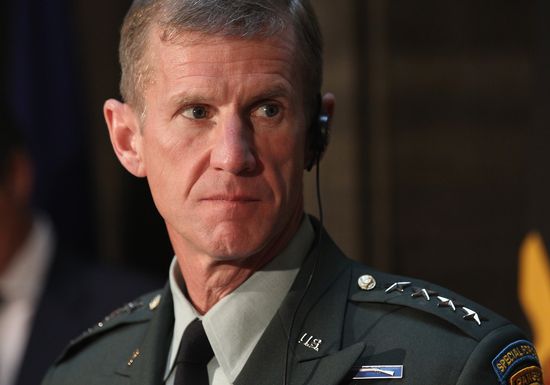
McChrystal – And The Press’s Failure
David Brooks writes the following sentence today:
The most interesting part of my job is that I get to observe powerful people at close quarters.
Like David, I am privileged in many ways to be able to meet and talk to a lot of powerful figures. David and I have been at many functions of this sort together, but I have to say I disagree. These interactions are the least interesting part of my job, and often the most misleading. Every now and then, you discover a nugget that adds something. But in general, you get the schtick and spin, larded with a few anecdotes to make you feel flattered to be included in the salons of power. And what still amazes me is how deferent most of even the A-list journos are (with a few glorious exceptions). In fact, the definition of an A-list journalist in Washington is the person who is chummiest and closest to the people they cover. They have risen to the top in part because they know what questions the powerful really don't want to answer – and decide not to ask them.
This is the most extreme when it comes to senior members of the military, where cults of personality by consummate operators, like the crashing bore, David Petraeus, create media narratives where reality is far less salient than spin. And so a great deal of the coverage is really about how plugged in the journalist is, and a lot of it is directed at his peers, whose approval he craves far more than he does his readers' or viewers'. The notion that we hacks should be instinctually hostile to the powerful, blunt in our questions, unsparing in our challenges, rude in our inquiries, and uninterested in getting to know anyone in power – that we should be much more skeptical precisely because we are so close – this seems almost archaic in late-imperial DC. In my view, that's why the public has come to despise the press in a populist age. Because the public rightly sees us as part of the establishment problem, not a means to its accountability. (One reason the United States so easily became a nation of torture, for example, is because Washington journalists, again with certain glorious exceptions, could not bring themselves to think of their friends and sources as war criminals.)
Now, of course, in the real world, some messiness is essential. Beat reporters cannot afford to freeze off all access with constant embarrassing truth-telling. But their aim should always be truth-telling as much as possible – not quick-hit Politico-style scooplets masking a deeper deference. My view is that these days too often it isn't, especially if it requires a reporter bucking the conventional wisdom – the Iraq surge worked! Petraeus is God! McChrystal is a genius!
David parses what Rolling Stone told us as "kvetching" by a brilliant, fat-free general (who happens to be losing a war). I think that greatly minimizes what has been revealed. What's been revealed is not just kvetching but an entirely dysfunctional military-political operation in Afghanistan – where the Obama operation is as much at war with itself as with al Qaeda and where McChrystal's supreme Special Forces arrogance has long been a big problem. Until now, it was not clear to me how Eikenberry and Holbrooke made matters worse. It strikes me that this is big news, and news that mainstream journalists failed to deliver.
Here's a very interesting little essay that captures a lot of what this story tells us. Money quote:
I think McChrystal and his buddies didn’t expect that Hastings would actually write down everything they said and put it into print. It’s an unfortunate staple of Beltway journalism that has bled over into war reporting that most reporters are loathe to burn their sources by writing derogatory things about them. To be blunt, most reporters are as career-obsessed as the officers they’re interviewing and they don’t want to poison the well. This is doubly true if the officer being interviewed is a four-star general. There is a simple reciprocity involved: if you want to be invited back to ride on The Boss’s helicopter, if you want continued access, you’d better not write about his soft spot for strippers and gin.
That sums up so much of Washington journalism. Which is why every expert defense reporter and every established journalist treated Stanley McChrystal as if he were God until they were scooped by a free-lancer who didn't give a shit about his Washington "reputation":
In the end it was a freelancer who didn’t give a damn about how many bridges got burned who brought the general down, a reporter who’d lost his fiancé in Baghdad in 2006 (she was a reporter, too) and who wrote an unloved memoir about it (the Times panned it) and who when I met him last year exuded the sort of undiluted hypervigilence that I have always associated with people who have untreated PTSD. (Full Disclosure: I ran into Hastings at the Norman Mailer Writers Colony last July and did two rounds with him at a local Provincetown bar, the name of which I predictably cannot recall.)
There was a time when all reporters aspired to this kind of attitude. I miss those days.
Deference, Please
"Senator McCain said that I was wrong. And far be it for me to disagree with military policy and strategy with someone like Senator McCain, so I backed off," – Greta Van Susteren, on McCain's suggestion that Afghanistan is easier to pacify than Iraq.
 The Dish