The Animal That Masturbates, Ctd

A reader writes:

I'd posit that the reason humans "shake hands with the unemployed" more frequently than similar species is that our mating and child rearing is a whole lot more complex than for most animals.  Humans produce few offspring and there's a much greater time investment in each child because young humans are unusually vulnerable for several years after birth.

Due to the complexity of mating, humans end up with a lot of … time on our hands.  We have to have the strong sex drive or we'd never procreate but at the same time we need a way to release the tension that comes about from the extended courtship process.  If that wasn't the case, we'd make more rash decisions during the courtship process and end up with children that aren't being raised properly.  

Another writes:

Thanks to you, I now refer to it as my "portable marvel."

I hesitate to link to this, but this chimp seems to have as much time on his hands as many humans. A reader writes:

If the impulse to masturbate is purely an instinctual stimulus-response action in animals then experimentation of this sort would be very unlikely. The fact that the chimp uses the frog in this way shows that it had actually thought about what it was wanting to do. Whether or not other animals do this would be an interesting question.

Indeed.
What Pols Won’t Say About Afghanistan

Greg

The over-arching problem, it seems to me, is that Washington cannot really publicly reconcile itself to the fact that it is going to leave Afghanistan much the way it found it: at war with itself. Even if the current COIN strategy succeeds, it will simply transfer the onus for fighting onto a better trained Afghan National Army.

Correction

A reader writes:

Er, you are aware, aren’t you, that the Buttonwood map displays *total debt,* public and private?  And that the accompanying bar graphs clearly show that the primary reason Britain shows up so poorly is the huge debt of its bloated financial sector?  I don’t think that can be attributable to the “Blair-Brown splurge.”  Indeed, Britain’s government debt ranks ninth of the fourteen in percent of GDP.  

The Rise Of The Amateur Opiner

Tim Lee has a superb post over at Megan's where he notes the strange twentieth century notion of paying people to express their opinions. I know this is sucking up to you, but it is my experience that the quality of the commentary in many of Dish readers' emails often surpasses that of many paid pundits. And because your world is not punditry, but life, you also tend to have a better grip on what's actually going on.

Every single one – every dissent, every vent, every challenge – is donated for free and without even the bauble of name recognition. So why, remind me, does anyone pay anything for op-eds?

We Are Being Warned

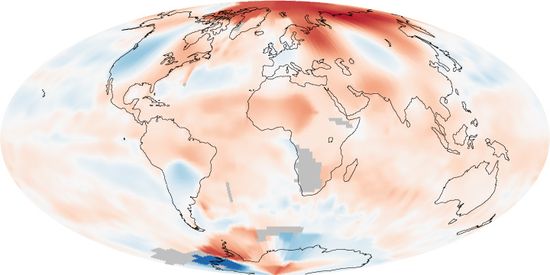
Temperature_gis_201005

This is a map of global temperature anomalies for last month. Pretty uneventful until you get to the Arctic, where the feedback loops of warming, loss of ice-reflection, more warming and so on are looking scary. Earth Observatory notes:

Temperature anomalies in May continued a much longer trend. GISS compared the January–May mean surface temperature anomalies for 2010 to those of 2005 and 1998 (the two warmest years on record). January–May anomalies show 2010 to be the warmest out of 131 years (2005 is the fourth warmest and 1998 is the fifth warmest). Moreover, Arctic temperature anomalies are especially pronounced, and have been since the turn of the twenty-first century.

“Ongoing temperature anomalies like these are strong evidence of the Arctic amplification of global climate change,” says Ted Scambos, lead scientist at the National Snow and Ice Data Center. The Arctic environment is very vulnerable to warming because of feedbacks that amplify the initial change. Sea ice retreat and snow melt reduce Earth’s albedo, which can lead to increased warmth and further melting. Scambos explains that, although the Northern Hemisphere experienced significant snowfall in early 2010, spring melt was rapid, exposing land surfaces to sunlight sooner than usual.

It's real. And we still do nothing. In fact, the American political system seems incapable of even absorbing the data.

How Do We Spend Our Time? Ctd

Daniel Hamermesh picks up on the American Time Use Survey. He notes:

In this recession, average work time (including school) dropped by 15 minutes a day.  Of this drop, 6 minutes went to additional sleeping; and another 6 minutes went to additional TV-watching.  The average American actually spent 2 minutes less on household production. The recession didn’t shift work from market to home activities that we think of as productive; the drop in market work went into activities that, at least at the margin, most of us would view as unproductive.

You mean watching Jersey Shore is inefficient? Whatever. I do what I want.

Wastes Of Space

Tom Vanderbilt illustrates his case against too many parking spots by noting that Purdue University researchers found that if "all of the vehicles in the county were removed from garages, driveways, and all of the roads and residential streets and they were parked in parking lots at the same time, there would still be 83,000 unused spaces throughout the county." Felix Salmon agrees:

For me the biggest and most invidious cost of parking lots is also the most difficult to measure: the way that they kill any attempt at decent architecture, both on the level of individual buildings and on the level of city development more broadly. Your favorite buildings, your favorite cities, and your favorite vacation destinations all have one thing in common: a distinct absence of massive parking lots. So why are these things mandated by zoning regulations across the U.S.? It makes precious little sense, and it’s high time that minimum parking requirements died a long-overdue death.