The Rise Of The Kid Flick? Ctd

A reader writes:

As a movie critic, I end up seeing most new releases and two of the biggest grossing films of the year, "How to Train Your Dragon" and "Toy Story 3," were not only family films, but also two of the year's best. They exceeded in quality and sophistication most of the movies aimed at adult audiences. (I'm just talking multiplex here. The art house continues to offer challenging films for adults.) "How to Train Your Dragon" was genuinely thrilling and the 3D animation was gorgeous. "Toy Story 3" was, in the tradition of Pixar, superb and had children laughing, while the adults cried. (If you haven't seen "Up," Pixar's big release from last summer, do so soon. It's one of the best movies of this century. My kids love it for the talking dogs, but some of its story of loss is too painful for me to watch repeatedly.)

Animated films are currently some of the most intelligent films being made for the multiplex.

Pixar has proven that quality – with the help of the monstrous marketing arm of Disney studios – can be successful. The animated film, though inherently more artificial, is providing us with more humane, challenging stories than we are seeing in live action. I keep expecting Pixar to challenge audiences too much– the movies "Up" and "Wall-E" spend a good portion of their running times as essentially silent movies–with stories of cranky widowers and robots helping humans overcome a world ravaged by overconsumption. But Pixar makes these films with such care, that they have gained the complete trust of the audience.

I celebrate, crave, quality films wherever I can find them. And right now some of the best movies are being made for families. It's a golden age for animation.

Noting the NSFW mash-up above, Gabe differs:

… I don’t care about Toy Story. That being said, it is high time the children of America learned about the gray-area vagaries and heartbreaking social complexities of the modern day drug trade and the political and legislative efforts being used to combat it in a format that is both relatable and appealing to them. Also, the show would be called Hamsterdam and feature animated hamsters. Obviously.
The News Is Broken

Publicopinion

Well, here's an idea:

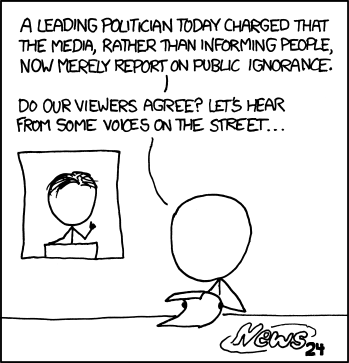
It's trite to say it, but the news business is biased toward, well, news. There are plenty of outlets that tell you what happened yesterday, but virtually no organizations that simply tell you what's going on. Keeping up on the news is easy, but getting a handle on an ongoing situation that you've not really been following is hard…

If I edited a major publication — or even a medium-sized one — I would begin each major legislative battle by detailing a few of my smartest, clearest writers to create a hyperlinked, fairly comprehensive, summary of the basic legislation. That summary would be kept updated throughout the process, and it would be linked in every single story written on the topic. As reader questions came in, and points of confusion arose, it would be expanded, so by the end, you'd have a document that was current, comprehensive, navigable and responsive to the questions people actually had about the legislation. Telling people what just happened is undeniably important, but given that most people aren't following that closely, we in the media need to do a better job of telling people what's been happening.

But don't we have Wikipedia for that?

(Cartoon: xkcd)

Dancing To Cancer

Classical Indian dancer Ananda Shankar Jayant shares:

At the minute I was diagnosed with cancer, I decided not to focus on the whole thing. The only way I could escape focusing on the cancer was to focus on something that animated me and moved me and touched me. And, I found that in my dance. Dance is really who I am. Dance is really my life’s breath, in that sense of the word. I — consciously, with a whole lot of visual and mental cues — pulled myself out of the thought processes that send you into that emotional whirlpool that cancer can push you into. It does that. There were times that I shed tears and times that I was miserable. But, because I had something else to focus on and something else to shift my mind to, I found that I was able to cut this whole thing out of my mindset. Your mind is really your final frontier. I was able to take my thoughts and push them into my dance. I made it so that the cancer was not a big deal. I would go and get my chemo, take the three days rest that my body needed, and then I was back in the studio dancing, teaching class or doing choreography.

Prayer and writing gets me through my HIV as well. You have to own the illness and then own an identity that is so much more than the illness. And tomorrow will be the 17th anniversary of the day I found out. I was griping about getting old the other day, and then I remembered it used to be an ambition of mine.

Can’t Debate, Busy Pummeling Strawmen

Friedersdorf enjoyed Matthew Continetti's article on the tea parties and Glenn Beck. He adds:

Mr. Continetti focuses on the political cost associated with this kind of rhetoric. I submit that it also exacts a cost in the world of ideas. Insofar as the conservative rank-and-file confronts an imagined cabal of leftists intent on destroying America from within, it'll remain utterly unequipped to argue with, persuade, or even intelligently oppose the actual liberals and progressives who compose the other half of the political spectrum. It's heartening to see more conservatives calling out Glenn Beck. In pushing back against this poisonous pathology, however, there is much more work to be done.   

Why Doesn’t The Right Like Soccer?

Seth Masket has a theory:

I think the soccer issue is one instance where conservative leaders are simply trying to draw a line.  They feel they’ve made enough accommodations to other countries and cultures.  They simply do not acknowledge soccer as an American pastime and feel they are justified in trying to exclude it from our main culture.  We cannot just keep adding things to our nation and assume that the nation will still stand for anything.  Lines must be drawn.  This far, no farther.

Or maybe they just think it’s gay.

So, Are We Winning In Afghanistan?

CFR interviews Stephen Biddle about the war in Afghanistan. This is about as positive a spin you can put on the situation:

We're at one of those moments where it's very hard to tell whether things are going well or badly. Counterinsurgency always has this "darkest before the dawn" quality.  When you start with a tough situation, you introduce reinforcements and you begin to contest insurgent control of population areas they now control, violence then rises. Enemy causalities go up, causalities to your own forces rise, casualties to civilians increase, general mayhem rises. If you succeed, you gain political control of these populations and violence eventually comes down. From an early increase in violence, you can't deduce that you're winning or that you're losing because you would see exactly the same thing either way at this point in the war.