Getting Shit Done, Ctd

The Gaza deal is best described by Marc Lynch:

The Israeli government will significantly ease the blockade of Gaza in exchange for American support for a whitewash of the investigation of the flotilla incident.

So the Mavi Marmara achieved its goal substantially – at the expense of any justice for the attack itself. Steve Hynd adds:

By forcing this small retreat, future Israeli and U.S. retreats will come easier and faster. Thus, although it sticks in my craw to countenance a lack of legal accountability for the Flotilla assault, I'll reluctantly take the product, if that leads to a wall being tore down, instead.

Andrew Sprung sees more signs of gradual progress in this new era of American diplomacy.

The Smug Condescension Of Paul Krugman

Kinsley takes aim:

Krugman himself looks at CBO projections of deficits declining from 10 percent of GDP now to four percent in 2014 before starting to rise again, and concedes that this is "not enough." Then he cavalierly says that all you need to solve the problem is (a) to bring health costs under control, and (b) a five-percent value added tax. Oh, is that all? I have no doubt that if Paul Krugman were economic dictator, we could impose these or other solutions. In the real world (or should I say "unreal world") of current American politics, either one of these partial solutions is unthinkable without a catastrophic crisis to force our hand.

How hard is that to understand?

Maciel’s Son Will Sue

Among the many truly horrifying aspects of John Paul II's favorite cleric and theocon idol, Marcial Maciel, was his rape and abuse of his own children. When Maciel was 60, he began a secret relationship with a 22 year-old Mexican woman, who already had one son and who had another with Maciel, the purportedly celibate upholder of traditional Catholic morality. Jason Berry has now interviewed the biological son, Raul, and coverage is scheduled tonight by ABC News' indefatigable Brian Ross (blotter story here). We knew all this before, but the details still hint at the evil harbored by John Paul II as Pope:

By Gonzalez's account, he was 10 when Maciel sexually abused him and Omar on a trip to Madrid, in 1989, and photographed them in the process. "My dad told me his uncle, this guy, used to masturbate him, and I have to masturbate him. … Why do you say that to a kid?"

He was nearing eleven when Maciel arranged for Gonzalez to live in Dublin with an Irish family, attend private school and learn English. When the call came to join his father for a weekend in London, he was homesick for his mother. "I started crying. And I said, 'I want to see you, you know.''"

In London, "I saw my dad, and he took me for a walk."

At this point in the interview he began sobbing.

"I knew this was going to happen," he said, of his emotions.

He described a stroll in London as Maciel bought magazines, took him back to the hotel and showed him "hard-core pornography" to arouse and then abuse him.

Collecting Our Thoughts

Steven Berlin Johnson reviews Nick Carr's new book. He disagrees with Carr that the internet is ruining our brains:

Actually sitting down to write out a response to something makes you see it in a new way, often with greater complexity. And that of course is the crucial flipside to the decline of long-form reading in the digital age: the increase in short-form writing. If we are slightly less able to focus because of the distractions of electric text, I suspect it is more than made up for by the fact that we are much more likely to write out our responses to what we do read.

I'm a writer by profession and it's totally clear to me that since I started blogging, the amount I write has increased exponentially, my daily interactions with the views of others have never been so frequent, the diversity of voices I engage with is far higher than in the pre-Internet age – and all this has helped me become more modest as a thinker, more open to error, less fixated on what I do know, and more respectful of what I don't. If this is a deterioration in my brain, then more, please.

The problem is finding the space and time when this engagement stops, and calm, quiet, thinking and reading of longer-form arguments, novels, essays can begin. Worse, this also needs time for the mind to transition out of an instant gratification mode to me a more long-term, thoughtful calm. I find this takes at least a day of detox. Getting weekends back has helped. But if there were a way to channel the amazing insights of blogging into the longer, calmer modes of thinking … we'd be getting somewhere.

I'm working on it.
Barton And The Right, Ctd

Reihan begins to come around:

My argument re: BP is clearly completely wrong if the WH had nothing to do with BP's decision to establish the fund. I assumed that the WH really did exercise its leverage. But I now get the sense that the WH was trying to take credit for a decision BP reached on its own, to arrest its freefall. And the WH decided to capitalize politically, which is entirely natural.

Worst Case Scenarios, Ctd

OilSeanGardnerGettyImages

Stephen Messenger absorbs the latest:

Well, it just keeps getting worse. Around two months ago, after the Deepwater Horizon oil rig sank, BP estimated that some 1,000 barrels of oil were leaking into the Gulf each day. That number was soon revised to 5,000 barrels and later to around 12,000. Then, just last week, those grim figures were raised again, putting the estimates at between 30,000 and 65,000 barrels of oil leaking each day. Now, according to a recently disclosed internal document from BP, that number could have been as high as 100,000 barrels of oil, daily–a fact BP decided to keep secret.

Andrew Revkin tempers that top estimate:

The calculation was for the highest possible theoretical flow if all of the engineered components containing the pressurized oil and gas were to fail. There’s no reason to think this is the flow at this point, but the disconnect between public statements and internal assessments is striking.

In other worst case handwringing, TechBear speculates over news of leaking methane and potential sinkholes. But the Daily What passes along the most terrifying scenario yet.

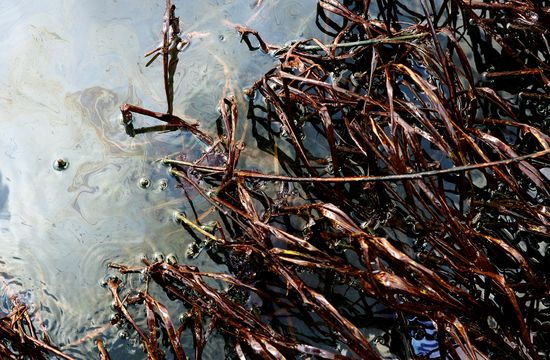
(Image: Oil lays down the marsh grass in Bay Jimmy June 19, 2010 near Port Sulpher, Louisiana. By Sean Gardner/Getty Images)