Bundles And Bundles Of Joy?

Bryan Caplan makes the case for having more children. Will Wilkinson counters:

Increases in average levels of education, levels of disposable income, gender equality, and access to birth control — that is, increases in the ability of people (and especially women) to deliberately control the conditions of their own lives — generally lead people to choose a smaller rather than larger number of children. As far as I can tell, Bryan's response is that it "lacks perspective" to take at face value this truly striking tendency of choice under conditions of increasing personal control. If Bryan really thinks rising education, wealth, and gender equality have somehow made us worse at evaluating the costs and benefits of children, he probably ought to turn in his economist card.

None of this is to say that there aren't excellent reasons to have families larger than the relatively small rich-country norm. It's just that these tend not to be the kinds of reasons economists consider "selfish."
Live-Tweeting A Firing Squad

Balko calls the following tweets by Utah's attorney general "shameless":

A solemn day. Barring a stay by Sup Ct, & with my final nod, Utah will use most extreme power & execute a killer. Mourn his victims. Justice

I just gave the go ahead to Corrections Director to proceed with Gardner’s execution. May God grant him the mercy he denied his victims.

We will be streaming live my press conference as soon as I’m told Gardner is dead. Watch it at http://www.attorneygeneral.Utah.gov/live.html

Curt Hopkins frowns:

The issue here is less one of the capital punishment's morality … and more the way this public servant chose to use the service. The tone of Attorney General Shutleff's subsequent Tweets seem strident and unprofessional. All other things being equal, that is any Twitter user's right. But not if you are representing your government, your state and its people.

As does Shani Hilton:

I admit that part of my issue with this is that I think that capital punishment is generally indefensible. But more than that, tweeting about someone's death—even the death of a convicted murderer—strikes me as callous and not fitting for the gravity of the situation. It would be different if, say, he had tweeted a link to a press release. But to send out a message about the end of someone's life so cavalierly. It boggles.

(Osocio has more on the Amnesty ad above.)

Barton And The Right, Ctd

Reihan goes to bat for Rep. Barton:

It should go without saying that demanding money from BP is not quite like a playground full of schoolyard bullies kicking a kid when he’s down. For one thing, BP isn’t terribly sympathetic. But that’s precisely the point—the Muslims who were burned alive in Gujarat in 2002 weren’t sympathetic to those who victimized them either. And that’s why we’ve developed long, drawn-out legal processes: to create an orderly society, we at least try to contain and manage our desire for vengeance.

Larison, not exactly a fan of big government, counters.

The Genius Handicap

Dreher sympathizes with child prodigies and their parents. He talks with "N," a friend with a "severely gifted" child:

Try, he said, to understand what it's like for kids who are so advanced that they can't relate to children their own age. But they don't know why they stand apart; all they know is that they do. They feel like freaks, he said, and in some sense they are freaks. The world tells them that they should just try to get along, and chastises them for being anti-social. N. said that parents often have to endure the well-meaning advice of family members and others who think that they're coddling these hothouse flower children, and the thing to do is to throw 'em in the pool, so to speak, and to make 'em swim.

"What do you do," he told me (and I'm reconstructing this conversation from memory), "with a kid who struggles to do basic math, but who discusses ideas integral to the basis for calculus?

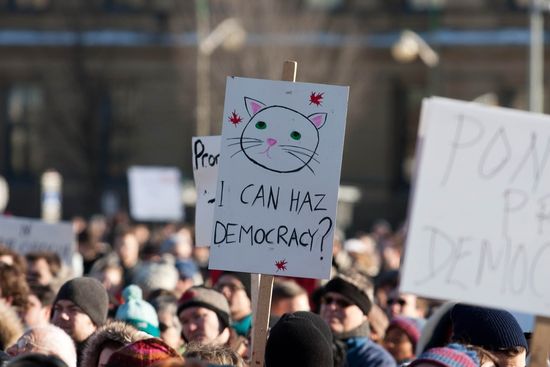
Lolcats vs Democracy?

Lolcats

Evgeny Morozov continues his series of disagreements with Clay Shirky by bashing Shirky's new book on the cognitive surplus:

As Markus Prior points out in his excellent 2007 book Post-Broadcast Democracy, today’s environment of information abundance splits the public into a small cohort of news junkies, who know everything there is to know about politics, and a much larger contingent of entertainment fans, who know the names of the latest YouTube celebrities and their favorite lolcats, but not of their home senators. “Although it is comforting to know that [viewers] finally get to watch what they always wanted to watch,” Prior writes, “their newfound freedom may hurt both their own interests and the collective good.” That is the case of those South Korean Internet users, who helped to spread panic that harmed their country’s diplomatic standing.

Shirky, of course, would never talk about viewers’ interests: that is not populist-speak. Populists prefer to make normative claims about the need to break up the traditional media without specifying how we should nurture responsible citizenship and promote good public policy in their absence. This just happens, apparently.

(Image by Flickr user Shortfin)

As The Fourth Estate Crumbles

Friedersdorf praises journalists who have exposed local government corruption. He wants to know who will take over that role as print dies:

I am pessimistic about the ability of a lot of newspapers to survive. So I'd like to suggest that, however you feel about newspapers, it's important that we generate ideas for replacing the local watchdog functions discussed in this post. Are there any readers who've observed viable replacements for the beat reporter in your community? Does anyone have ideas that are as yet untried?