The American View Of Soccer, Ctd

FOOTIEDanKitwood:Getty

A reader writes:

Despite being a marvelous game, soccer will never become popular in the US because the sport’s pace and flow does not lend itself to commercial interruption. Baseball is perfect for commercials because of its inning structure, and football and basketball have numerous time-outs. So soccer will never get the huge investments from networks and sponsors that have enabled American football and basketball to prosper. And hard to imagine soccer going that route without destroying the game.

Another writes:

Oddly, I think one of the major things keeping Americans from becoming more invested in soccer is the aesthetics of injury – that is, the way players react to being fouled.  I'm an American who has long been a lover of soccer, but there is still something galling about the way footballers react to a hard challenge – the crying, the rolling about in pain, the desperate clutching of extremities – only to get up and be fine 90 seconds later.  I know that flopping is not unique to soccer.  But it's highly unfortunate that global soccer developed in such a way that a certain brand of histrionic flopping became the norm. 

Another:

Most of your reader replies have missed the basic point of why soccer has not and will not achieve the success in the US that it has enjoyed elsewhere: Americans need scoring.

I'm an avid fan of football, baseball, and basketball, and while I appreciate the international love for soccer, I'm certainly in the majority of Americans who will never be soccer fans.  It wasn't enough that stars like Babe Ruth, Magic Johnson, Larry Bird, Michael Jordan, Red Grange, and Jim Thorpe were charismatic; they were the top scorers of their time.

Die-hard fans of any sport enjoy the nuances of fundamentals and defense. But to attract the casual fan, American sports leagues have had to cater to higher scoring.  In baseball, they seized on Ruth's popularity as a home run hitter by ending the "dead-ball era," lowered the mound after the late '60s favored the pitcher, and turned a blind eye to performance enhancing drugs in the late '90s when Mark McGwire and Sammy Sosa's home run chases brought back fans that had left after the mid-'90s labor issues. Football has tweaked its rules from the beginning to favor scoring, right up to this day when quarterbacks and wide receivers are protected to an enormous degree by the rules.  Similarly, the rough and tough defenses of 1980s basketball have been practically outlawed by the foul-calling of NBA officials to stimulate scoring, and the NBA's first big breakthrough was spurred by the installation of the 24 second shot-clock to pressure players to score more quickly.

The problem with soccer, and the reason it will never be widely accepted by the casual American sports fan, is that it cannot adapt the game to increase scoring – such as shortening its huge friggin' field – without losing legitimacy within the international community.

The best scorer in the American professional soccer league last season was some guy named Jeff Cunningham (I didn't know who he was until I just looked him up, and I watch ESPN every day). He scored 17 goals in 30 games.  Landon Donovan, the closest thing to a household name among American soccer players, scored 15.  That's just not going to cut it for American sports fans, and American soccer is handcuffed to change it.  Indoor soccer was invented to overcome those issues, and achieve greater scoring, but can never attract marquee talent because it has no international legitimacy.  Without the fan base soccer enjoys internationally, the best American players, the ones most likely to win over American fans, will continue to play in Europe.  It's a Catch-22.  And one that cannot be overcome.

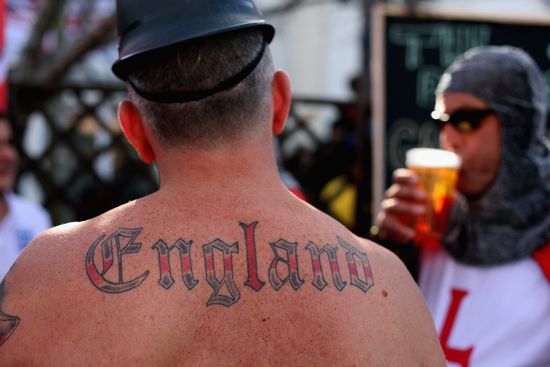
(Photo: An England football supporter shows his tattoos in a bar on the Waterfront on June 18, 2010 in Cape Town, South Africa. He is surrounded by fans dressed as Pythonesque medieval knights. Cape Town hosts the match between England and Algeria today in the second of their group stage matches. By Dan Kitwood/Getty Images.)
“Don’t Let Them Forget About Us”

Dan Zak reports on Leeville, LA. Slideshow here. He follows up at his blog:

This is a town that shouldn’t exist, topographically, but has been kept alive by two American prospects: seafood and oil. Now both those industries are crippled by the uncontrolled leak out in the gulf. Leeville is evaporating. Every person I talked to used the words “ghost town.”

Netanyahu’s Achievement

From a Pew Study (pdf) released yesterday:

In Egypt the percentage of Muslims expressing confidence in Obama fell from 41% to 31% and in Turkey from 33% to 23%. Last year only 13% of Pakistani Muslims expressed confidence in Obama, but this year even fewer (8%) hold this view. And while views of Obama are still more positive than were attitudes toward President Bush among most Muslim publics, significant percentages continue to worry that the U.S. could become a military threat to their country.

The Arab world, for reasons both ugly and realistic, was waiting to see if Obama could actually wrest free of the pro-Israel lobby and put real pressure in Israel. And they saw that, while a great deal has indeed shifted in the domestic contours of this debate, AIPAC's control of the Congress and US foreign policy remains impressive. When Netanyahu stared down Obama last year and Obama retreated, the impact of the Cairo speech was neutralized. And that, remember was Netanyahu's and Cheney's strategy all along: to destroy the Obama moment's potential to shift the US back to a more balanced position in the Middle East.

This struggle isn't over, of course. And those who score cheap early victories over Obama tend to discover the power of a long game. But one reason the Muslim world has lost confidence in Obama is because they have every reason to. On the core issues – especially the acceleration of the colonization of the West Bank – nothing has changed. Which is what AIPAC wants, and why AIPAC is, in my view, working against the broader security interests of Israel's most important ally.

The Nitty Gritty Of Governance

Here's something that won't seize cable news:

Authorities arrested 485 people since March in the largest nationwide mortgage-fraud crackdown of its kind, the U.S. Justice Department said.

During the enforcement effort, 1,215 criminal defendants responsible for $2.3 billion in losses faced some type of legal action, the department said. The crackdown, dubbed Operation Stolen Dreams, also included 191 civil cases resulting in the recovery of more than $147 million.

“This represents the largest collective enforcement effort ever brought to bear in confronting mortgage fraud,” said Attorney General Eric Holder at a news conference in Washington. “These schemes are despicable, they are dangerous to our economy and they will not be tolerated.”

Slowly, a government eager to govern is rediscovering its atrophied muscles. And this is not socialism. It's the regulation that makes capitalism possible and fair.

Palin’s Next Prop? Ctd

THATCHEROliScarff:Getty

A reader writes:

Don't forget that Thatcher was also a research chemist for a number of years before politics, and qualified as a barrister as well. Palin went to how many different colleges before getting her BA in Sports Journalism? (The answer is four, in five years.) Thatcher served 32 years in Parliament, 18 before she stood for PM. Palin has 8 years as a councilperson or mayor of a city with fewer than one-tenth the number of people as Thatcher represented for Finchley.  And then two years as governor of a small state with a part-time legislature.

I can't say Thatcher is one of my favorite politicians, but I've never heard anyone disparage her intellect or work ethic. For Palin to compare herself to Thatcher, and to try to get a photo op, is absolutely insulting.

Another writes:

Palin wants to be viewed as Reagan's heir. I wonder if her angling for a photo op with a elderly woman suffering from dementia is because a photo op with Reagan's widow has fallen flat? I distinctly remember in last summer's Vanity Fair piece on Nancy Reagan that the author said that three subjects were off-limits for the interview were abortion, gay marriage, and Sarah Palin.

Another:

Obviously Palin has never visited anyone suffering from dementia, otherwise she would never even consider such a meeting. Five members of my family and I recently went to visit an aunt who was suffering from severe dementia.

We all gathered in a room and waited for the nurse to fetch her. When the nurse brought her into the room she looked confused and frightened. The nurse guided her to the corner of the bed to be seated, and this seemed to clam her down; she smiled and folded her hands her lap. Then she started speaking…very rapidly. Nothing she said made sense. If you didn't listen to her words it almost seemed like any conversation you had ever had with her. Her voice inflections were the same, and she smiled during her brief pauses, and she still gesticulated her "thoughts" in the same boisterous manner she always had. There was a glimpse of the person she once was, and it was a bittersweet moment that had me smiling while tying my stomach in knots. It's difficult to explain…it was exhilarating to see any glimpse of the woman I loved so much, but 'just a glimpse'' was painful and cruel.

Very quickly that moment disappeared. She started talking even more rapidly and aimlessly walking around the room. Eventually she walked out of the room, down the hall and into one of the common areas. The nurse gathered her up again, and spoke to her in a very soothing, calming voice…"Come over here, Bridgie, and see if you can visit these people over here." My mom and her sister tried the same tactics, softly and politely coercing her to join us. Bridgie started to become more and more unwound, the more people engaged her, and soon she started to cry. It was obvious at this point that our presence was overwhelming her, and we need to leave – right away.
 
I couldn't even hug her goodbye. This was too much for me. It was the first time in my life that I couldn't control my tears in front of a group a people. I cried my way down the halls and out the doors, through the parking lot to the car, and all the way home. I cried forever. I cried a river that day. It was the most heart-wrenching experience of my life.
 
Knowing what I know now, I can't imagine bringing an entourage of cameras and detached visitors into the room of a dementia patient. Even if it were just a few people, the chances of it not going well are there. Because with a dementia patient, you never know what you're going to get. You never know what will upset them. Palin needs to rethink her callous, selfish desires and consider the fragile, vulnerable state of Ms.Thatcher.

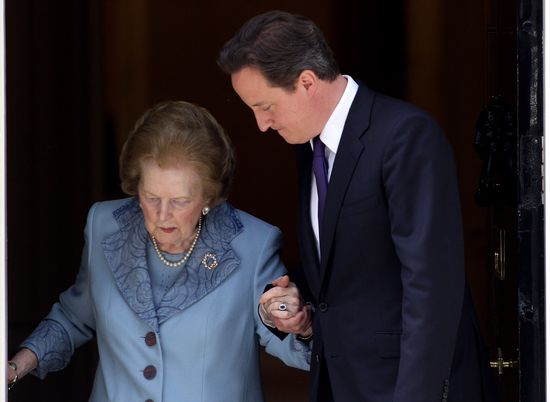
(Photo: British Prime Minister David Cameron and former Prime Minister Baroness Thatcher leave from Number 10 Downing Street following her visit on June 8, 2010 in London, England. By Oli Scarff/Getty.)