In easy-to-digest cartoon form.
Month: June 2010
No Nudge Goes Unpunished
Howard Gleckman highlights a potential problem with 401(k) plans that automatically enroll employees:
Mauricio and Barbara found that employer match rates are about 7 percentage points lower for opt-out plans. They can’t say for sure whether auto enrollment causes lower match rates. But it sure is possible. After all, if more employees participate, their employers will have to spend more to match their contributions. Whatever the cause, it seems that while auto-enrollment may increase the number of workers with 401(k)s, it won't necessarily boost their retirement savings.
How Should We Deal With Conflict Minerals?
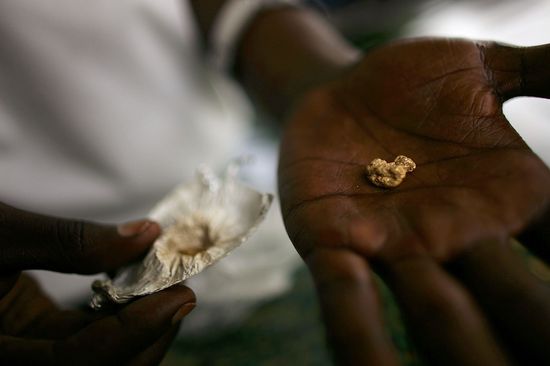
Dana Goldstein checks how a program intended to fight rape in Congo is faring:
The State Department has provided The Daily Beast with documents detailing how the $17 million to fight sexual violence have been allocated, mostly toward treatment programs for rape survivors. But human rights advocates hope for more. They believe the US should stop sending hundreds of millions of dollars in aid–including military training–to Rwanda and Uganda, whose armed militias perpetrate violence and rape across the border in Congo. They also criticize the administration and Congress for failing to crack down on multinational corporations that operate mines in the country, some of which have paid off armed groups in exchange for access to mineral deposits.
An Africa blogger pushes back against these activists:
Legalizing and legitimizing the mining sector is the best way to stabilize the region…It's ludicrous to pretend that the mineral trade in Congo can be affected in any significant way by American legislation, or that doing so will significantly affect the level of violence in the region. Without the basic tools of public order in place and functioning as instruments of the public good in the DRC, the provisions of [the Conflict Minerals Trade Act] are likely to work about as well as does the Kimberley Process Certification Scheme does in weak states that lack functioning governmental institutions – which is to say, not at all.
(Image: A gold buyer displays a recent purchase March 28, 2006 in the gold mining town of Mongbwalu, Congo. By Spencer Platt/Getty Images)
Ross On Afghanistan: Getting Warmer, Ctd
Millman goes another round:
Apart from the overarching point that our resources, our responsibilities, and our interests are all limited, the key point that Rory Stewart makes in his article that Ross cites as “admirably honest” is that “[t]here are, in reality, no inescapable connections between Afghanistan and Pakistan, al-Qaeda and the Taliban.” If this is true, then if our goal is overwhelmingly to keep al Qaeda from again regaining its prior position in Afghanistan, to say nothing of Pakistan, then we should not assume that defeating the Taliban and/or keeping them out of power should be a primary war aim. Right now, nearly all the discussion about Afghanistan is predicated on the assumption that the American goal is to keep the Taliban out of power. If, instead, the assumption were that the Taliban, in some form, was inevitably going to return to power – not necessarily to exclusive power, of course – then we’d be having a very different conversation.
The Disease Is Also The Cure?
Sean Collins favorably reviews Daniel Ben-Ami's book defending economic growth:
The limits to growth that critics cite are not insurmountable, says Ben-Ami. For example, he argues that the answer to climate change is more and better technology, rather than reduced energy use and cutting back on economic growth. But technology is expensive, which is why growth is so important. Cynicism about growth is negative because it denies us the resources to deal with problems.
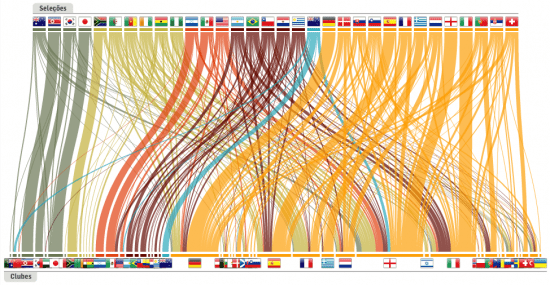
Exporting Soccer Players
Flowing Data finds a visual of the international soccer trade:
Slave Narratives
TNC talks to a historian about primary documents:
All oral histories are "memory" — retrospective accounts, in contrast with documents like wills or memos that were produced when events were actually taking place. Over time, people forget and revise, as when many Holocaust survivors began to retell their stories to match up with the narrative of Schindler's List. It is not dishonesty — it just makes oral histories a particular type of document, which we need to note has been produced AFTER the event.
In the case of the slave narratives, we would also want to do the math — many of the subjects who were still around to be interviewed in the 20th century were very young when they were slaves. How "accurate" are your memories of childhood? How "accurate" will they be when you are 80? What assumptions do kids make that adults don't, and vice versa?
The Daily Wrap
Today on the Dish, Palin shut out even conservative bloggers, Sharron Angle tried to hide her real views on abortion, and the Palin campaign model metastasized. Taibbi pwned Lara Logan, Pareene called out an LA Times blogger, a CNN reporter chose access over reporting, and a reader nailed the insecurity of MSM reporters. Friedersdorf wanted to drop the topic of Trig, readers disagreed, and Bernstein went another round. Douthat defended himself on Afghanistan. Empire watch here.
In Cup coverage, Dayo Olopade saw a surge in pan-African pride. More soccer fodder here, here, and here. The Economist examined the blackmailing of journalists' opinions, Fallows explored the end of privacy, a reader wondered why anyone trusts the secrecy of email, and Greg Marx explained the necessary intimacy of blogging. John Hawkins didn't think Frum was sufficiently conservative and Frum replied.
In other commentary, Gail Dines baited Douthat with porn, Tony Woodlief praised parenting, Free Exchange suggested that the gays could make better parents, and Dylan Matthews balanced Social Security. Hewitt Award here, a recession view here, and a glimpse at guerrilla gardening here. MHB here, VFYW here, and FOTD here. The latest Window View winner here.
— C.B.
Face Of The Day
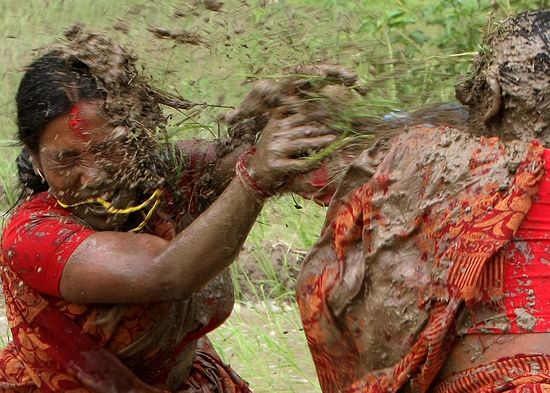
Nepalese farmers throw mud at each other in a paddy field in Tau-Daha village on the outskirts of Kathmandu on June 29, 2010. The farmers are celebrating National Paddy Day on 'Asar 15' of the Nepali calendar as the annual rice planting season begins. By Prakash Mathema/AFP/Getty Images.
History, Without Make-Up On
TNC just finished Grant's memoir:
There are those [who] manipulate history to bleach the Civil War, who would sanitize all the unpleasantness until we are left with an unfortunate family feud in which there was no right or wrong. This is history marshaled for a kind of nationalist faith-healing. My thoughts on the apostles of comfortable narrative are a matter of public record. In my care, the spiritualists have been handled roughly.
 The Dish