Dashiell Bennett defends that godawful noise:
It figures that the French would have the temerity to blame their crappy performance on the noise.
Dashiell Bennett defends that godawful noise:
It figures that the French would have the temerity to blame their crappy performance on the noise.
A reader writes:
The fact that anyone considers that interview "pwning" of Palin shows us just how far we've gone in accepting that Palin should be treated with kid gloves. The interview was very mildly challenging of her, while not being critical of her by any reasonable standard.
Sarah came in blathering nonsense about what is being done wrong, and O'Reilly doesn't interrupt her, but changes the topic a bit with his questions and asks her a challenging, albeit totally fair question of what she would do in this situation. She gets lost for a while, stumbling on her answer and then coming to one coherent thought about allowing help from outside, at which point he is sure to mention "good point."
The only point in which he's not in agreement with her is when she claims Obama isn't putting the effort to stop the leak first, which he does challenge, but is very reserved and deferential in comparison to standard O'Reilly outrage.
Have you ever seen O'Reilly interview someone who he truly distrusts or says something which angers him? In those cases he will talk over the interviewee, accuse them of insincere motives, and constantly redirect the interview any time they make a point, without giving them any sort of concession. He would never say "good point" in such an interview. He would never let the interviewee go on for a full paragraph of their scripted answer, as he often does with Palin, in such an interview.
Now, her blank stares and weak answers may be exposing, but in no way is O'Reilly trying to give her a tough interview. He's bending over backwards to give her credit, and at some point she goes so far into the crazy that he can't defend it, although he reacts in mild disagreement rather than horror.
Of course, my reader is right. It does say something about how low we've sunk that even I treated this softball interview as some kind of breakthrough.
Shani Hilton profiles Holla Back DC:
Taken objectively, it's…an amazing collection of often very short accounts of street harassment, written by harassees who are mainly women. They can be as simple as a few sentences describing a man saying things like, "Damn, baby. I thought you were coming to see me. Mmm, mmm." They are sometimes longer tales of harassers saying they want to rape the harassee. And there are stories of men groping and assaulting women….
One thing that nearly all of the posts have in common is an acknowledgement of the effects that street harassment have on women.
Most write that they felt shaken, angry, helpless, or tearful after an incident. They write that it took time for them to pull themselves together. That's the thing I think many men don't understand about the harassment: it completely strips a woman of autonomy and it forces a reaction that lasts long after the incident is over. Many times, harassers are seeking a positive reaction, and when they don't get that, they turn to calling the woman they complimented moments earlier a "bitch." And either way, the woman has been forcibly dragged out of her own thoughts. That's why so many women studiously ignore all strangers on the street, I think. It's a form of insulation from getting shook.
"(The bailiff just made Maggie NOM put her bare feet down. She is so disrespectful)," – Rick Jacobs, live-blogging the closing arguments of the Prop 8 trial.
Maggie Gallagher had her bare feet up on a chair or table?
Yglesias tweaks Drezner's argument:
I guess what I wonder is what would soccer displace if it were to become more popular? It’s not like people are spending tons of time these days sitting alone on the couch playing solitare and hoping for someone to dream up a new sport to watch. The general trend has been toward creating more and more options and more and more fragmentation of the audience for just about everything. The TV networks are in decline, the record labels are in decline, the movie studios are in decline, everything’s in decline. Not because entertainment is in decline, but because we’ve never had more entertainment options. Under the circumstances, it seems to me less likely that soccer will break through and become as popular as basketball or hockey is today than that football and baseball will see their popularity ebb down…
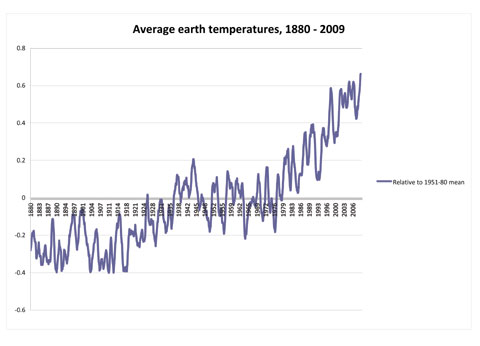
Bradford Plumer flags the EPA's new global warming analysis:
Yesterday, the EPA released its modeling of the Kerry-Lieberman climate bill. A lot of the coverage focused on the agency's conclusion that the cap-and-trade program would be quite affordable—costing families less than a dollar a day. But I'd say the most salient part of the analysis was the section Brad Johnson highlighted: If the United States passes something like the Kerry-Lieberman climate bill and helps negotiate an international agreement on carbon emissions, we'll have a 75 percent chance of keeping temperature rises below the danger zone of 2°C. But if we do nothing, our chances of meeting that goal are roughly 1 percent.
That's the difference between barreling headlong toward catastrophe and staying safe.
Steinglass asks:
Maybe the EPA is wrong about these probabilities. But if it's right, how much is that worth?
Chart via Leonhardt.
Cameron Abadi reveals that a famous photo of Iranian martyr Neda Agha-Soltan isn't of the right woman:
A woman named Neda did indeed die last summer on the streets of Tehran, gunned down by members of an Iranian militia. Her full name was Neda Agha-Soltan. But mixed in with the tragic footage of that Neda's death, broadcast around the world in a viral video that galvanized world opinion against the Iranian regime, was a compelling Facebook snapshot of a smiling young beauty in a flowered headscarf.
Her name was Neda, too — Neda Soltani.
What follows is the incredible story of what happened when the age of social media collided with political upheaval in a land behind a curtain — and how it even forced a 32-year-old graduate student into political exile.
Closing arguments are today. You can read the plaintiff's and the defendant's answers to Judge Walker's questions here. Brian Leubitz summarizes:
So what are the proponents’ [of Prop 8] advantages? Well, if you read more than a page of their responses you see what they think is their strong point: rational basis scrutiny. In other words, Pugno and the gang believe that because gays and lesbians have never been considered a “suspect class” under the law, they are the ones defending the strategic ground. They only need to prove that there was some “rational basis” for the state to enact the legislation, nothing more….
[The opposing argument from the plaintiffs is that] they believe that a) gays and lesbians are/should be a suspect class and that b) the proponents must prove their case accordingly. Now, I should point out that in In re Marriage Cases, the 2008 decision that made my marriage possible, the California Supreme Court said that sexual orientation is a suspect class under the California Constitution. That doesn’t apply to the federal courts, who are interpreting the federal Constitution, but it is worth noting. However, no federal court has ruled that the federal Constitution does view sexual orientation as a suspect class. This case seeks to change that. It’s a broadening of the law, but one that is reasonable considering recent jurisprudence.
FDL is live-blogging. So is the Courage Campaign and the San Jose Mercury News.
Scott Morgan embeds a clip of Palin and Ron Paul talking about marijuana:
Though unwilling to support legalization, Palin clearly has some sympathy for marijuana users on privacy grounds and sort of gets the fact that marijuana enforcement is a stupid distraction from important police work. But you can't have it both ways. As long as police and prosecutors hold the power to pursue and punish people for pot, they'll continue to do so, and they'll say they were just doing their job when some poor soul gets their dog shot over a dimebag. There exists a rather fundamental incompatibility between prohibition and politeness.
Still, Palin's comments are interesting in the context of the overall discussion.
The whole point of the segment was to bring together representatives of the Tea Party movement and debate some sensitive issues. Listening to Ron Paul's opposition to marijuana laws and Palin's reluctance to defend them, you start to wonder if anyone in the right-wing activist movement still cares about fighting a war on marijuana
Food trying to escape:
The Huber Experiments – Vol. 1 from The Upthink Lab on Vimeo.
 The Dish