Sharron Angle is to be shielded from the press – apart from love-ins at NRO – for a few more weeks. The press, it appears, takes this as a fait accompli, not as something to resist, expose and complain about.
Month: June 2010
Dissent Of The Day
A reader writes:
Quit classifying the whole tea party movement as people who stood by when Bush and his thugs shit on the Constitution. They say the tea parties actually grew out of the 2008 campaign of Ron Paul – someone who was very critical of Bush and his totalitarian ways. There is also a new show that many people are labeling as the tea parties' own TV show: Freedom Watch, hosted by Judge Andrew Napolitano. He is a guy who criticized Bush and his horrendous civil liberty and spending policies.
Not all the Tea Party people are only in it to be anti-Dem or anti-Obama. You and much of the media are trying to create a false narrative that groups the whole movement into a group of Bush-loving racists. Do not forget there is a libertarian wing, and it is the most honest group of people out there. They are principled, and the R or D in front of a politicians name means nothing to them. Please acknowledge this and quit stereotyping such a large and diverse group of people.
I do think this sliver of libertarian principle exists out there, which is why I have been very sympathetic to someone like Ron Paul or indeed, Dick Armey, who did show up for duty when Bush shredded core civil liberties and spent like a sailor on meth. This strain does exist and I find it a refreshing – if somewhat utopian – addition to our debate. It is also not motivated by racism or resentment: to take one example: the Northern Colorado Tea Party just canceled an appearance by Steve King because of his racially charged comment about Obama. But what I was describing is a mass movement that clearly did not exist under Bush and is peopled by millions who supported him to the bitter end. Understanding these people's motives is the interesting thing.
The Deepwater Horizon Speech Reax, Ctd
A reader writes:
For whatever it's worth, I'm a native of and currently live in Louisiana, about 20 miles outside of New Orleans. My dad is a Cajun river rat in the truest sense, born and raised in Southeastern Louisiana. His father's native language is Cajun French — literally, he had to learn English as a boy. My dad has never fished commercially, but it defines his out-of-work, weekend persona — it dominates his spare time. He often talks about a dream life living in a shack somewhere out in the marsh, fishing all day. He's a product of the cultural fabric of southeastern Louisiana.
My dad comes home from work these days depressed about the oil spill. He thinks about it all damn day, and, like many here, he has no shortage of outrage at everyone involved in this mess.
When Obama pivoted to his remarks about "The Blessing of the Fleet," my dad started crying.
He's not someone who is going to give you a nuanced opinion about politics or policy — in fact, he's relatively apolitical — but he knows what he knows.
Maureen Dowd can talk all she wants about these amorphous, nebulous standards like a "Clint Eastwood moment" or whatever, and Anderson Cooper is free to think he knows the people here better than anyone because he's been here for a few weeks, but Obama connected with my dad last night — of that I can be sure. And trust me, my dad isn't exactly a pushover.
I have more trust in the sanity and common sense of Americans on this than many of my fellow pundits.
O’Reilly Pwns Palin
A moment of truth on the Factor:
First, [O’Reilly] challenged Palin by saying, “49% of Americans still want BP to run the show and only 45% want the government to run the show.”
If you stop the video at about the 3:00 point, you can see the look of dismay on Palin’s face, followed by nervousness, moments after he said that, as she must have realized this was not going to be the kind of cakewalk she has probably come to expect on Fox News.
O’Reilly went on to ask, “What is your solution, here, Governor? What would you do tonight – tell the nation tonight, what you would have said, the main point in that speech. Go.”
Palin obviously had no idea. “Stopping the gusher,” she said. “That’s the number one priority of the nation.”
“But nobody knows how to do it,” O’Reilly countered.
“Well, we haven’t had the assurance by the president that that has been his top priority.” Her voice rose with more condescension, as she continued to evade the question and, instead, went on to accuse the president of making “cap and tax” his greater priority and “using this crisis… to increase the cost of energy.”
“Are you telling me that you don’t think the president’s top priority is stopping that leak? Is that what you’re telling me?” O’Reilly asked, not bothering to hide his incredulity.
He clearly realizes what a total farce she is – and he slowly dismantles her mindless partisanship by the end of the segment. Good for O’Reilly. Particularly good for exposing just how little this phony knows about energy policy, her alleged expertise.
Mercede Backs Levi On Palin’s Calling Trig “Retarded”
Here's the relevant blog-post:
Have I ever seen Sarah Palin refer to Trig as the “retarded one”?
No I have not personally heard her use that term, but I do remember my brother twice coming home and telling me about it.
So we now have independent confirmation that Palin, after making a huge song and dance about the use of the word "retarded" by Rahm Emanuel to describe – metaphorically – some Democrats, referred to her own Down Syndrome son – literally – as "retarded" in front of him at home. And yet no one in the MSM challenged her on this point when she launched into her Emanuel nonsense, as if her word is somehow automatically more reliable than Levi's – because, er, she's powerful. No one, in fact, has even asked her to rebut Levi's and Mercede's assertion. And no one has yet found an obvious lie in anything Levi has said, while her lies spew out like Deepwater Horizon.
Deference, again. Deference, always. And to give an insight into who really does have power in this situation:
Do I feel safe living in Wasilla?
No. I do not feel that my property is safe, nor do I feel my family is safe.
Amazing how many people say that in private about living under the shadow of Todd Palin. And one reason I remain happy that Joe McGinniss accepted the offer to live next door is that it's an open declaration that he is not afraid.
Bursting that bubble of fear and intimidation is critical to getting at the truth.
The Deepwater Horizon Speech Reax
What stood out was that for all his praise of the House climate bill and talk about the "consequences of inaction" and so forth, not once did he utter the phrase, "It's time to put a price on carbon." And that suggests to me that this speech was primarily about containing the damage to his administration, and was not the pivot point in the energy debate that many people were hoping for.
Drum:
The whole point of a prime time Oval Office speech (transcript here) is that it announces something big. On that score, Obama failed right from the start. He told us that lots of people are already working the cleanup. Yawn. That Ray Mabus is going to develop a long-term Gulf Coast Restoration Plan as soon as possible. A plan! Hurrah! That we're gonna make BP pay for everything. Roger that. And then this: "I have established a National Commission to understand the causes of this disaster and offer recommendations on what additional safety and environmental standards we need to put in place." A commission! So much for "going big."
To repeat what I and other political scientists said before the health care speech last year — there's a lot less going on here than meets the eye. These speeches don't really matter very much. He's fighting a spin war on the oil spill, and to the extent that matters this is part of a series of markers he's laying down to convince opinion leaders open to convincing that he and the federal government are doing a good job. On the energy/climate bill…what matters more than anything he said is what happens next
My general sense of the matter is that there was really very little Obama could have said at this point that would have satisfied anyone. We’re already 57 days into this mess and he’s been talking about it non-stop. Absent some surprise announcement that he’s been working with James Carville and come up with an instant solution, he wasn’t going to give us anything new of significance.
Even with those very low expectations, though, this was a shockingly underwhelming speech.
Whether he's taken command of the response is immaterial now; it is now his spill to fix. Obama ran for office on the promise of restoring Americans' faith in their government's ability to solve modern problems. The economy aside, this is the biggest test of whether he can bend the curve of history in that direction.
It may be too much to ask a president, even a president with near-imperial powers, to contain something that is uncontainable, but Obama has taken responsibility for doing so, and his follow-through will be vital.
Basically, [Obama is saying he just wants some kind of bill. His standards are very low. I can't necessarily blame him — the votes aren't there in the Senate and he can't conjure them up. He needs something that at least begins the process of transitioning to a clean energy economy. But with the public uninterested in climate change, interest groups mostly advocating for the status quo, and moderate Democrats unwilling to take another tough vote, he's not going to get much.
A bill to mitigate climate change isn't a jobs bill, as Nancy Pelosi has argued, and it's more than just a bill to make sure China doesn't capture to much of the renewable-energy business. It's going to be a big bill with some unpopular stuff in it because it's trying to do a hard and important thing. And if Americans have been told that this bill will be all goodies — all jobs and energy and so forth — it's hard to imagine them sticking around once they hear that the price of electricity is going to jump up, even if only by a little bit.
All that said, I think the politics of this are rapidly moving toward an efficiency and innovation-investment solution, and that bill does look more like goodies and can be sold on these grounds. That still leaves the question of how to pay for it, but at least it matches where the polling is on this subject. The downside is that it doesn't match the actual problem we're trying to solve.
All of this piling-on is fair enough so far as it goes: Certainly last night’s speech will not echo down through the ages alongside Lincoln’s Second Inaugural, and it was more than a little irritating to sit through an Oval Office address with so little meat on its bones. But while the pundit class is free to use the occasion of a toxic oil spill to defend the environmental benefits of fossil fuels, or to explain that what a nation coping with 9 percent unemployment really needs to hear is a re-run of Jimmy Carter’s “malaise” speech, the president of the United States faces far more significant constraints. And given those constraints, and the cultish spirit in which too many Americans approach the office of the presidency, I thought Obama probably did the best he could last night — even if that “best” mainly inspired a sense of the limits of the president’s powers, and sympathy for the thankless aspects of the job.
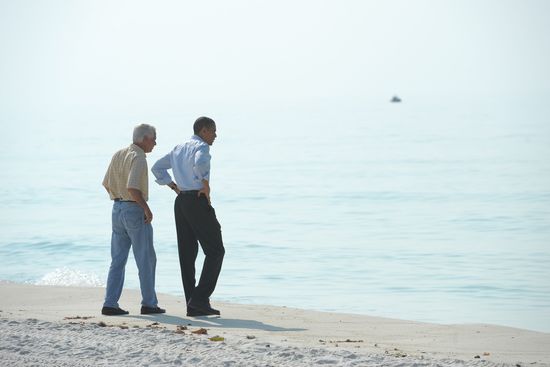
(Photo: US President Barack Obama (R)and Florida Governor Charlie Crist walk on the Casio Beach section of Pensacola Beach before a briefing with local officials on the BP oil spill June 15, 2010 in Pensacola, Florida. By Mandel Ngan/AFP/Getty.)
Netanyahu Moves?
A shift on the blockade:
The prime minister told Blair that he never thought the blockade as constituted was particularly wise, as he understood that the civilian population, and not Hamas, bore the primary brunt.
“It’s important for me to have a policy that I can defend before the world,” Netanyahu told Blair.
Trying To Understand The Tea Party, Ctd
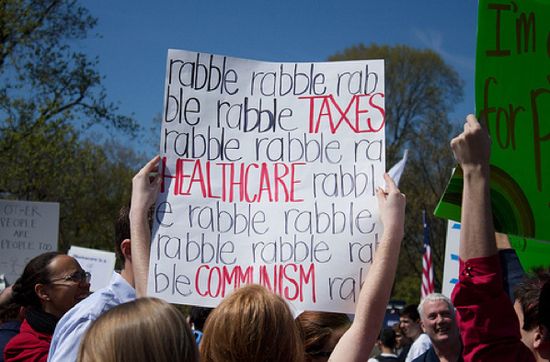
Kevin Drum counters J.M. Bernstein's dependency theory with polls showing that tea-partiers are wealthier than the average American. He concludes that the current movement is nothing new:
[T]hey're the usual reactionary crowd that goes nuts whenever there's a Democrat in the White House and they're looking for something to be outraged about. And right-wing media and the Republican Party have decided (correctly, I think) that banging on about the deficit is a handy way to gin up opposition to pretty much everything Democrats want to do.
The previous tea party incarnations worked the same way, but their leaders chose topics suited to their time and circumstances. In the 30s it was opposition to the New Deal. For the Birchers it was communism. For the Clinton-haters it was the culture wars. Those were the most obvious and convenient stalking horses of their day for broad-spectrum outrage at Democrats, while today's is the deficits/socialism message. There's really nothing mysterious here. It's just ordinary partisan politics.
So please please please: trying to figure out what's behind the tea parties is fine. But psychoanalysis isn't the right tool. History and politics are.
This point also came through in the many emails. But the emotional intensity of partisanship is worth exploring further, and when human beings are involved, the unconscious is always as important as the conscious. And, for the record, I found Hofstadter/Adorno's critique more illuminating than Bernstein's.
(Image via The High Definite)
The Holocaust’s Enduring Impact
Here's a fascinating study on the correlation between areas of the former Soviet Union that were the most aggressive in the mass murder of Jews in the 1940s and subsequent levels of economic growth. Yes: genocide is not good for prosperity – although this is possibly the most absurd standard by which to judge such evil.
The Speech
I guess I am not feeling the same visceral stuff that Maureen is tapping into, but I did not watch the president’s Oval Office speech last night. I did not feel the need to be reassured that the feds and BP are doing all they can to stanch this open wound and deal with the awful, ongoing clean-up and consequences. And I did not expect a detail-specific rallying cry for climate change legislation, however much I would have liked to hear it. You don’t issue a rallying cry of that kind from behind the Oval Desk, when grappling with a much more immediate and difficult crisis-management problem. You do not lay out legislation you know cannot be passed right now. I have read the speech and watched it online. It’s hard to differ from Jim Fallows’ assessment:
Will we look on this speech as signaling the moment when the United States stopped talking about the distortions of its oil-based economy, and did something about it? No.
And that’s the only thing worth noting. The rest is cable news-cycle blather.
The speech did, however, seem to me to achieve what it was supposed to: signal strong presidential engagement with this now seemingly permanent blight on the world and our consciousness. For those who need their hand held as we wait for the relief wells that have always been the only real solution, I guess this is important. But it missed an opportunity to explain who exactly is in charge now, as Clive notes:
One important accusation does seem fair, and might be starting to stick: there is no clear chain of command. Who is in charge of operations? Whose responsibility is it to co-ordinate the efforts of the multiple agencies and levels of government–to organise offers of help from abroad, and to put resources where they can best be used? I had innocently supposed that after two months such a structure must exist, but maybe not. If there is a chain of command, Obama could have done himself a lot of good tonight by explaining it.
He looked nervous too, don’t you think? It was an unconfident performance. He moved his hands too much. He did not look strong. It was a bad night for his presidency, and he would have been wise to give no speech rather than this speech.
I wouldn’t go that far. The real import of this moment will be how the president builds on even Bush’s grasp of America’s oil-addiction problem and does something in response commensurate to the broader crisis once this incident is resolved. That broader crisis is America’s continued addiction to a substance that empowers our enemies and cooks the planet. One thing at a time. I see this speech as laying down a marker not initiating a new crusade, however necessary that may be.
So far: two steps backward for every one forward. But it’s worth remembering that almost every step backward on innovating post-carbon energy comes from the GOP. Obama and the Dems would have passed a serious climate bill by now if it weren’t for total Republican obstructionism (with the fitful exception of Butters). Obama is not the real obstacle here: the American people are, however manipulated by short-term political maneuvering by Republicans. And he does not have the political capital at this point in time to twist their arms. He has already pushed so many as far as they can go – on the issues of the economy and health insurance.
I’m hoping one day he will be able to push again. Maybe with a more Republican Congress from next year on, he has more of a chance. Because they will be forced to say what they’re for, rather than always pivoting from day to day based on what they’re against.
 The Dish