A Glimpse Of NYC, Ctd

A reader writes:

See, this is why I don't care what you or anyone outside New York City says about the snobbishness of my hometown: it's just the greatest mix of people from everywhere on Earth, with all kinds of music, language, food, colors, faces – God, I love it.

This is why misfits move there from all over – especially from "Middle America." This is why almost a century ago gays started fleeing Oshkosh and Houston for NYC:  bring your song with you and no matter if it's a weird song you can sing it. Whatever makes you "different" elsewhere is what makes you welcome in New York.

I haven't lived there in 10 years. But this made me miss my home.

“This Tiny Speck Of Nuisance”

The St Petersburg Times has a searing expose of how the Super Adventure Club has allegedly forced dozens of members of the elite Scientology group, Sea Org, to have abortions against their will:

According to those speaking out, women who didn't schedule abortions were shunned by fellow Sea Org members, called "degraded beings'' and taunted for being "out ethics,'' straying from the order's ethical code.

Some were isolated, assigned manual labor and interrogated until they agreed to abortions, said church defectors, including men whose wives got abortions.

Scientology leaders have denied the accusations – made by several women under oath.

I wonder why the Christianists have not protested this policy of religiously-pressured abortion. Maybe Sarah Palin could have a word with her publicist, Greta van Susteren, about the policy.

Before The Explosion

GQ has a terrific, eye-opening account of the men who worked on the Deepwater Horizon rig before the disaster struck. The whole piece has a tragic irony to it. You can see what's coming, even if they can't. Money quote:

The problems with Macondo started on his last hitch, about two weeks into the job. Twice drilling had to stop—oilmen call it getting stuck—once to patch a crack in the bore hole, then again to drop a cement plug into a tender spot in the subsurface that collapsed around the drill string, the miles of pipe attached to the drill bit. All told, the Horizon lost at least ten expensive days. And no one gets a completion bonus when a well comes in late.

Mike senses the crew is frustrated but still determined, muscling through the final days of a job gone wrong. The well's been drilled almost to depth, 18,000 feet, and then all that will be left is sealing it off until a production rig starts pumping out the oil and gas. Another ten days and the Horizon will move on to another site. And the news on the rig isn't all bad. Next week, executives from BP are flying out to congratulate the crew for its safety record. In seven years, it hasn't lost even an hour of operating time because someone got hurt.

The Slaughter Of Innocents

It has taken Britain almost four decades to admit to a war crime in Northern Ireland:

The Bloody Sunday Inquiry report found that all those killed were unarmed and that paratroopers had lost control and opened fire without warning. Some had been trying to flee when they were hit and soldiers had made up false accounts in a bid to cover up their actions, the report found.

A total of 13 unarmed civilians, seven of them teenagers, died in Londonderry when soldiers from 1st Battalion, the Parachute Regiment opened fire during clashes after the banned march was stopped from entering the city centre on January 30 1972. A 14th man died some time later from his injuries.

This panicked murder of unarmed civilians was the Brits’ Gaza moment (along with their Cheney moment in instigating the torture of terror suspects in prison). And this long-delayed report helps show how war crimes take time for democracies to process and take responsibility for. The entire history of the last forty years suggests something else as well: that Irish terrorism was not defeated by force of arms, or brutality, or collective punishment. It took negotiations with the worst parties, a stoic acceptance of some terrorist violence because the attempt to stamp it all out only made it worse, economic growth, and insistence on the most logical partition.

Maybe at some point, the Israelis will absorb these lessons. And maybe they won’t.

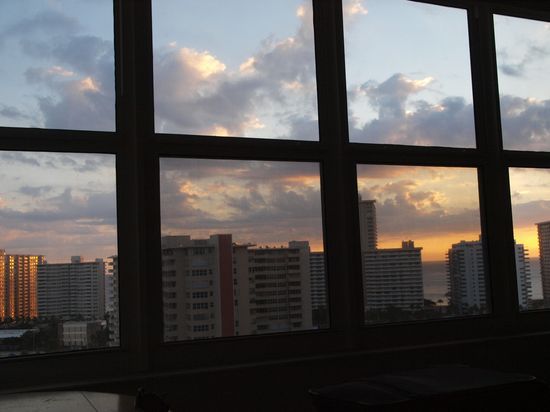
The VFYW Contest: Winner #2

Vfyw-contest-2

A reader writes:

Not sure about this, but I think this is Honolulu, Hawaii – either toward the Moilili/University side where it’s sparser, or toward the Ala Moana Park side … sort of where Waikiki peters out?  Clouds are right, it’s the right place for the setting of the winter sun, and the buildings are all relatively early postwar.

Another writes:

I’m an architect, and the view from this particular window looks just like my stay several years ago in a Singapore Public Housing Estate. Judging by the location of the setting sun, I’d say Choa Chu Kang district.

Another:

I know it’s at the beach, and since I’m hoping January is a hint, I’m going to say somewhere warmer and where people flock for the summer. I have a 50/50 shot of getting sunrise or sunset right, so I’m going with sunrise, because the sky seems too orange to me. I guess my guess will be Myrtle Beach, South Carolina.

Another:

Looks to me like Tehran, Iran – north side of Elahiyeh facing south.

Another:

I’m gonna take a leap of faith and assume your reader is more likely to catch the sunset than the sunrise, so that means we’re looking at a western-facing beach.  Obviously tropical or subtropical, as indicated by the palm trees.  Architecture and surroundings are all pretty tidy-looking, ruling out most developing-country beach cities, which tend to have a fair share of grit.  Beach looks pretty straight and wide-open, meaning it’s not in a bay.  Shall we say Naples, Florida?

Another:

Looks like Communist architecture. Sofia, Bulgaria?

Another:

This one is too hard. If it is the evening, it could be Toronto, facing South to Lake Ontario. They have a lot of those Soviet-looking residential buildings, but the waterfront doesn’t look right.  It could be Odessa, Ukraine. What the hell, Toronto.  No, Odessa.  Odessa is my guess.

Another:

High rise concrete block apartments, looks like Communist architecture, so somewhere in the former Warsaw Pact or Soviet Union.  I’m going to go out on a limb and say Tallinn, Estonia.

Another:

St. Petersburg, FL?

Another:

The construction looks cheap and dated, but there is a beach. Manilla, Philippines?

Another:

Decidedly North American, but I’m guessing not US. The bland color of the lake behind the buildings seems oddly Canadian to me. I’m guessing Toronto.

Another:

Buildings look South American, and for some reason that feels like a sunset over the ocean.  Let’s go Valparaiso, Chile.

Another:

That definitely looks European to me, and not Western.  I see water, so that should narrow it down a bit.  I’m torn between Croatia (perhaps Split?) and something a little more mainstream, such as Athens.  Final Answer: Athens.

Another:

Spain, Canary Islands, Tenerife, Santa Cruz de Tenerife?

Another:

This is hilarious. Back in the pre-contest days, I would flippantly zero my eyes in on the new image, avoid the caption and pretty instantly come up with a winning guess. I figured I was at least partially right 70-80% of the time. Let’s say I graded on a curve and felt pretty smug about my VFYW-dar.

Now for the humiliating part. I initially had no impulse about this city. Too many clouds for the Persian Gulf. Not the usual US architecture. Vaguely east-Asian? Sunrise or sunset? Should be an easy guess if you’ve been there. I studied it some more. The main body of water (what looks like the ocean), the inland channel or river to the left, the low-slung apartment architecture, the clouds … WTF: Miami Beach, FL.

Close:

Fort Lauderdale, Florida, 7.15 am, on January 12, 2010.

Seventeen of the nearly 600 entries guessed correctly, but the first to do so came from reader E.G., who wrote:

As a frequent visitor to the east coast of Florida, I would have to guess the view of aging mid-rise condos looking out to the sea was in Ft. Lauderdale, Florida. I am also inclined to believe this is Ft. Lauderdale since you probably have a large number of gay readers from that area.

It was a tough one, we know. We love this contest. Every Saturday?

Trying To Understand The Tea Party II

Shot

Or maybe it's back to Hofstadter, citing Adorno (sorry, governor Palin, this post is probably one you'll want to skip):

From clinical interviews and thematic apperception tests, Adorno and his co-workers found that their pseudo-conservative subjects, although given to a form of political expression that combines a curious mixture of largely conservative with occasional radical notions, succeed in concealing from themselves impulsive tendencies that, if released into action, would be very far from conservative.

The pseudo-conservative, Adorno writes, shows conventionality and authoritarian submissiveness" in his conscious thinking and "violence, anarchic impulses and chaotic destructiveness in the unconscious sphere. The pseudo-conservative is a man who, in the name of upholding traditional American values and institutions and defending them from largely fictitious dangers, consciously or unconsciously aims at their abolition.

John Yoo anyone? Dick Cheney? I can think of few examples of this more telling than the suspension of habeas corpus, the enactment of preventative war as policy and the institutionalization of torture as the celebration of American traditional values. So Hofstadter helps me understand how a movement based on inalienable individual freedom had nothing to say about the most authoritarian period in the American executive branch in their lifetimes. But the maintenance of shrill ideology against reality is still the most prevalent feature. Hofstadter noted some classic examples from a previous era that seem plucked from Fox News today:

The lady who, when general Eisenhower's victory over Robert Taft had finally become official, stalked out of the Hilton Hotel declaiming "This means eight more years of socialism" was probably a fairly good representative of the pseudo-conservative mentality … [So also was] the general who told [the Freedom Congress] , demanding an Air Force capable of wiping out the Russian Air Force and industry in one sweep, but also a "material reduction in military expenditures …" the people who a few years ago believed simultaneously that we had no business fighting communism in Korea, but that the war should be immediately extended to an Asia-wide crusade against communism …

It all sounds weirdly familiar, doesn't it? The cognitive dissonance and the obvious human misery behind it:

The pseudo-conservative believes himself to be living in a world in which he is spied upon, plotted against, betrayed and very likely destined for total ruin. He feels that his liberties have been arbitrarily and outrageously invaded … he is the most bitter of all our citizens about our involvement in wars past but seems not the least concerned about avoiding the next one.

Brutally accurate, no? What you see is the predominance of acute alienation – the opposite of a natural conservative at peace with the world as it is – and the intensity of emotional rage it provokes. I would add one thing to this analysis. The Bush-Cheney presidency was, in some respects, the perfect pseudo-conservative administration. They waged war based on loathing of the experts (damned knowledgeable elites!); they slashed taxes and boosted spending for their constituencies, while pretending to be fiscally responsible; they tore up the most ancient taboos – against torture – with a bravado that will one day seem obscene; and they left the country in far worse shape than they found it.

Throughout all this, the Tea Partiers supported them. So how do they manage the cognitive dissonance that two failed wars, a financial collapse and a debt crisis have brought? How do they deal with the fact that their beloved president was manifestly the most incompetent and disastrous in modern times? They blame it on the next guy.

Yes, they are doing all they can to avoid facing the fact that they did all of this … to themselves. And sometimes, the truly, deeply humiliated can only carry on through blind rage.

(Painting: The arrest of Robespierre by Jean-Joseph-François Tassaert)

Trying To Understand The Tea Party I

MaxRobespierre_Best

This ad seems to imply that the Founding Fathers were opposed to all taxation, as opposed to taxation imposed by an alien power without any representation. Is this now the official view of Tea-Party Nation? One would have thought that the principle was no taxation without representation, not no taxation at all.

I confess to staying baffled by this whole movement. I spent many years wailing about spending under Bush, and the Tea Party was largely silent. I'd like to see serious cuts in entitlements, means-testing of social security benefits, and sharp reductions in military spending … to avoid the default that could one day come when we least expect it. The Tea Party has proposed no such entitlement cuts – let alone defense. Because taxation is historically low, and because we're never realistically going to tackle the debt without more revenues, I also favor some tax increases – on carbon, and on consumption. The Tea Party is opposed to any new taxation. So at that point, I don't know what to do. I don't know how to respond. Do I share a generalized frustration with a government that takes away half my earnings every year? Yes. Does an intervention to ease a huge market collapse drive me nuts? Sorry, but: no. Neither does a modest attempt to provide some subsidies to help millions get access to affordable healthcare at a time of extreme economic insecurity. Call me a Marxist, I guess. But I have yet to see anything in Obama's first eighteen months to convince me of a need for conservative rage.

J.M. Bernstein comes to my rescue with the help of, among others, yes, Hegel (and an intelligent understanding of same).

His thesis is that the tea-partiers know they need government – i.e. social security, Medicare, unemployment insurance, access to basic healthcare – and that need has been brutally revealed these past two years. We all know this somewhere deep down – but in some, this knowledge is too much to handle:

This is the rage and anger I hear in the Tea Party movement; it is the sound of jilted lovers furious that the other — the anonymous blob called simply “government” — has suddenly let them down, suddenly made clear that they are dependent and limited beings, suddenly revealed them as vulnerable.  And just as in love, the one-sided reminder of dependence is experienced as an injury.

All the rhetoric of self-sufficiency, all the grand talk of wanting to be left alone is just the hollow insistence of the bereft lover that she can and will survive without her beloved. However, in political life, unlike love, there are no second marriages; we have only the one partner, and although we can rework our relationship, nothing can remove the actuality of dependence.  That is permanent.

In politics, the idea of divorce is the idea of revolution.  The Tea Party rhetoric of taking back the country is no accident: since they repudiate the conditions of dependency that have made their and our lives possible, they can only imagine freedom as a new beginning, starting from scratch.

This, of course, is not conservatism, but its nemesis. And what happens when even that start-from-scratch utopia fails? I guess we may soon find out.

(Illustration: Mixed media portrait sculpture of Robespierre by artist George S. Stuart, Ojai, CA in the permanent collection of the Museum of Ventura County, Ventura, CA.)

Hewitt Award Nominee II

"The president had a choice between standing with Benjamin Netanyahu, or standing with Ahmadinejad and Hamas. Hamas is a terrorist organization. This should not have been a difficult choice, but the President chose to stand with Hamas and then they were rewarded this week with $400 million in aid," – Michele Bachmann, to FNC host David Asman (who titled a recent piece, "Is the president funding terrorism?").