Iran, A Year Later, Ctd

Juan Cole believes that the Green Movement still has life left in it. Karim Sadjadpour does a Q & A:

Two things happened after the elections that impacted Tehran’s foreign policy. First, any lingering moderates or pragmatists were essentially purged from the decision-making structure, leaving Ayatollah Khamenei surrounded by a group of likeminded hardliners with two overarching political instincts: mistrust and defiance. Second, the ongoing internal power struggles made it even more difficult than usual for the regime to make decisions. 

Essentialism And Pleasure

Jonah Lehrer reviews Paul Bloom's new book:

The Yale psychologist Paul Bloom has written an excellent new book, How Pleasure Works, that I had the pleasure of blurbing. The book elegantly refutes the idea that our pleasures are mere sensations, or that our delight can be neatly reduced into some ingredient list of superficial perceptions. Instead, Bloom emphasizes the importance of essentialism, which is the instinctive belief that everything in the world has an underlying reality, or true nature, or essence.

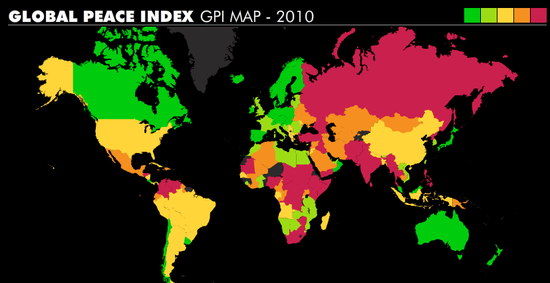
The Least Peaceful Country

Globalpeace
Iraq claims the title for a fourth year:

Iraq received the worst score because of the continued political and social conflict in the country. Despite security improving in 2009 and the holding of provincial elections at the beginning of that year, there were still 4,645 Iraqis killed according to Iraq Body Count. In comparison, the Brookings Institution recorded 2,259 Afghans that died that year. The country also had a high number of displaced and refugees, which have not returned home. Military expenditures also increased last year because Iraqi forces were asked to do more with the U.S. beginning to withdraw. The growth of Prime Minister Nouri al-Maliki’s power was given mixed reviews because while he provided leadership, he also led to internal problems with other parties and the Kurds. Overall, the Institute thought that while 2009 was an improvement over previous years, the continued tensions and violence within Iraq justified putting it at the bottom of its list.

Study and interactive map here.

Coupon Clippers

Meet your king:

My sister challenged me to try and eat well for a month spending only $1 a day for food. It probably would have been wise if I had thought about how much I hate shopping and cooking before I took on the challenge, but once I committed, nothing could stop me (not even a trip to the emergency roomtwo times — in the first week) I began May 1 with absolutely no food and managed to stay under my $31 budget for the month (I bought $597.96 worth of food and other stuff for $27.08 during the month).

If We Bomb Iran

Bill Kristol and Jamie Fly

If the Iranian regime is so concerned about their survival that they won't hit the U.S. after a military strike against their country, than they obviously aren't going to be using their nuclear weapons against anyone lest they invite a far more devastating attack. The same argument, in other words, that leads Kristol and Fly to conclude we can safely attack Iran can be flipped around to conclude that we can live with and contain a nuclear-armed Iran.

The True Cost Of Oil: $4.60

Ezra Klein does the math:

For all the complexity of calculating the true cost of oil…it’s unclear that it matters as much as some might think. I assumed that a world in which gasoline’s total costs were present at the pump would be a world in which our consumption was radically different. But almost all of the experts I spoke to said that wasn’t true. If an energy source as dirty as coal had to pay its true cost, we’d likely stop using it. But, disasters aside, that’s not the case with oil.

Years of regulation and innovation have made us better at finding, extracting, refining, and using oil. Oil might be cheap compared to its true costs, but adding those costs in wouldn’t make it unaffordable. That gets to the bigger issue, which is that energy sources are only cheap or expensive relative to one another. And the anchor beneath our reliance on oil is that, at this point, there’s nothing to replace it.

The Daily Wrap

Today on the Dish, bloggers reacted to Afghanistan's new bounty, Andrew offered a snap analysis, and Thomas Barnett's focused on the China connection. In Israel coverage, Schumer admitted his desire to punish Gazans, the Globe and Mail profiled the Knesset member present on the flotilla, Victor Davis Hanson suggested that Obama is anti-Semitic, and Andrew went another round with Chait.

In Palin coverage, she defended her wardrobe and told a pernicious lie about her hotness. Andrew challenged Lisa Miller over Sarah's cover story, Jay Nordlinger earned a Malkin over Trig, and we highlighted a bit of hathos. (Some South Carolina hathos here.)

Updates from Iran here and here. Kristol beat his war drum, a NC congressman went ballistic on an amateur reporter, Fiorina couldn't say sorry, Josh Green did so to Rand Paul, and McArdle got married.  Andrew discussed homophobia with Dan Savage while Apple succumbed to the ick factor. World Cup coverage here, here, here, here, here, and here.

In assorted commentary, Scott Horton sounded off on Dawn Johnsen's failed bid, Balko cheered Brownback's call for eliminating government programs, Beinart mulled over the media coverage of Afghanistan, Exum examined the argument that terrorists are idiots, Greenwald argued that partisanship is breaking apart, Bartlett surveyed Republicans in favor of debt default, Tara Parker-Pope assessed the value of pets.

Readers extended the thread on dead birds, another hailed the role of Twitter in Iran, and another criticized Jonah Lehrer's take on scientific truth. Creepy political ads here, a cool ad here, and another Malkin Award here. MHB here, VFYW here, and FOTD here.

— C.B.
Clouds, Not Clocks, Ctd

A reader writes:

I have to disagree with Jonah Lehrer's recommendation that "scientists should learn to expect this cycle — to anticipate that the universe is always more networked and complicated than reductionist approaches can reveal." That is the basic definition of the scientific profession – to expect that cycle. Newton knew that he had only reached his own incomplete understanding by "standing on the shoulders" of giants and the scientific community has not forgotten the lesson. They know and, yes, anticipate that each new discovery about the universe will raise more questions than it will answer.

It is the popular press, not scientists, that have fallen into a cycle of anticipation and disappointment. A physicist will never talk about a "God Particle" because they know that the discovery of one will not disprove or prove God's existence but simply cause us to reconsider the framework with which we approach the question. The term "Theory of Everything" is at best only used semi-ironically. Proving one would unite the two fields of physics but would it cause scientists to shut down their laboratories and declare the enterprise finished? Of course not, it would only provide new questions.

As is often the case, Carl Sagan said it best: "We have a method, and that method helps us to reach not absolute truth, only asymptotic approaches to the truth — never there, just closer and closer, always finding vast new oceans of undiscovered possibilities. Cleverly designed experiments are the key."

Borrowing For What?

Noah Millman makes a compelling case:

The opposition [to the stimulus]…is usually described in terms of austerity, that we should be trying to cut the debt and have government tighten its belt just as private citizens have had to tighten theirs. And austerity makes absolutely no sense in the current economic environment. Precisely because interest rates are low, this is a good time to borrow. But the question is: borrow for what? Every dollar we borrow today has to be repaid or refinanced – and we should assume that refinancing will be at substantially higher interest rates than today. The argument we need to be having is about how to increase national productivity.

That means reducing or eliminating subsidies for uneconomic activity – whether the mortgage interest deduction or agricultural subsidies. That means shifting the tax burden away from income – and especially away from wages – and towards consumption. That means shifting discretionary spending priorities away from defense and towards a sustainable infrastructure. That means shifting spending away from retirees and towards youth – and that, in turn, means getting more value per dollar out of both health-care and education spending (two areas where, I suspect, productivity growth properly measured has actually been negative).

There’s a vital role for Republicans to play in this argument that I don’t really hear them playing.

That role is getting into the weeds and finding ways to shift how government spends, not merely what it spends. But I fear the anti-tax ideologues will veto any shift toward consumption or energy taxes; and the very hard work of getting healthcare and education more efficient won't win many campaigns.