Bill Kristol wants to get a third war on, Churchill references and everything. There's nothing to fear, says the man who told us there were no serious sectarian tensions in Iraq.
Month: June 2010
“A Fully Reclining Web Browser”
Clive Crook warms to the iPad.
The Limits Of Twitter, Ctd
A reader writes:
I object to the notion that there was no twitter revolution last year. There may not have been one in Iran, but there was certainly one ABOUT Iran. These were tweets being put out in English, predominantly by people in the West, anyone seriously paying attention knew they were a fairly troublesome gauge of what was going on.
The Real Twitter Revolution occurred mostly in the Anglophone West, in New York and London, in Vancouver and Auckland. It was not in the streets but rather in dorms and living rooms, offices and internet cafes. It was a revolution in media by which countless people, myself included, finally saw the man behind the curtain of the mainstream media. My faith in the Mainstream media, particularly in the lauded 24 hour news channels (and CNN above all) had been slipping for years, mostly I suspect due to Jon Stewart, but it was Iran and Twitter that took a hammer to it.
If it weren't for twitter, for blogs (if it hadn't been for the events in Iran, I'd have never found the dish!) and for all the rest of new media, we wouldn't have had any idea what was going on in Iran last year. The traditional media waffled, avoided the matter, and when they finally decided the story was worth covering after all, seemed mostly to read tweets on air. As I watched CNN drop the Iran story as if it had never been to focus on the physical death of a man whose career had died over a decade earlier, a revolution took place in the heart of my consciousness. That the mainstream media lies, that it ignores, and that it is woefully incapable of doing its job.
I haven't been quite the same since.
How Much Would You Spend On A Pet?
Tara Parker-Pope finds a study:
Most pet owners (62 percent) said they would likely pay for pet health care even if the cost reached $500, but that means more than a third of pet owners said that might be too much to spend on an animal.
What if the bill for veterinary care reached $1,000? Fewer than half of pet owners said they were very likely to spend that much at the vet. Only a third said it was very likely they would pay a $2,000 vet bill.
Once the cost of saving a sick pet reached $5,000, most pet owners said they would stop treatment. Only 22 percent said they were very likely to pick up $5,000 in veterinary costs to treat a sick dog or cat.
On Favorite Teams
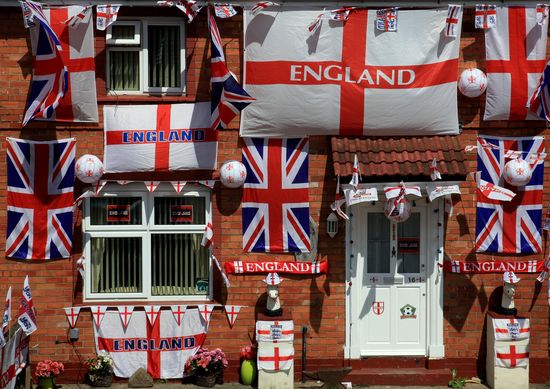
Scott Adams has a theory:
If you wear the jersey of your favorite team, your brain associates the colors and the logo with the good feelings of watching a game. The rational part of your brain might tell you that you wear the team jersey because you look good in those colors, or you support the team. But I think the real reason is a simple association with the stimulation you feel when watching your team compete. It's an accidental subroutine.
More Intelligent Life traces the history of sport.
(Image: England flags adorn a house in a street in the Knowle West area on June 11, 2010 in Bristol , England. Although the 2010 FIFA World Cup is being hosted 1000s of miles away in South Africa the tournament is celebrated throughout the UK with many homes, business and cars now flying England flags and other football paraphernalia. By Matt Cardy/Getty Images)
The Erosion Of Partisanship?
Friedersdorf interviews Greenwald:
I think the citizenry is becoming less and less defined by loyalty to one of the two parties, and these partisan divisions are breaking down, becoming much less clean. We saw that with opposition to TARP, the general anger toward corporatist control of Washington, discomfort with our policy of endless wars, and the widespread disgust with incumbent power. Far more important than Right v. Left is insider v. outsider (or politically powerful v. powerless). That fact is becoming more crystallized, and the more that happens, the more the artificial barriers that divide citizens (Right and Left) will erode, the more apparent will be the commonalities. The political establishment (both parties) benefits from keeping citizens divided against one another based on trivial distractions and tribal loyalties, which has the effect of strengthening the political establishment. That's been the impediment to having citizens across the ideological spectrum join together to combat abuses of power in Washington, and I think it's eroding. That, I think, is what Washington elites fear most.
Clouds, Not Clocks
Almeria 2008 from Vicente + Sara on Vimeo.
Jonah Lehrer looks inside fMRI machines:
Time and time again, an experimental gadget gets introduced — it doesn’t matter if it’s a supercollider or a gene chip or an fMRI machine — and we’re told it will allow us to glimpse the underlying logic of everything. But the tool always disappoints, doesn’t it? We soon realize that those pretty pictures are incomplete and that we can’t reduce our complex subject to a few colorful spots. So here’s a pitch: Scientists should learn to expect this cycle — to anticipate that the universe is always more networked and complicated than reductionist approaches can reveal.
…Karl Popper, the great philosopher of science, once divided the world into two categories: clocks and clouds. Clocks are neat, orderly systems that can be solved through reduction; clouds are an epistemic mess, “highly irregular, disorderly, and more or less unpredictable.” The mistake of modern science is to pretend that everything is a clock, which is why we get seduced again and again by the false promises of brain scanners and gene sequencers. We want to believe we will understand nature if we find the exact right tool to cut its joints. But that approach is doomed to failure. We live in a universe not of clocks but of clouds.
The VFYW Contest: Where Is That Window

Sent by a reader back in January. You have till noon Tuesday to guess it. Country first, then city and/or state. If we have a tie, the time will count. And remember to put “VFYW Contest” in the content line of the email. Winner gets a free The View From Your Window book. Have at it.
The Definition Of Happiness
Does it change with age?:
Whereas younger people are more likely to associate happiness with excitement, older people are more likely to associate happiness with feeling peaceful—a change driven by increasing feelings of connectedness (to others and to the present moment) as one ages.
Mental Health Break
Into the deep:
 The Dish