"I cannot believe that a bunch of lacy-drawered, limp-wristed people could do what those men have done in the past," – Yuma mayor Al Krieger, on gays serving in the military. His follow-up interview is even worse.
Month: June 2010
“A Convicted Serial Environmental Criminal,” Ctd

We will have to wait for the full report on the Deepwater Horizon well to find out exactly what went wrong. But this is a fascinating industry press piece that damns BP:
Engineers contacted by Technology Review insist that conclusive answers will come with completion of the investigations, but criticize, for example, BP's decision to install a continuous set of threaded casing pipes from the wellhead down to the bottom of its well. "The only thing I can figure is they must have thought it was a cost-cutting deal," says Bommer of BP's well design.
This can be problematic in deep, high-pressure wells for two reasons.
First, it seals off the space between the casing and the bore hole, leaving one blind to leaks that sneak up around the casing pipe (as the BP Deepwater blowout is suspected to have done). Second, the long string gives gas more time to percolate into the well. A preferred alternative in high-pressure deepwater is a "liner" design in which drillers install and then cement in place a short string of casing in the lower reaches of the well before casing the rest of the well. This design enables the driller to watch for leaks while the cement is setting.
"It takes a more time and costs a little more but it's a much safer way to do it," says Geoff Kimbrough, vice president for deepwater operations at Houston-based drilling consultancy New Tech Engineering.
Kimbrough cautions that transforming corporate cultures will take time because choosing the more conservative operation can easily cost $10 million to $20 million. Not all companies have leaders who readily support these decisions, says Kimbrough: "The courage to do that doesn't come overnight. It comes from years and years of support from senior management."
If this pans out, we need to see these corporate criminals in the slammer.
(Illustration by Mike Mitchell.)
Why Doesn’t Krugman Fear The Debt?
Crook asks:
I think Krugman is correct to argue against "fiscal austerity now now now", especially for the US. But Galston's view, as I say, is consistent with this. It's the long-term outlook they disagree about. I don't understand why Krugman won't more fully acknowledge the long-term problem. Why not give equal emphasis to the need for further short-term stimulus combined with tax increases and/or spending cuts later? Difficult to do, of course, but what is the objection in principle?
Michelangelo Meets Reality TV
Edward Winkleman is underwhelmed by Bravo's latest:
The contestants are being judged on their rapid-response creativity, and that's not the same thing as making art. A work of art is completed when the artist says it is, not when the buzzer goes off. Time to fail, to make mistakes, and to correct them is built into the process. You wouldn't judge Michelangelo's David after only 12 hours of carving it, and in that respect the show needs to toss words like "great" or "masterpiece" (really?) around a bit more carefully in my opinion.
Why Are We Afraid Of Public Speaking?
Jesse Bering does the heavy lifting:
In a study published earlier this year in the journal Psychophysiology, University of Würzburg psychologist Matthias Wieser and his colleagues tried to make some evolutionary sense of why public speaking is so many people’s biggest fear. One of the reasons, they argue, is that the state of social anxiety generated by being the center of attention has an unfortunate adaptive effect—we become super-alert to the presence of angry faces. This limbically-driven attentional bias in which angry or unhappy faces are processed especially rapidly by a socially anxious brain would have been evolutionarily adaptive (and probably continues to be so) because it helped our ancestors to avert dangerous social uprisings that had the potential to ruin their reputations, reproduction and very survival.
Weed Goes Mainstream
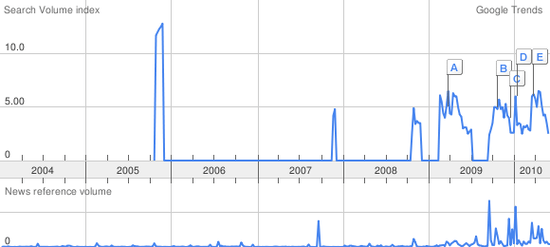
Scott Morgan thinks that the marijuana debate has broken into the MSM:
Everywhere you look, even the mainstream press is picking up on the fact that people want to talk about this. Just look at NPR's The New Marijuana series, which has churned out more marijuana stories this week than I have time to read. CBS has been doing the same thing with Marijuana Nation, CNBC had a big hit with Marijuana Inc., and even Fox News has recruited John Stossel and Judge Napolitano to trash the drug war on Rupert Murdoch's dime.
Google trends data on "marijuana legalization" here.
The Making Of A Twinkie
A gallery of ingredients in the raw.
No Double Dip?
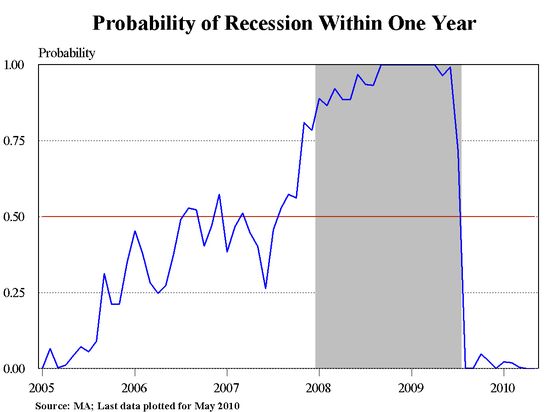
That's what Macroeconomic Advisers is saying:
Early in the recovery many forecasters, concerned that the nascent expansion was fueled only by temporary inventory dynamics and short-lived fiscal stimulus, fretted over the possibility of a double-dip recession. Now, with the emergence of the sovereign debt crisis in Europe, that concern has re-surfaced. Certainly we recognize that the debt crisis imparts some downside risk to our baseline forecast for GDP growth. However, based on current, high-frequency data — most of which is financial in nature and so is not subject to revision — we believe the chance of a double-dip recession is small.
Reality Check
What The Brain Can’t Tell Us
Jonah Lehrer shows how navigating a city street depletes the brain. He applies this research to the "is Google making us stupid" debate:
The lesson, I think, is that everything is a cognitive tradeoff. The city street forces us to exert top-down attention, and that leads to measurable decreases in mental function. On the other hand, the internet, it is argued, encourages a constant state of multitasking and distraction, and that leads to an intellectual shallowness, as we lose the ability to focus for extended tracts of time. My hunch is that the online world will, before long, come to seem as inevitable and necessary as the metropolis. Why? Because the value it provides far outweighs the cognitive costs (which may or may not exist.) And this is why I'm wary when the brain/mind becomes the main criterion for discussing the value of the internet. Such an approach is roughly equivalent to thinking about cities solely in the narrow terms of a few attentional lab tests.
 The Dish