Why Not Test Everything?

Balko uses Henry Skinner's case to lobby for the mandatory DNA testing of crime scene evidence:

Skinner's case raises a fundamental question about how police and district attorneys investigate and prosecute crimes: Why wasn't this evidence tested before Skinner's trial? And why hasn't it been tested since? The answers lie in the adversarial nature of our criminal justice system. There are times when neither the prosecution nor the defense is particularly interested in discovering the truth. That's where policy makers need to step in. In cases like Skinner's, they should establish a common-sense rule: When there is biological evidence at the crime scene, all of that evidence should be sent for DNA testing. No exceptions.
The Daily Wrap

Today on the Dish, Andrew delivered his latest take on Israeli politics, kept the heat on Michael Oren, and bloviated over means testing Social Security. He also highlighted the harsh anti-gay policy of the Boston archdiocese, and readers chimed in here and here. In spill coverage, the Brits bit back over perceived xenophobia, more horrible details emerged about dead birds, and the company got lampooned by UCB. Further BP coverage here, here, and especially here.

An unusually long string of daily quotes here (Kristol), here (NoKo), here (Kagan), here (Israel), here (Prop 8), and here (oil spill). We also dug into the data on interracial marriage, saw more evidence of gay acceptance, and kept an eye on the far right in Holland. Palin hilarity here. Glenn Beck hathos here.

In assorted commentary, Larison countered Yglesias on Iran sanctions, Joel Wing spotlighted the extreme wealth in Iraq politics, and Joe Klein took down Dorothy Rabinowitz over Obama's patriotism. Readers dissented over the gay generational divide, shared their thoughts on the spill's spiritual crisis, offered expert opinion on California's new primary scheme, sounded off on the VFYW contest, and shared more info on the Carpenters.

Hewitt award here, a close candidate here, and Thiessen bile here.  Entertaining videos here, here, and here. Random hilarity here and here. Petite vanilla scone update here. Super creepy ad here. MHB here, VFYW here, and FOTD here.

— C.B.

Dissents Of The Day

A reader writes:

You wrote:

Gay equality is being pioneered among the younger, braver generation. They get it. And those who stood by must live with the knowledge of their own cowardice.”

As a heterosexual soon going into my 60s, I find your comments on homosexuals of my generation extremely unjust. If you were an adolescent in the 1960s Southern Bible Belt, coming out of the closet could get you badly beaten or killed. Two close friends of mine who I knew as a teenager kept it well hidden, until they moved to New Orleans in their twenties where they could live there lives discreetly (they were not partners). They only admitted their homosexuality to me by showing me their lifestyle and waiting to see my reaction. They relied on their close friends’ discretion to not jeopardize their physical safety or their career prospects.

They were brave young men, who tried to live their lives as best they could in an extremely reactionary and violent society which was very anti-homosexual. Neither of these men’s families adjusted to their homosexuality. They later died of AIDS in the mid-nineties leaving partners, parents, brothers, sisters and friends, who grieved them.

Without these men pushing the boundaries to a certain extent, while relying on the discretion of family and close friends, homosexuals today would have a much harder time.

Another writes:

Are they really braver? It’s much easier to be out about your own sexuality today than it was when I came out 20+ years ago. This is like saying that the black Americans who chose to sit in the front of the bus 20 years after Rosa Parks were braver than she was, which is absurd. Yes, let’s give credit to young people today for being far more welcoming of gays’ equality. But that’s not because THEY are braver. It’s because those who chose to come out 20 years, 10 years, 5 years ago were braver.

One more:

Coming out of the closet when state laws protect one from discrimination, there is an Gay-Straight Alliance at one’s high school, a substantive body of law that prohibits legalized discrimination, openly gay characters on TV, and gay marriage in several states is not a sign of bravery, but of growing acceptance that makes coming out easier, if not a foregone conclusion (I am not even sure young people are even in the closet to come out of). To come out when state law prohibited homosexual activity; gay bars were not only illegal, but regularly raided by the police; and even a rumor one was queer was enough to end careers, that is bravery. How brave does one need to be to be an openly gay State Dept. employee today versus in the 50s during the McCarthy hearings?

When I came out, in 1980, Stonewall had happened and there were gay pride parades. However, to come out in the 1950s or ’60s, as did the members of Mattachine Society, THAT is bravery. The young people today can mostly (not all) waltz out of the closet to accepting peers without any thought it will hurt their job or school prospects. They can do that because of, not their own bravery, but the bravery of those who preceded them. Young people today are standing on the broad shoulders of very tall, very brave giants.

Unemployed And Stuck

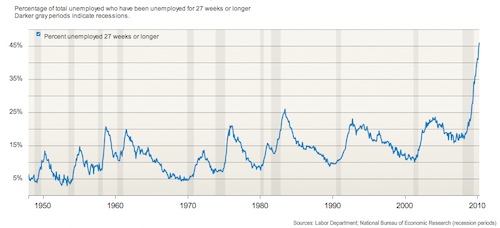
Longterm

Building off Annie Lowrey's reporting, Ezra makes an obvious point about the long-term unemployed:

My hunch is that this interaction between housing prices and labor mobility is at the heart of a lot of the rise in long-term unemployment. Areas where there are no jobs are also areas where the housing sector is devastated. So the people who are there can't sell their homes, which means they can't move to places where there are jobs, which means they just get stuck in this endless unemployment cycle. They've applied for what little is available, and until they're willing to walk away from their mortgage, they're just stuck without a job.

Quote For The Day VI

"I don't know what people expected the president to do exactly, if they want him to go out there and wash pelicans. He's the president. He's not someone who cleans beaches. It's important for us Louisianans to know that we have his support and I think he's communicated that," – Keith Jones, who lost his son in the Deepwater Horizon rig explosion.

Quote For The Day V

"Boycotting a trial almost never a winning strategy. [Supporters of Prop 8] identified 8 experts. What happened is that their experts broke down, either at deposition or at trial. They tried to come up with the evidence, they knew they were required to come up with evidence. They tried to build that trial record and they simply failed. They didn’t fail because they’re bad lawyers, they failed because there isn’t any evidence to support the argument they’re advocating,"- David Boies, during a conference call previewing the plaintiffs' closing arguments in the Prop 8 trial.

Daily Show Bait Now, Ctd

Taken. Clive Crook weighs in on the Ambinder-Greenwald spat:

Greenwald demands skepticism toward those in power — which any good journalist must have — but then confuses this with implacable hostility. They are not the same. The job of a reporter is to question, understand, and inform. You need a vigorous skepticism to do this. But unreasoning hostility is as inimical to understanding as blind deference.